


Sourcing country analysis – a guide to Library sources
12/03/2026

For those researching a country, you will find that country information tends to take two forms:
- Analysis – country reports are descriptive reports covering most areas of interest on a country. They contain an analysis of the business environment and include information on political, environmental, social, technological and risk factors. These are the best place to start your research.
- Datasets – raw data, e.g. GDP, inflation figures, etc.. These are generally downloadable to Excel.
In this post, we focus on sources for country analysis. For sources of data, please scroll down.
The Library’s best sources for country analysis are:
- BMI (formerly FitchConnect)
- Passport
BMI
BMI, from FitchSolutions, (formerly FitchConnect), contains in-depth country risk reports for over 200 countries. Content includes SWOT analysis, economic outlook, political outlook and 10 year forecasts.
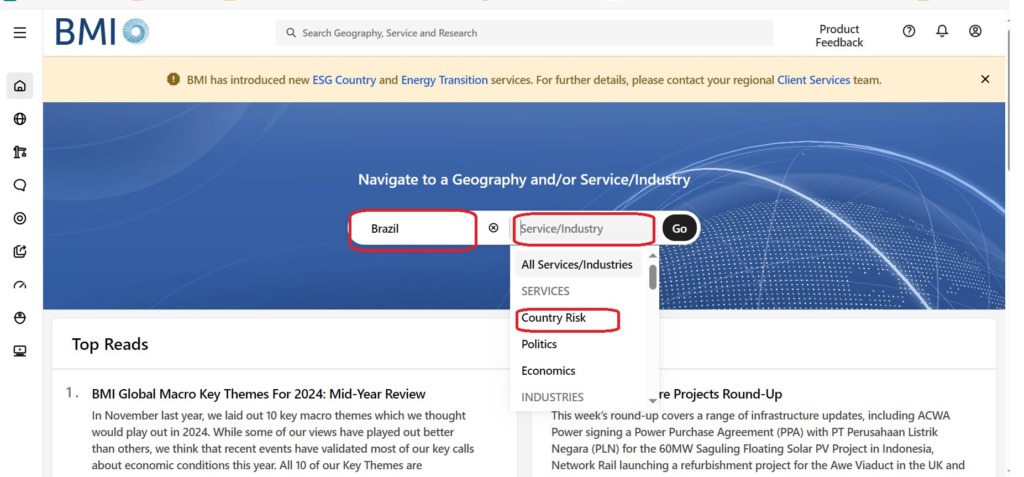
The easiest route to BMI’s country risk reports is to first click in the ‘Geography’ area of the navigation bar in the middle of the page, and enter your country (we’ve used Brazil in this example) then click in the ‘Service/Industry’ area and select ‘Country Risk’ from the drop down menu options listed. Click on ‘Go’.
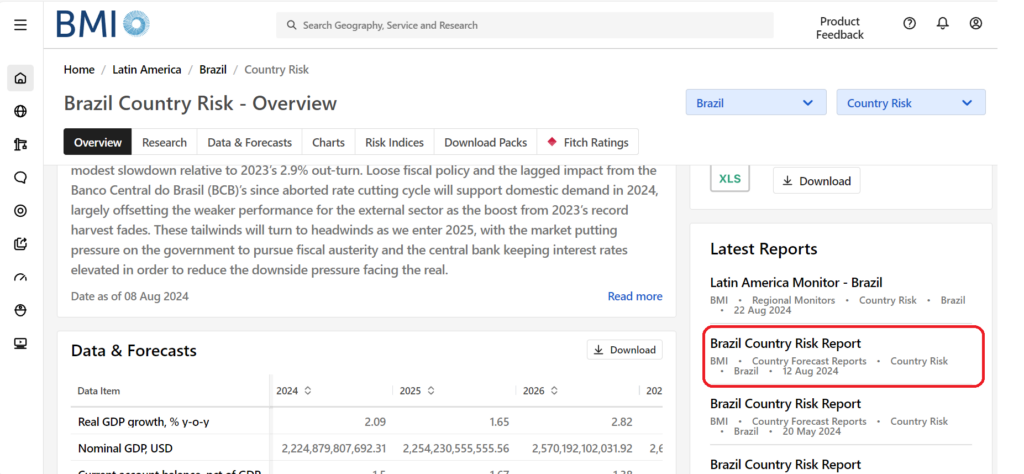
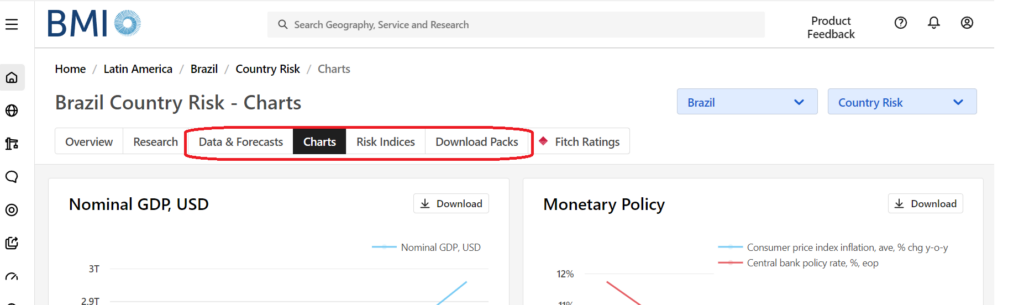
This will take you to the ‘Country Risk – Overview’ pages. Here you will see a key view, data & forecasts, charts/pictograms and a list of the latest reports, all for your country of choice. You may see the Country Risk Report in the list of Latest Reports,
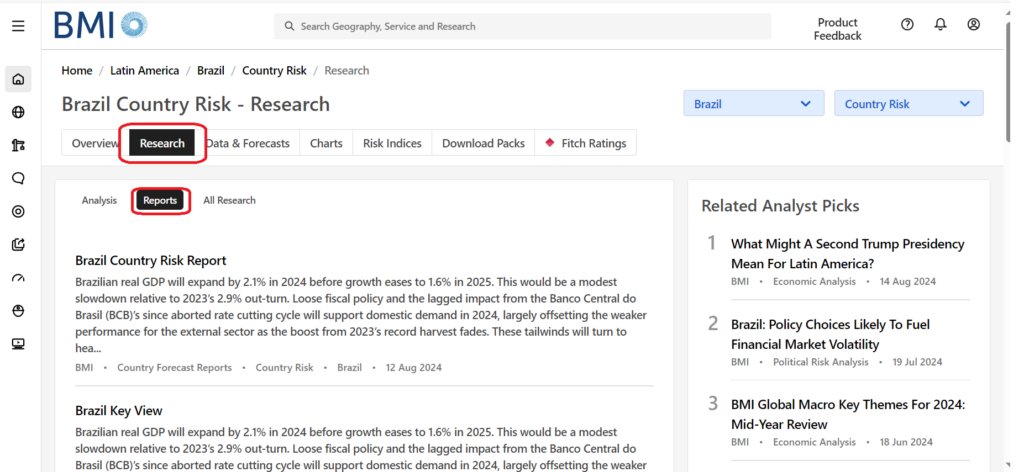
but if it’s not there, click on ‘Research’ in the tabs and then ‘Reports’. The Country Risk Report will appear in this list of reports and you should find Economic and Political SWOT analysis reports here too.
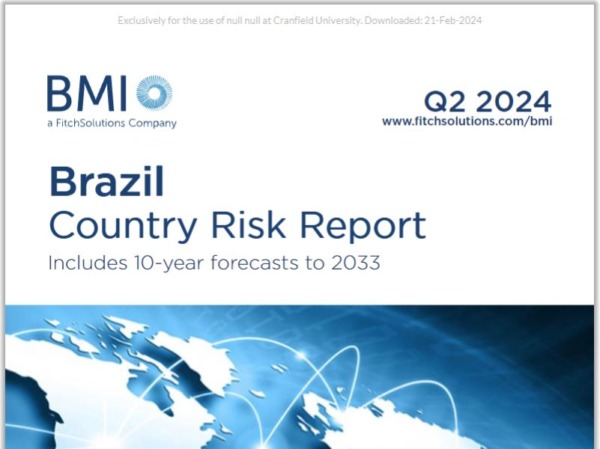
Click on your report of choice and, ta-dah! Now just sit back and read! A Country Risk Report will include a SWOT analysis, plus sections on economic outlook, trade, monetary and fiscal policy, currency, politics and detailed macroeconomic analysis and forecasts. Once in a report, you can read it on screen or download it as a PDF.
You may also have noticed in the previous screen some other tabs – Data & Forecasts, Charts, Risk Indices, Download Packs. Click on each of these for useful data to support the reports. Most of these can be downloaded to Excel, but if you want a copy of a Chart you will need to capture it as a screenshot.
Passport
Passport provides PEST analyses, Business Dynamics and Economy, Finance and Trade reports for individual countries. To access these, the easiest option is to type your country name and the word ‘economy’ and click to search.
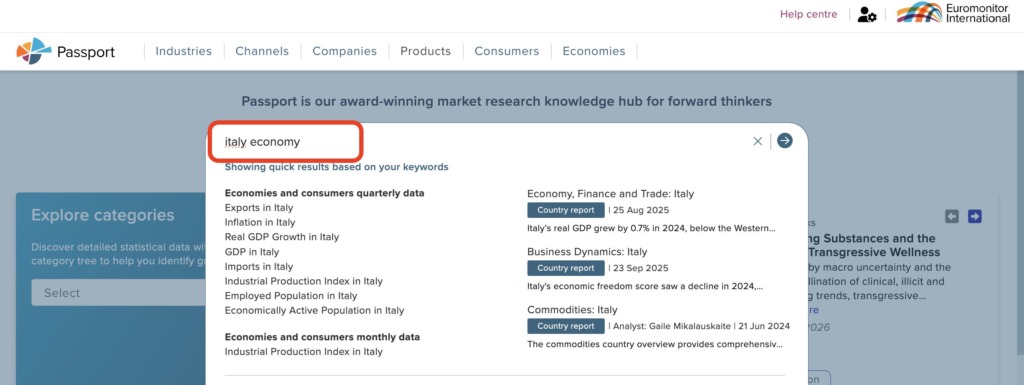
This will take you to the ‘Economy, Finance and Trade’ report for your country, see below. Download and print options are available, should you need them.
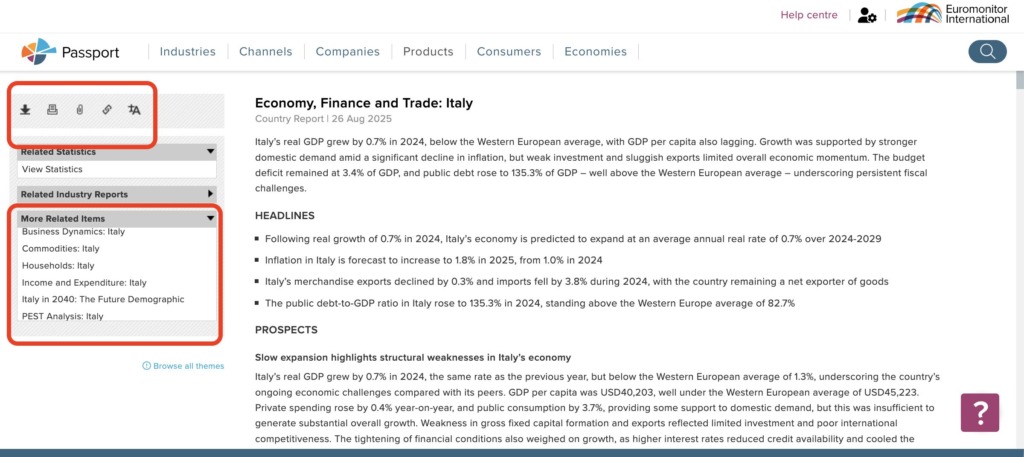
To access other relevant materials, look at the ‘More related items’ dropdown menu on the left of the screen. From there you will have access to PEST analyses and Business Dynamics.
If country coverage is patchy…
Usually the resources listed above will provide you with more than enough analysis for your research. If not, or if you are looking for something specific, the journal databases listed below can be useful. Both include some country profiles. Select this as your ‘publication type’ on the advanced search screen.
You may also be interested in…
Sources of macroeconomic data:
Other sources of macroeconomic data and analysis:
If you have any questions about sourcing country information – either data or analysis – please contact the Library.
Feature image from Pixabay. Available at: https://pixabay.com/photos/earth-internet-globalisation-2254769/

Categories & Tags:
Leave a comment on this post:
You might also like…
Library services over Easter, 3-6 April
Kings Norton Library will remain open for study 24/7. You will need your University ID card to enter the building and can use the self-service machines to borrow and return items as usual. Barrington Library ...

How do I access the full-text of Harvard Business Review (HBR)?
This is a frequently asked question, and it's worth knowing how to access this key management journal. So, how do you access HBR in full-text? The short answer is via our eJournals finder. You can find ...
Engineering problem to solve? Let Knovel help you find a solution
Did you know that Knovel provides you with more than just eBooks? Knovel is a key database for many engineering, mechanical and materials courses here at Cranfield University, and contains content from an extensive range ...

What happens when female scholars meet influential leaders?
On the 5 March 2026, our British Council Women in STEM Scholars had the privilege of sitting down with two excellent role models of industry and academia: Professor Dame Karen Holford, ...
From MSc to CEO: Igniting a research revolution
For many, a master’s degree is achieving a big milestone. Kilyan Ocampo, Computational Fluid Dynamics alumni shares how studying at Cranfield helped launch his career in the energy sector. Today, Kilyan ...

Commuting, collaborating and growing: My first term experience at Cranfield
My first term at Cranfield University has been an extremely positive and rewarding experience. While the course has been intense at times, it has pushed me in the best possible way and allowed me ...