


Finding competitor analysis for companies
14/08/2024

Often when you are researching a company, it will be useful to compare it to its peers. Here are some resources you can use to find and compare competitor companies.
Peer Comparison and Peer Analysis in Fame
Fame’s Peer Comparison function will give you a ready-made comparison of a UK or Irish company’s financial performance against its ten closest competitors. From within any company report, you can access this from the table of contents panel on the left.
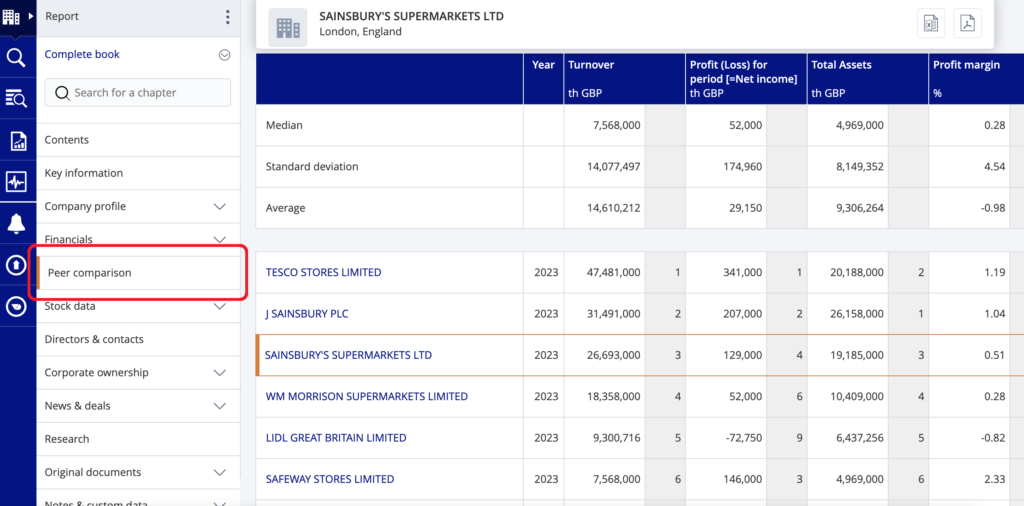
Peer Comparison for Sainsbury’s Supermarkets in Fame
For those who need to delve a little deeper or who wish to create their own customised set of companies to compare, the Fame Peer Analysis tool will be of interest. You can read more about this here. You can access the Peer Analysis tool via the Tools icon on the blue Fame toolbar.
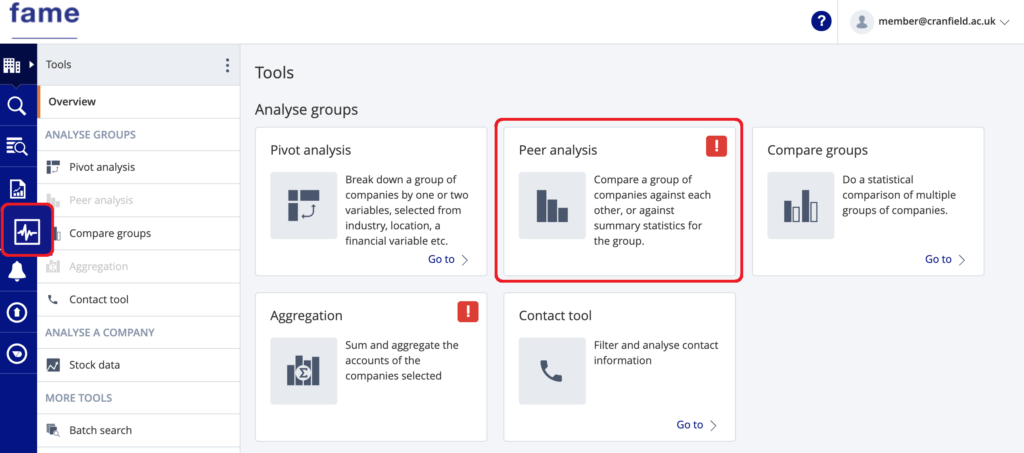
Peer Analysis tool in Fame
Competitor analysis in IBISWorld
Those familiar with IBISWorld will know that each of its reports includes a chapter on Companies. You can access this via the table of contents menu on the left of any report screen.

Major players in the UK coffee shops sector from IBISWorld
Peer comparison in Factiva
Factiva’s Company Snapshots include a peer comparison. From within any Snapshot, access this from the left hand menu. Select from a variety of peer groups and comparison variables.
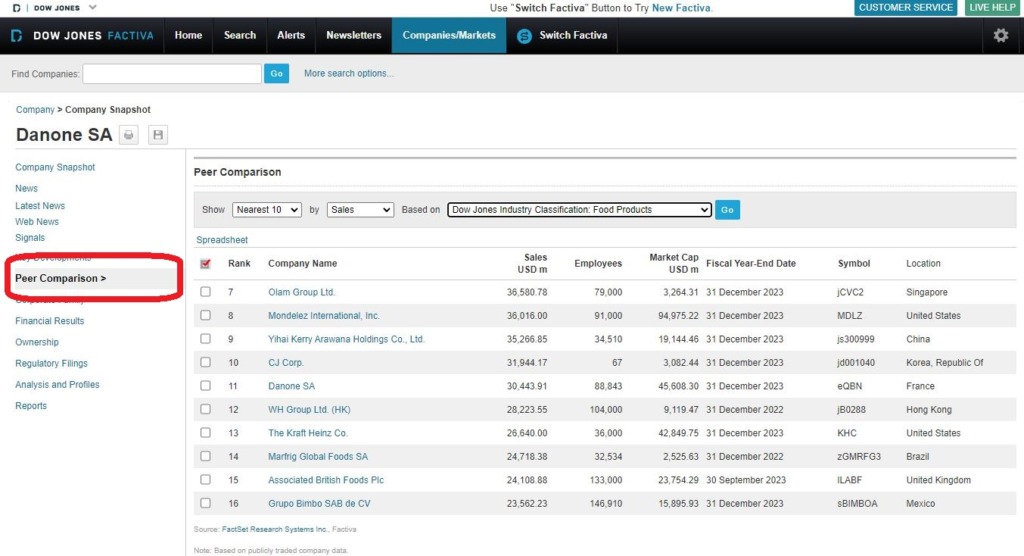
Danone’s closest competitors according to Factiva
For more information on Factiva’s Company Snapshots, check out our previous post here.
Peer Analysis in Capital IQ
Finance fans may be familiar with Capital IQ’s Peer Analysis function. It provides pre-defined peer groups and templates or you can create your own in this highly customisable interface.

Peer Analysis for Kelloggs within Capital IQ
For more information on Capital IQ, including how to set up your own account, please read our previous post here.
Relative Valuation in Bloomberg
Bloomberg’s Relative Valuation function will allow you to compare any listed company to its peers – either nationally or globally for a financial comparison.
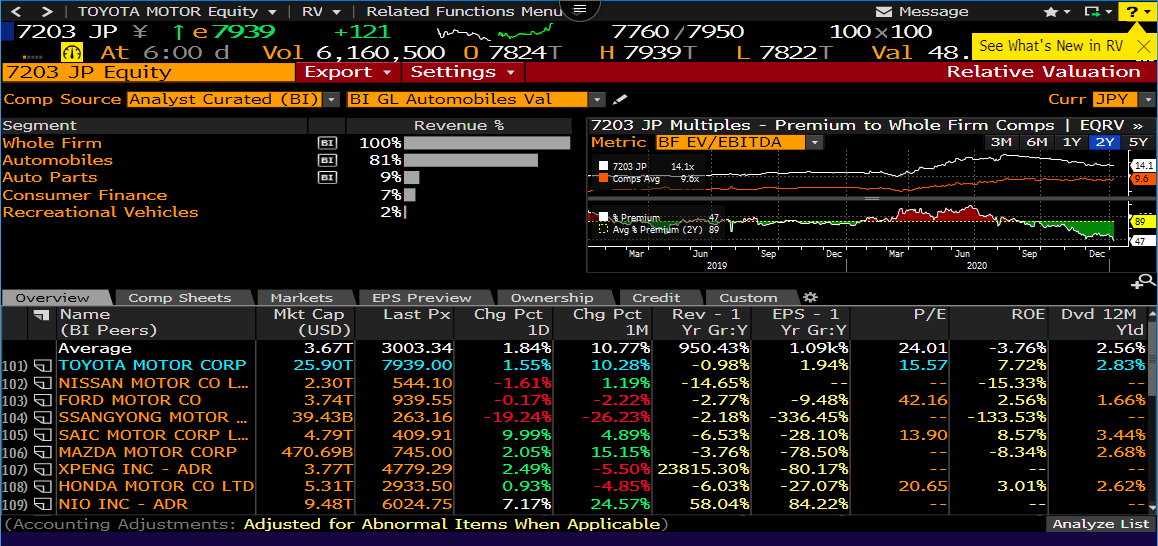
From a company’s record, use <RV> to access a variety of pre-defined peer groups and geographical settings and compare either by whole company or by segment. Tabs allow for both default and customised analysis.
If you have any questions about any of the resources above or any aspect of company research, please contact the Library.
Feature image from Pixabay. Available at: https://pixabay.com/photos/skyline-skyscraper-skyscrapers-1925943/

Categories & Tags:
Leave a comment on this post:
You might also like…

Building more than research: Reflections from the ECRn Symposium 2026
There’s something quietly powerful about a room full of early career researchers. Not just the ideas, although there were plenty of those—but the conversations, the curiosity, and the sense that everyone is figuring things ...

Library services over Easter, 3-6 April
Kings Norton Library will remain open for study 24/7. You will need your University ID card to enter the building and can use the self-service machines to borrow and return items as usual. Barrington Library ...

How do I access the full-text of Harvard Business Review (HBR)?
This is a frequently asked question, and it's worth knowing how to access this key management journal. So, how do you access HBR in full-text? The short answer is via our eJournals finder. You can find ...

Engineering problem to solve? Let Knovel help you find a solution
Did you know that Knovel provides you with more than just eBooks? Knovel is a key database for many engineering, mechanical and materials courses here at Cranfield University, and contains content from an extensive range ...

What happens when female scholars meet influential leaders?
On the 5 March 2026, our British Council Women in STEM Scholars had the privilege of sitting down with two excellent role models of industry and academia: Professor Dame Karen Holford, ...
From MSc to CEO: Igniting a research revolution
For many, a master’s degree is achieving a big milestone. Kilyan Ocampo, Computational Fluid Dynamics alumni shares how studying at Cranfield helped launch his career in the energy sector. Today, Kilyan ...
This is an outstanding post that’s filled with so many useful nuggets. Thank you for being so detailed on competitor analysis. Great work and keep it up.