

Finding competitor analysis for companies
14/08/2024

Often when you are researching a company, it will be useful to compare it to its peers. Here are some resources you can use to find and compare competitor companies.
Peer Comparison and Peer Analysis in Fame
Fame’s Peer Comparison function will give you a ready-made comparison of a UK or Irish company’s financial performance against its ten closest competitors. From within any company report, you can access this from the table of contents panel on the left.
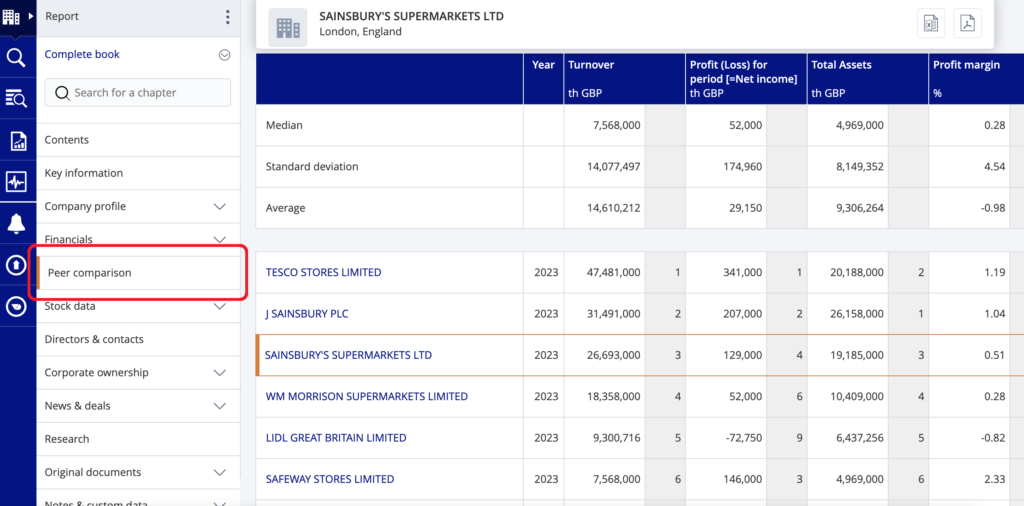
Peer Comparison for Sainsbury’s Supermarkets in Fame
For those who need to delve a little deeper or who wish to create their own customised set of companies to compare, the Fame Peer Analysis tool will be of interest. You can read more about this here. You can access the Peer Analysis tool via the Tools icon on the blue Fame toolbar.
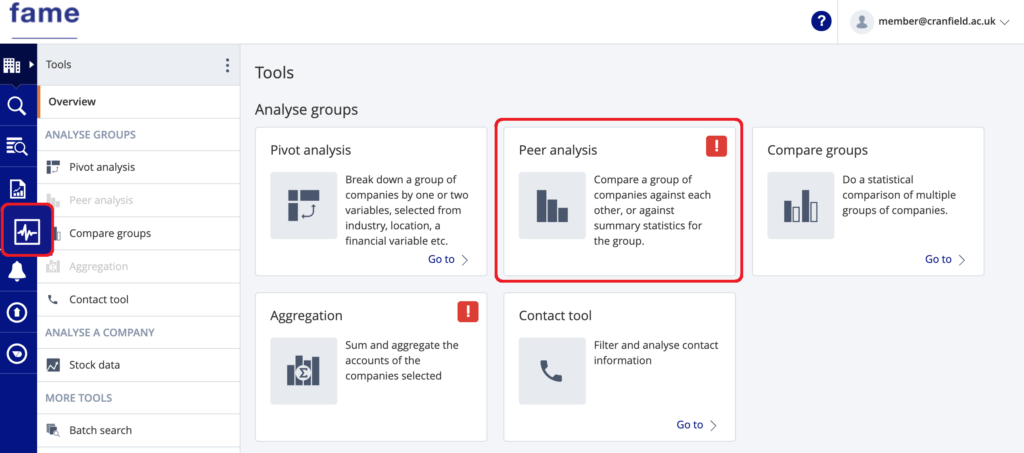
Peer Analysis tool in Fame
Competitor analysis in IBISWorld
Those familiar with IBISWorld will know that each of its reports includes a chapter on Companies. You can access this via the table of contents menu on the left of any report screen.

Major players in the UK coffee shops sector from IBISWorld
Peer comparison in Factiva
Factiva’s Company Snapshots include a peer comparison. From within any Snapshot, access this from the left hand menu. Select from a variety of peer groups and comparison variables.
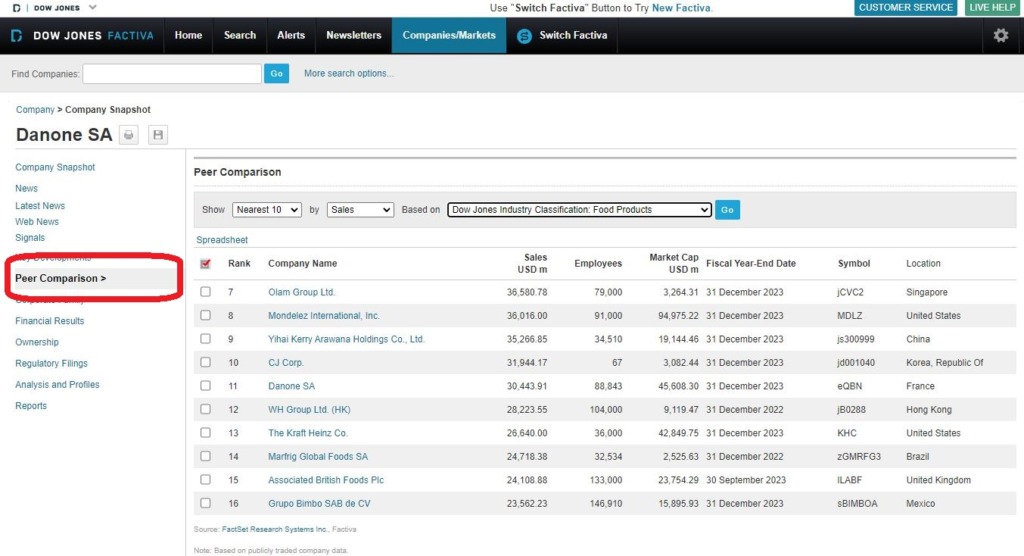
Danone’s closest competitors according to Factiva
For more information on Factiva’s Company Snapshots, check out our previous post here.
Peer Analysis in Capital IQ
Finance fans may be familiar with Capital IQ’s Peer Analysis function. It provides pre-defined peer groups and templates or you can create your own in this highly customisable interface.

Peer Analysis for Kelloggs within Capital IQ
For more information on Capital IQ, including how to set up your own account, please read our previous post here.
Relative Valuation in Bloomberg
Bloomberg’s Relative Valuation function will allow you to compare any listed company to its peers – either nationally or globally for a financial comparison.
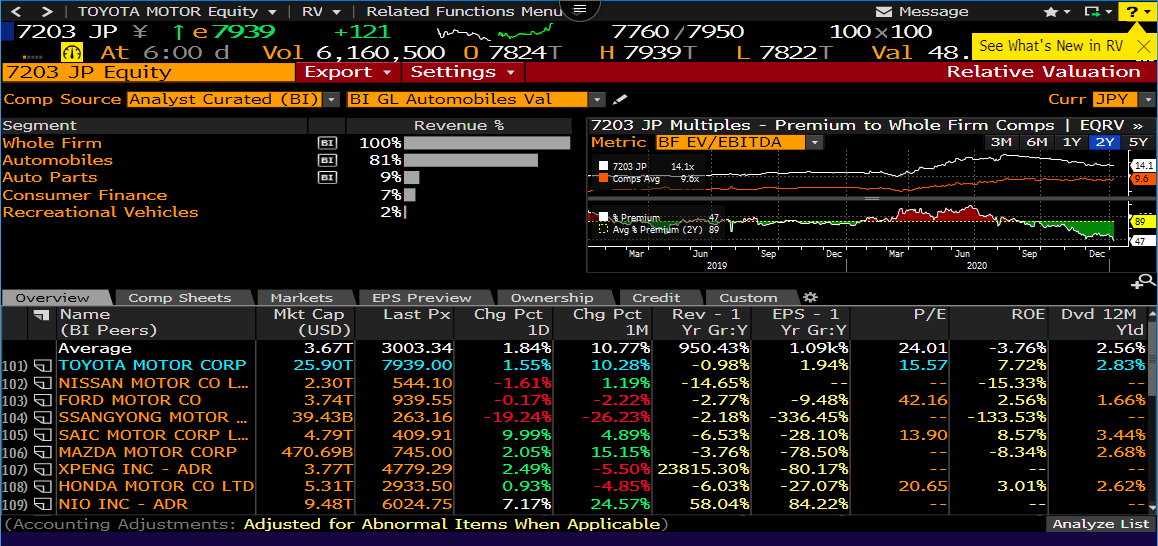
From a company’s record, use <RV> to access a variety of pre-defined peer groups and geographical settings and compare either by whole company or by segment. Tabs allow for both default and customised analysis.
If you have any questions about any of the resources above or any aspect of company research, please contact the Library.
Feature image from Pixabay. Available at: https://pixabay.com/photos/skyline-skyscraper-skyscrapers-1925943/

Categories & Tags:
Leave a comment on this post:
Comments are closed.
You might also like…

Moving to the UK to study? How to plan for banking, exchange rates and transfers
Currency and banking are two of the most practical parts of financial planning for international students. They are also often the most overlooked. We asked Dr Lakshmy Subramanian, Course Director for Cranfield University's Banking, ...

Cranfield: an environment where innovation thrives
The latest Knowledge Exchange Framework rankings from UK Research and Innovation (UKRI) gives an insight into the real and meaningful impact that UK universities have. The seven categories that make up KEF6 cover everything ...

How Cranfield accelerated my career in Logistics and Supply Chain Management
After graduating from the MSc in Logistics and Supply Chain Management at Cranfield University, I've been reflecting on the experiences that made my journey so valuable and the impact it has had on my ...

Mendeley: a powerful tool to organise and manage your references
Are you looking for a way to manage your references, create in-text citations and reference lists for your assignments or thesis? If so, you may wish to consider using Mendeley. What is it? Mendeley is ...

Keen to develop your study skills?
Alongside the technical skills and academic knowledge that you will gain on your course, as a Cranfield student you have the opportunity to develop a range of other skills that can enhance your learning experience. ...

The V-conomy: powering the sixth wave of global economic growth
The world could be on the verge of a major surge in economic growth and development, driven by the convergence of AI and clean energy technology. Waiting to ride the K-wave The Russian ...
This is an outstanding post that’s filled with so many useful nuggets. Thank you for being so detailed on competitor analysis. Great work and keep it up.