


Bringing the vision of advanced air mobility closer to reality
23/07/2024
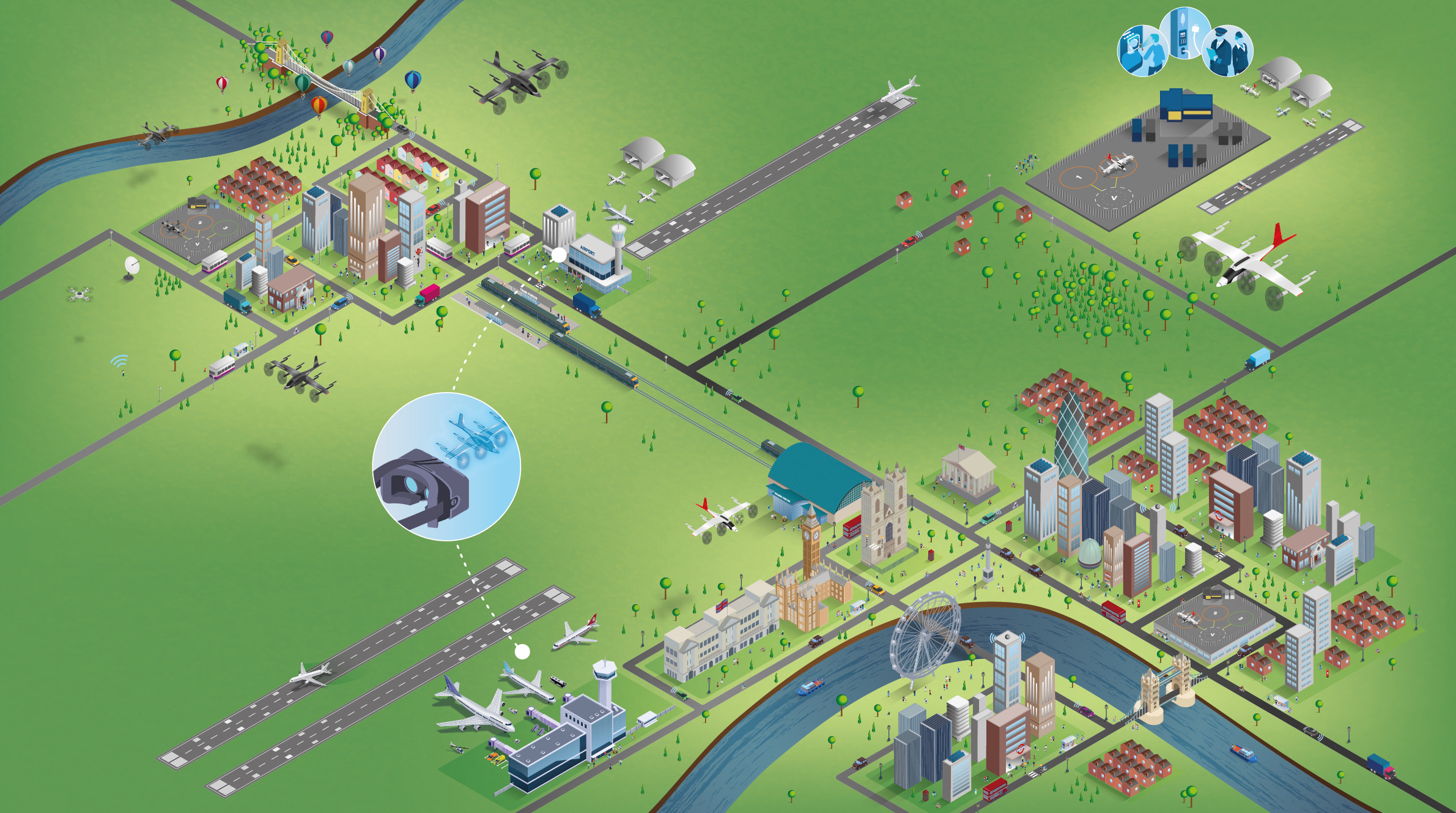
Experts at Cranfield University led by Professor Antonios Tsourdos, Head of the Autonomous and Cyber-Physical Systems Centre, are part of the Air Mobility Ecosystem Consortium (AMEC), which aims to demonstrate the commercial and operational viability of Advanced Air Mobility (AAM) in the UK. Professor Tsourdos explains more about Cranfield’s involvement:
Collaborating with AMEC partners, Cranfield is helping to model infrastructure for vertiports, including schedule optimisation and resource management.
Working with Skyports, Cranfield brings its expertise in passenger behaviour research and airport management to help shape infrastructure requirements for landing pads and vertiports. Ensuring that this is highly integrated with supporting infrastructure such as aircraft parking, landside access and embarking and disembarking areas is key to ensuring efficiency and a positive customer experience.
Cranfield is also supporting NATS in the development of the future airspace concept of operations. Collaborating closely with the consortium, academics are developing networks topology and network efficiencies for a network of vertiports. This is absolutely crucial for airspace management, and it’s key to consider operational constraints such as aircraft capabilities. Getting safety, task allocation and network integration right will ensure that aircraft can fly seamlessly between vertiports.
An ongoing focus area of work is ensuring scalability in the network and modelling how the future might look, and ensuring the network and infrastructure can take increased capacity.
Working closely with Skyports and NATS, the University has involved Master’s students who have generated ideas and information as part of their group projects. The engagement with industry through the project has been a fantastic opportunity for students to gain relevant experience.
Talented students on the Advanced Air Mobility Systems Master’s course have been modelling scenarios, conducting feasibility studies and generating ideas to help unlock the full potential of AAM applications. The course modules are also now available through UKRI’s Future Flight Challenge as a more flexible, ‘stackable’ option on Advanced Air Mobility, recognising the demand for skills in this area.
To read more about AMEC’s progress in this area read their full update blog…

Categories & Tags:
Leave a comment on this post:
You might also like…

Keen to develop your study skills?
Alongside the technical skills and academic knowledge that you will gain on your course, as a Cranfield student you have the opportunity to develop a range of other skills that can enhance your learning experience. ...

The V-conomy: powering the sixth wave of global economic growth
The world could be on the verge of a major surge in economic growth and development, driven by the convergence of AI and clean energy technology. Waiting to ride the K-wave The Russian ...

Need help using the Python programming language?
We know some of our students are currently trying to learn Python, so we wanted to make you aware of some great LinkedIn Learning videos that can help. But don't you have to pay for ...

What does it really take to become a Chevening Scholar?
Say “Turkmenistan” to most people and you’ll get a blank look. That was true when I left Ashgabat for the UK to study an MSc in Logistics and Supply Chain Management at Cranfield University ...

Get a head start on referencing and plagiarism
We offer a module on Referencing And Avoiding Plagiarism which you can find on your Canvas dashboard. It explains the role and importance of citing references and how to incorporate the work of other authors ...
How Cranfield shaped my journey as an Aerospace Engineer
If I'm being specific about the moment it clicked, it was reading a paper called "On the Role and Challenges of Computational Fluid Dynamics (CFD) in the Aerospace Industry" by two Boeing engineers, P. ...
Comments are closed.