


Marketing in this Covid-19 driven recession
25/03/2020

Professor Malcolm McDonald offers these thoughts during these difficult times in order to encourage all those of us who are intensely worried by the effects of the COVID-19 driven recession.
It is pure fiction to imagine that the impending recession is going to disappear soon.
The typical reaction to such misfortune is what Andrew Lorenz in the Financial Times describes as “anorexia industrialosa”, an excessive desire to be leaner and fitter, leading to emaciation and eventually death. Yes, of course there is a necessity for cost cutting, but it has to be done sensibly, as I shall spell out later.
But if this is the only response to recession, it is doomed to failure, largely because it results in even worse service to customers and customers just will not stand for this anymore.
Why is this?
Perhaps we need reminding briefly that the rules of competition have changed. The “make and sell” model has been killed off by a new wave of entrepreneurial technology-enabled competitors unfettered by the baggage of legacy bureaucracy, assets, cultures and behaviours. The processing of information about products has been separated from the products themselves and customers can now search for and evaluate them independently of those who have a vested interest in selling them. Customers now have as much information about suppliers as suppliers have traditionally accumulated about their customers. This new state has created a new dimension of competition based on who most effectively acts in the customers’ interests. So, this is the backcloth against which we face this new challenge in the early part of 2020.
I have 120 pieces of scholarly research to prove that long term successful companies take the trouble to segment their markets. Segments are groups of customers with the same or similar needs, not sectors. They work hard at understanding these needs and their behaviour patterns. They prioritise these segments according to their likelihood of enabling the company to achieve its profit objectives and they then develop appropriate product/services packages for each. They are ruthless in times of recession at focusing their attention on the segments they intend to keep in the long term, and they prune out those which are a drag on their resources. Only then is cost cutting and downsizing justified.
I am, of course, referring to Pareto’s Law (the 80/20 “rule”) About 20% of your customers will deliver about 80% of your revenue and profits, so trying to delight everyone with all of your offers guarantees average service that will delight no-one. By identifying your core market of primary customers and delighting them with selected differential offers, you will successfully preserve a resilient customer base.
Although this will not apply to all organisations, here are some guidelines for managing in this COVID-19-driven recession based on what I have said above.
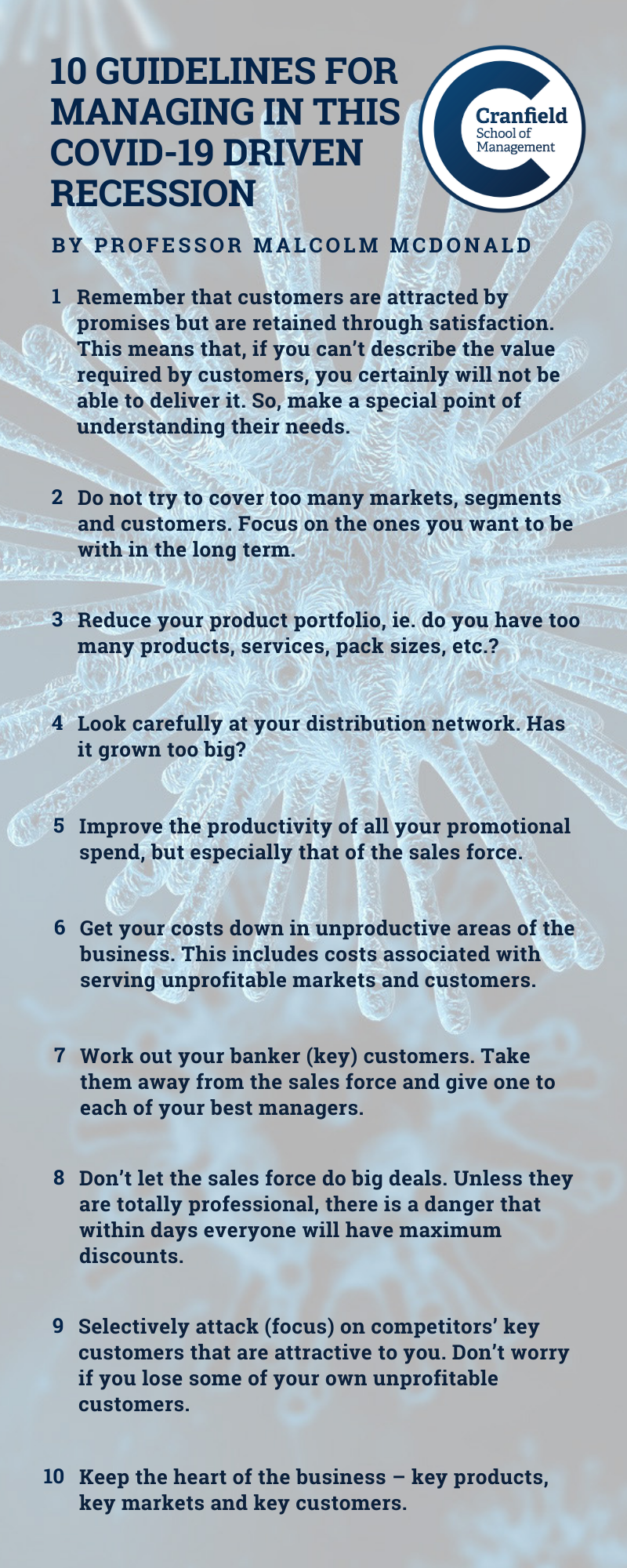
The problem, of course, for certain types of businesses with massive fixed costs such as airlines, is on an entirely different scale and whilst the principles are the same, this short article is not intended for them.

Categories & Tags:
Leave a comment on this post:
You might also like…

5 budgeting mistakes students make (and how to avoid them)
Good financial planning isn't about how much money you have. It's about the habits you build. We asked Dr Lakshmy Subramanian, Course Director for the Banking, Economics and Finance MSc, about the budgeting mistakes ...

Finding your reading materials
Use Library Search Library Search is the first place to start when you are trying to find academic sources for your work. This is the search box on the library website homepage. It allows you ...

Formula 1 was the dream and Cranfield was the conduit
I still remember the exact moment Formula 1 (F1) got its hooks into me. I was in my first year of an aerospace undergraduate engineering degree when I watched a video about the sport ...

Introducing Barrington Library
Welcome to all our new students! Barrington Library supports all the students and staff at Cranfield Defence and Security on the Shrivenham site. We are looking forward to meeting you all soon, in person or ...

About to start your journey at Cranfield? We’re here to help!
Congratulations on accepting your offer to study at Cranfield! If you’re keen to get a head start before your course begins, our Library Services team is here to support you every step of the way. ...

Bank holiday hours for Library Services: Monday 31 August
Library Services staff will be taking a break on Monday 31 August for the bank holiday. You will still be able to access all the resources and help you need via our library website. The 24/7 ...