

Accelerating ambition: How Amelie Rohan engineered her future at Cranfield
07/01/2026
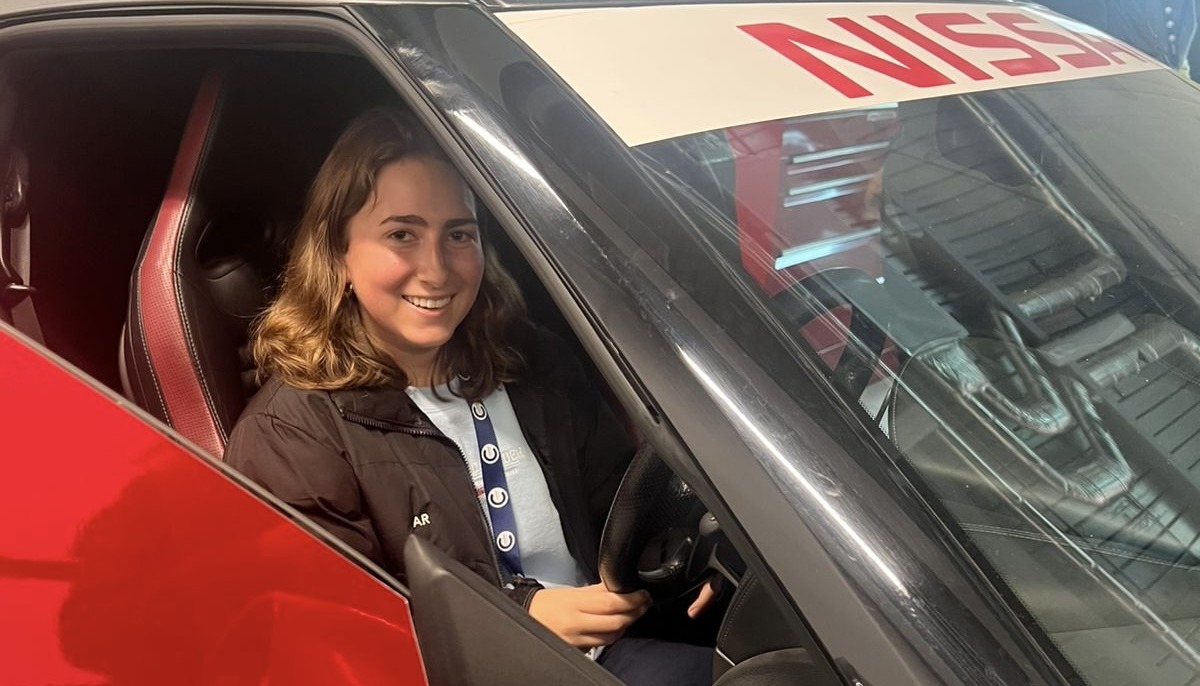
In the world of high-performance automotive engineering, the gap between being a “fan” and being a professional is measured in more than just miles. It is measured in technical precision, hands-on grit, and a powerful professional network.
For Amelie Rohan, that journey began at Durham University, where she completed a BSc in Mathematics. While this degree provided a rigorous analytical foundation and strong problem-solving skills, Amelie knew that breaking into the elite world of motorsport and automotive consultancy required a more applied, engineering-focused “turbocharge.” Acting on the advice of mentors and inspired by the energy she felt at a Cranfield Open Day, Amelie realised that if she wanted to translate her mathematical background into real-world engineering impact, Cranfield University was the ideal next step to studying a postgraduate degree in Automotive Engineering.
The power of focus: Immersion over everything
At Cranfield, the learning environment doesn’t just teach the industry, it mirrors it. Amelie found herself immersed in the university’s signature intensive two-week teaching blocks. From 9am to 5pm, every distraction was stripped away, leaving only the student and a singular engineering challenge.
While the pace was demanding, the results were transformative. This structure allowed Amelie to truly “live” a subject—breathing in technical nuances and deconstructing complex systems before shifting gears to the next module. It was a rhythm that built the mental stamina and focus required for the fast-paced professional world.
Real-world simulations:
While lectures provided the blueprint, Amelie found that the “real magic” happened when the books were closed and the projects began. The MSc course utilised two major pillars to prepare her for the workplace:
- The Group Design Project (GDP): This served as a masterclass in collaboration. Working on multi-faceted systems with a diverse team, Amelie learned that engineering is as much about communication and shared problem-solving as it is about complex calculations.
- The Individual Research Project (IRP): This was Amelie’s ultimate highlight. Granted the freedom to pursue a topic she was “genuinely obsessed with,” she transformed her research into a passion project. The thrill of discovering something new in a field she loved was the moment she transitioned from a student to a specialist.
A seamless shift to MAHLE Powertrain
Today, Amelie is putting that academic preparation to the test every single day. Now working as a Graduate Engineer at MAHLE Powertrain, she describes the transition from the lecture hall to the consultancy as “seamless.”
Cranfield provided Amelie with more than just a diploma; it gave her a professional toolkit that she opens daily. At MAHLE, a leading name in engineering consultancy, she draws on three key pillars from her master’s:
- Technical expertise: Applying core physics to solve real-world powertrain challenges.
- Software proficiency: Navigating the exact digital platforms used by industry leaders.
- Project management: Managing the shifting deadlines and varied scopes of high-level consultancy work.
The Group Design Project proved to be the perfect rehearsal for her career. The collaborative problem-solving she practiced on campus is exactly what she does now, the only difference is that her results are now heading directly to the global market.
Life in a “world of its own”
Even as a British student familiar with the UK system, Amelie found Cranfield to be a unique ecosystem. During the project phases, the rigid schedule gave way to a professional level of flexibility.
Success for Amelie wasn’t just about crunching numbers or perfecting CAD models; it was about learning to manage her own time and find a personal rhythm. She discovered the importance of balancing high-stakes engineering with the social connections and “fun” that make the postgraduate journey a life-changing experience.
Looking ahead
With a clear goal to stay hands-on and continue solving the problems that move the world, Amelie has entered the industry not just as a graduate, but as a confident peer. Her story serves as an inspiring roadmap for any aspiring engineer: when you choose a path fuelled by genuine curiosity, the work doesn’t feel like a chore, it feels like a pursuit.


Categories & Tags:
Leave a comment on this post:
You might also like…

Mendeley: a powerful tool to organise and manage your references
Are you looking for a way to manage your references, create in-text citations and reference lists for your assignments or thesis? If so, you may wish to consider using Mendeley. What is it? Mendeley is ...

Keen to develop your study skills?
Alongside the technical skills and academic knowledge that you will gain on your course, as a Cranfield student you have the opportunity to develop a range of other skills that can enhance your learning experience. ...
The V-conomy: powering the sixth wave of global economic growth
The world could be on the verge of a major surge in economic growth and development, driven by the convergence of AI and clean energy technology. Waiting to ride the K-wave The Russian ...

Need help using the Python programming language?
We know some of our students are currently trying to learn Python, so we wanted to make you aware of some great LinkedIn Learning videos that can help. But don't you have to pay for ...

What does it really take to become a Chevening Scholar?
Say “Turkmenistan” to most people and you’ll get a blank look. That was true when I left Ashgabat for the UK to study an MSc in Logistics and Supply Chain Management at Cranfield University ...

Get a head start on referencing and plagiarism
We offer a module on Referencing And Avoiding Plagiarism which you can find on your Canvas dashboard. It explains the role and importance of citing references and how to incorporate the work of other authors ...
Comments are closed.