


From theory to leading the way: Simrat Singh’s robotics journey
14/11/2025
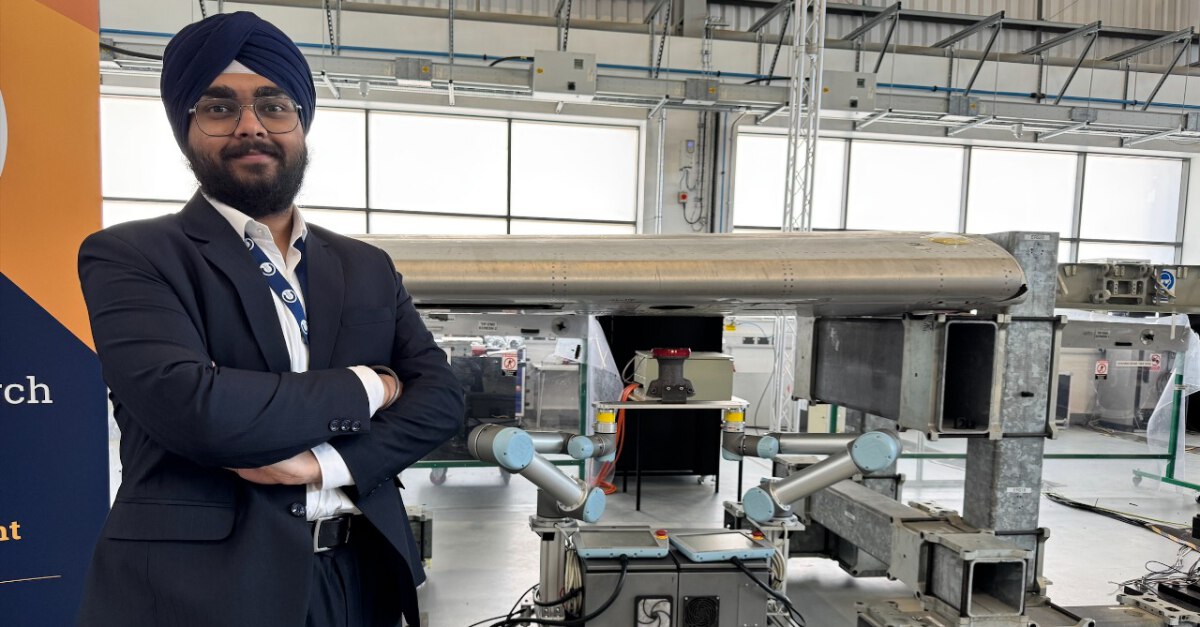
Simrat Singh, an Indian national, came to the UK to pursue an MSc in Robotics at Cranfield University. Now, he’s a Lead Robotics and AI Engineer at Swift Robotics, applying everything he learnt. We caught up with him to talk about his transformative experience, the power of hands-on learning and his ambitions to define the future of human-robot collaboration.
Why Cranfield? Beyond the classroom
For Simrat, the choice to study at Cranfield wasn’t just about the name; it was about the applied experience. “I chose Cranfield because of its strong reputation for industry-focused research and its close collaboration with leading technology and robotics companies. The hands-on learning, including labs and real-world projects, was a major draw.”
Specifically, the MSc in Robotics was the perfect fit. “I wanted a course that goes beyond just programming robots, focusing instead on designing intelligent systems that can collaborate safely and effectively with humans,” Simrat explains. The curriculum’s balance, which included no exams and a focus on assignments and projects, perfectly aligned with his desire for practical application and deep understanding.
Real-world experience: The Cranfield difference
Simrat found the course to be highly engaging, balancing essential theory (kinematics, autonomy, AI) with extensive practical work. A key highlight was the emphasis on real-world problem-solving and collaboration.
“The industrial group project gave me a great insight into the industry and the freedom to choose my thesis project helped me implement those insights later.”
This practical focus immediately translated into his career. “The course prepared me for the real world by giving me direct exposure to industrial practices from the very beginning. In the first week itself, we were interacting with and coding real industrial robots.” he recalls. “This, combined with guest lectures from industry leaders like Airbus, provided the confidence and skills to excel in an industrial environment.”
Simrat’s career ambitions were significantly influenced by Cranfield’s focus on smart technology. “This perspective has motivated me to pursue a career in developing human-centred robotic systems that combine automation with adaptability and learning.” he says. That motivation now sees him leading a team in the exciting field of Human-Robot Interaction.
Life as a Robotics Engineer
Simrat is currently the Lead Robotics and AI Engineer at Swift Robotics. “It’s a very exciting role where I’m responsible for developing and integrating intelligent robotic systems.” he says. The role is fast-paced, innovation-driven, and demands constant learning -a perfect extension of his studies.
Looking ahead: Innovation and entrepreneurship
Simrat’s journey is far from over. His future aspirations include pursuing a PhD in Robotics and Artificial Intelligence, specifically to deepen his research into human-robot collaboration. Alongside this, he plans to launch his own robotics start-up. “My long-term vision is to bridge the gap between academic research and commercial innovation, turning advanced robotics ideas into practical technologies that improve people’s lives.” he states.
His advice to future students in smart technology is simple yet crucial: “Don’t rush through the learning process.” He encourages students to master the fundamentals, make full use of the world-class labs, and not hesitate to explore personal projects. “Taking initiative and being curious are what really help you grow in this field.”

Categories & Tags:
Leave a comment on this post:
You might also like…

Mendeley: a powerful tool to organise and manage your references
Are you looking for a way to manage your references, create in-text citations and reference lists for your assignments or thesis? If so, you may wish to consider using Mendeley. What is it? Mendeley is ...

Keen to develop your study skills?
Alongside the technical skills and academic knowledge that you will gain on your course, as a Cranfield student you have the opportunity to develop a range of other skills that can enhance your learning experience. ...

The V-conomy: powering the sixth wave of global economic growth
The world could be on the verge of a major surge in economic growth and development, driven by the convergence of AI and clean energy technology. Waiting to ride the K-wave The Russian ...

Need help using the Python programming language?
We know some of our students are currently trying to learn Python, so we wanted to make you aware of some great LinkedIn Learning videos that can help. But don't you have to pay for ...

What does it really take to become a Chevening Scholar?
Say “Turkmenistan” to most people and you’ll get a blank look. That was true when I left Ashgabat for the UK to study an MSc in Logistics and Supply Chain Management at Cranfield University ...

Get a head start on referencing and plagiarism
We offer a module on Referencing And Avoiding Plagiarism which you can find on your Canvas dashboard. It explains the role and importance of citing references and how to incorporate the work of other authors ...
Comments are closed.