


“Computer says ‘So’ – Innovation and Cynefin” – first of four on this subject
18/02/2019

Some of you will remember the famous sketch in the TV series, Little Britain, where the “Computer Says No” to a prospective customer, and the frustrating time that person has in understanding why!
Well, with today’s bright and shiny “Innovative Solutions” employing so-called “Big Data” and “Artificial Intelligence” the real danger is that a user of such tools will be directed to carry out some action, and when questioned, possibly in court, the only response they’ll be able to give is “I had to do it because The Computer Says So”!
In our last blog, we looked at “Thinking Differently (and understanding)” vs “Doing Differently (without understanding)”. I’ve heard many senior executives and busy managers say, “I don’t have time to understand, just give me three alternatives, and I’ll pick one”. Presumably, the ability to pick the right one, or even to know they’re the right three in the first place, increases as one ascends the corporate ladder? Just why are these senior people so busy? We’ll look at that in a future blog.
In the previous blog, we touched on the Cynefin Framework – IBM being cited as the originator of this concept. It is a framework for understanding – understanding what type of Environment your business is operating in, and the type of Business Systems, Processes or Stages working in such Environments. It provides an understanding of which Approaches, Techniques and Tools work best in each Environment and which do not.
Apparently, Cynefin is pronounced ku-NEV-in, and is a Welsh word that signifies “the multiple factors in our environment and our experience that influence us in ways we can never fully understand.”
With the help of Bill Dettmer (Goal Systems International), we’ve developed this framework beyond its initial inception to cater for how we have seen things working in our customers’ situations. It is work in progress. Rather than explaining the structure in detail here, we’ll briefly try to bring this framework to life through some examples to highlight the 4 main Environments / Systems – let’s call them Domains – represented by the 4 boxes below.
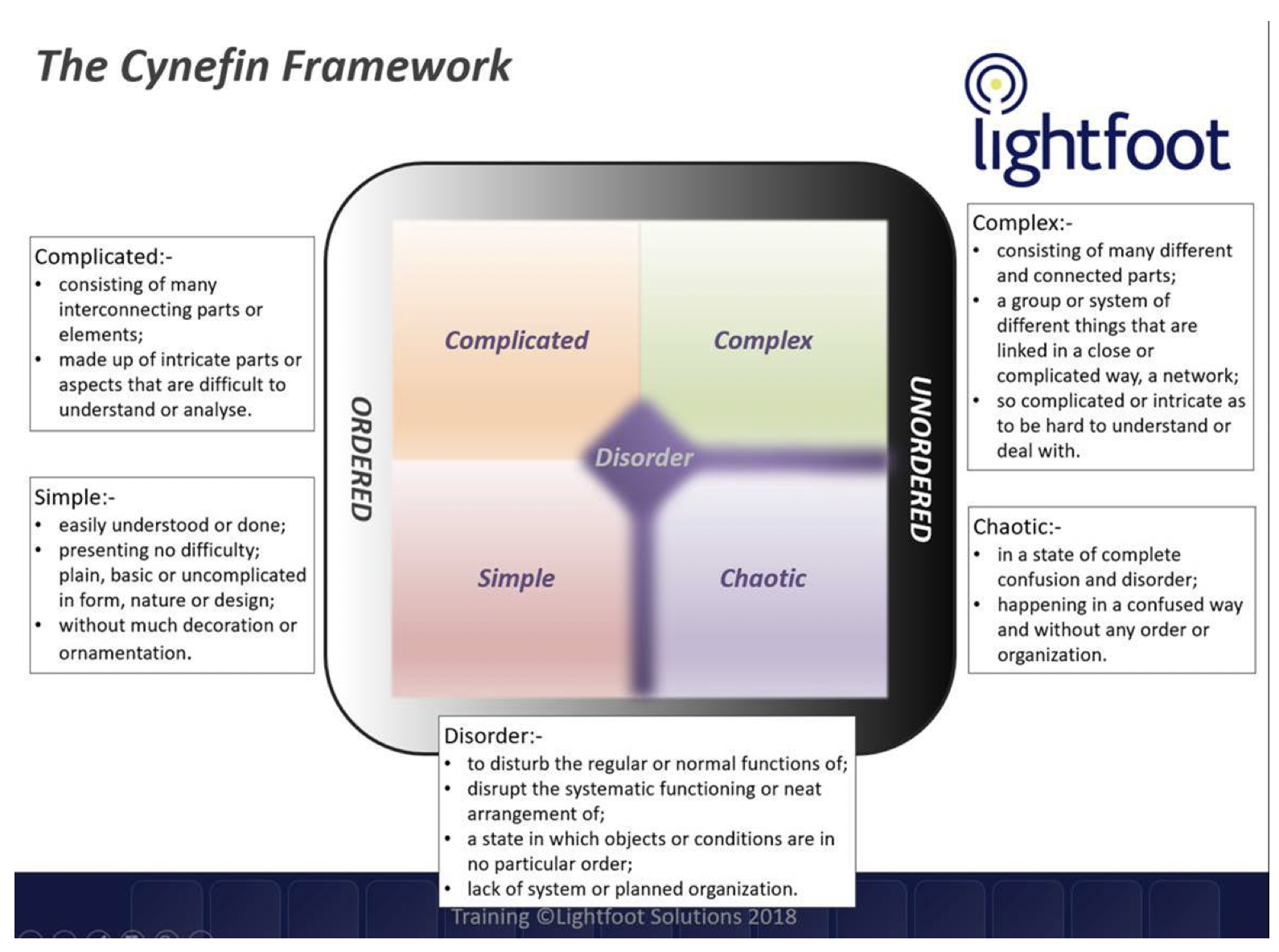
And we’ll refer back to a previous blog where we introduced the term VUCA (Volatile, Uncertain, Complex and Ambiguous), see
We’ll use a “VUCA Score” to help determine which Domain we’re in, as sometimes it may be difficult to determine where we are.
We’ll just cover the Simple Domain in this first of four blogs, then work our way around to the rather special and exciting Chaotic Domain in subsequent blogs:
Simple Domain (Volatility = Low; Uncertainty = Low; Complexity = Low; Ambiguity = Low): For example, taking a call from a customer to change an insurance policy, or taking a call from a member of the public and passing on to the control room for despatch. Each of these is a relatively Simple Environment, with relatively low variability and low uncertainty, that can be catered for by relatively Simple Business Stages (that may be part of a potentially more Complicated Business Process or System).
Almost all good management techniques and tools work well here, and include Lean, 6-Sigma, SPC, Cause & Effect, Correlation Analysis, Logical Thinking Process, Boyd’s OODA Loop, and it is straightforward to predict forward as to what to expect in the future, and so on. Common Practice (some would call it Best Practice) can be applied derived from a common understanding of the Domain.
But note, even a Simple Domain can fall into the frenzied area labelled Disorder. For example, if you’ve planned on a certain number of resources for, say, an Environment where there are 1,000 calls per hour spread evenly over that hour, and suddenly you get 1,000 calls in 10 minutes, or 10,000 calls an hour over a few days, the Business System or Process you’ve set up will not cope and go into Disorder as callers hang up and call again or use other means to contact you. Often, the Disorder in the Environment only lasts for a few minutes or hours, possibly days, but eventually reverts back, and the System recovers and eventually carries on operating as normal.
…. Next time, we’ll take a look at the Complicated Domain ….
…. But in the meantime, what would be very dangerous is if we come to rely on some of the emerging innovations and, in the final analysis, we can only say, ”We did it because The Computer Says So!”.

Categories & Tags:
Leave a comment on this post:
You might also like…
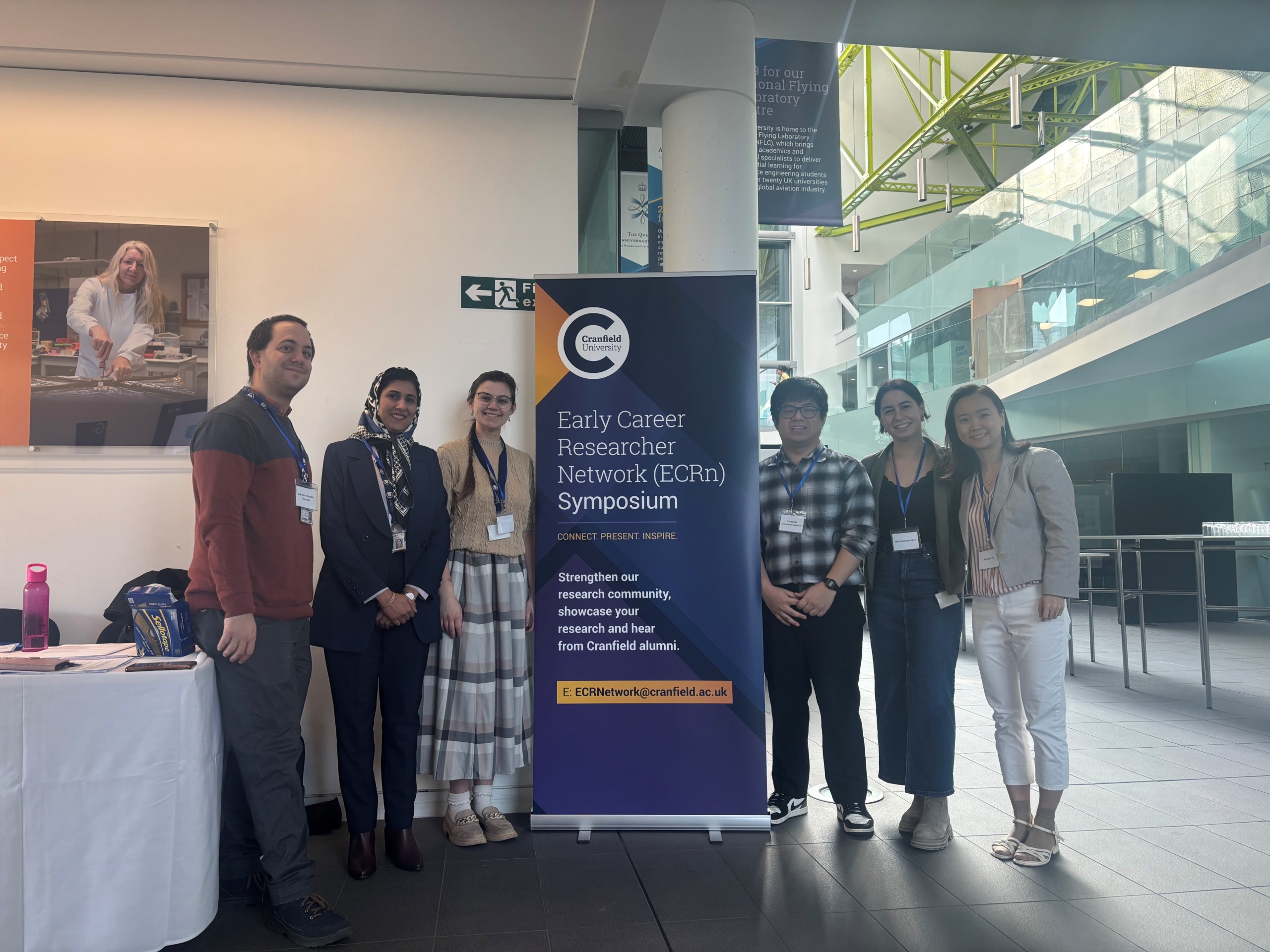
Building more than research: Reflections from the ECRn Symposium 2026
There’s something quietly powerful about a room full of early career researchers. Not just the ideas, although there were plenty of those—but the conversations, the curiosity, and the sense that everyone is figuring things ...

Library services over Easter, 3-6 April
Kings Norton Library will remain open for study 24/7. You will need your University ID card to enter the building and can use the self-service machines to borrow and return items as usual. Barrington Library ...

How do I access the full-text of Harvard Business Review (HBR)?
This is a frequently asked question, and it's worth knowing how to access this key management journal. So, how do you access HBR in full-text? The short answer is via our eJournals finder. You can find ...

Engineering problem to solve? Let Knovel help you find a solution
Did you know that Knovel provides you with more than just eBooks? Knovel is a key database for many engineering, mechanical and materials courses here at Cranfield University, and contains content from an extensive range ...
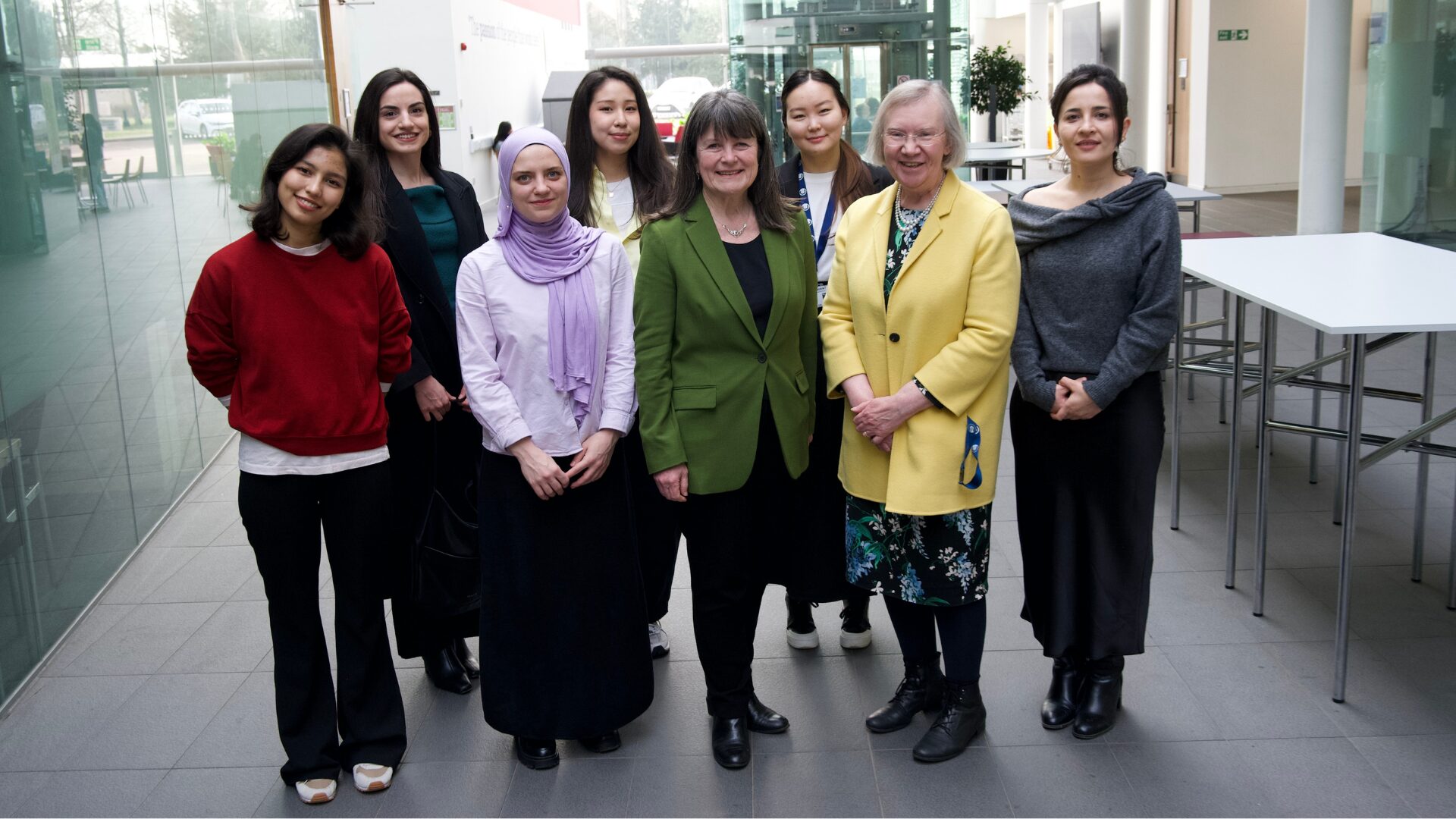
What happens when female scholars meet influential leaders?
On the 5 March 2026, our British Council Women in STEM Scholars had the privilege of sitting down with two excellent role models of industry and academia: Professor Dame Karen Holford, ...
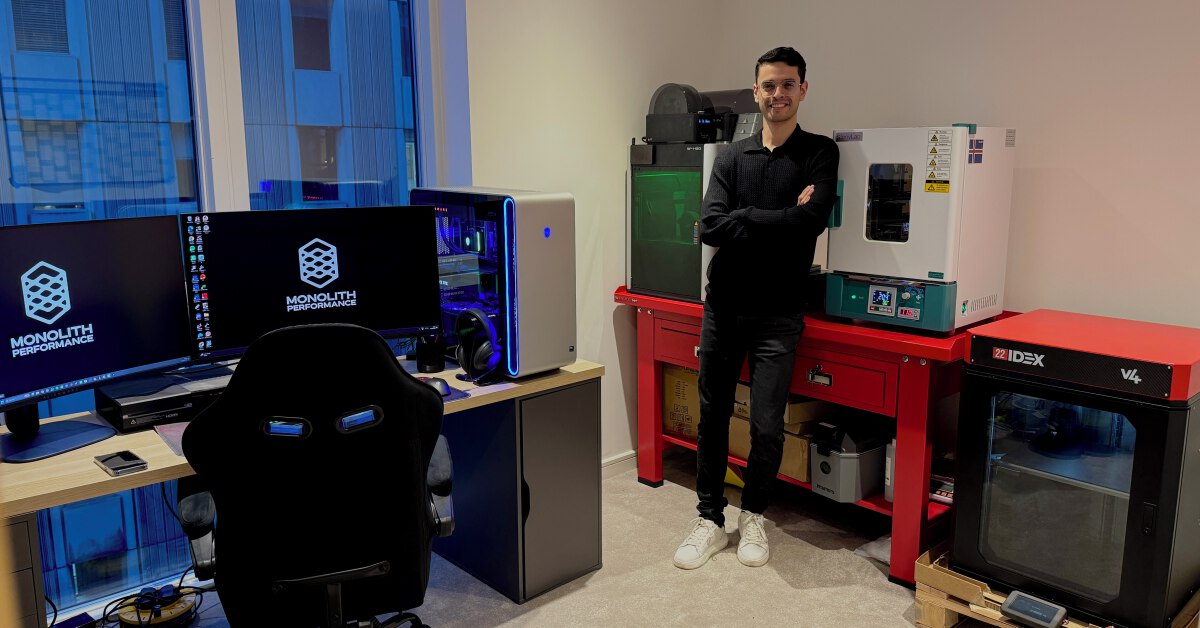
From MSc to CEO: Igniting a research revolution
For many, a master’s degree is achieving a big milestone. Kilyan Ocampo, Computational Fluid Dynamics alumni shares how studying at Cranfield helped launch his career in the energy sector. Today, Kilyan ...