


James Bidwell: Making Waves through the Power of Disruption
21/03/2022
“It’s as if we’ve gone from 2020 to 2030 in one weekend!”
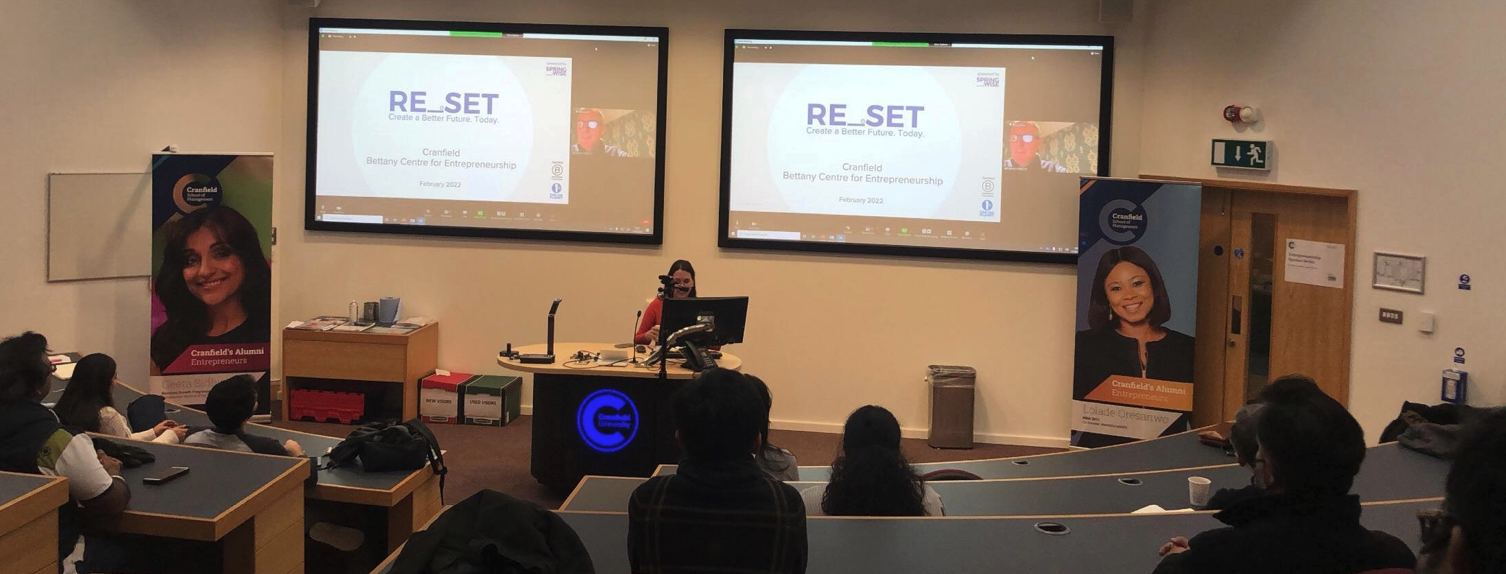
On Thursday 17 February, we were delighted to welcome the second guest in our 2022 Bettany Centre for Entrepreneurship Speakers Series, James Bidwell, who joined us remotely from Switzerland. His is a fascinating story – a compelling tale of entrepreneurial success which has brought together his passions for innovation and sustainability. Perhaps the most remarkable feature of James’s journey as a business founder and investor is that it did not start until his late 40s. As he told the audience, it’s never too late to start your career as an entrepreneur.
After graduating from Bristol University in 1987, James spent two decades in the corporate world, working in advertising and marketing and then as a CEO. He came to prominence when he was hired as Marketing Director by the London department store Selfridges. Within a short time, he had turned a staid and rather conventional shop into one of London’s coolest shopping destinations. From there, he was hired as CEO of Visit London, with a remit to publicise London’s Olympic Games and following that to set up the UK arm of a US fashion house. The last job was short-lived: James grew quickly disillusioned with the waste generated by this industry. He quit his position, convinced that there was a better way to do business, and determined to pursue it.
In 2014 he bought Springwise, the world’s leading aggregator and disseminator of innovations. The company constantly scans the world for original and disruptive ideas. Each day three of these are selected and showcased to subscribers, and today Springwise has around 11,000 innovations on its database. They can come from anywhere. The key point is that they are ideas that are disruptive of business as usual, that they illustrate positive change and many of these feature as examples and case studies in his recent Amazon bestseller, Disrupt! 100 Lessons in Business Innovation or, as James describes it, “Springwise in a book”.
This idea of the power of disruption is the thread that connects Springwise to James’s two subsequent entrepreneurial forays: Re_Set and Capital D. Re_Set, James co-founded with his wife Sophie, in 2017 and is a strategy consultancy with a very clear purpose. Informed by the insights generated by Springwise, the consultancy works with clients to develop strategies for a disrupted world in which sustainability is the most pressing issue. In addition to innovation and sustainability, Re_Set helps clients with strategies that build on defining business purpose and culture, and address the challenges of digital transformation. Its most prominent clients to date are the Primark Cares strategy, work for the UKHO, part of the Ministry of Defence, and various infrastructure players such as Ports of Jersey and Grosvenor Estate. James and Sophie helped create Capital D as a leading pan-European PE house by becoming strategic partners in 2017. Its point of difference – D is for Disruption – is that it invests in ventures that are designed to disrupt their industries and capitalise on macro trends driven by the fast pace of change
In the two businesses James Chairs, he has put his money where his mouth his. Both Re_Set and Springwise are certified B corporations, having undergone a rigorous process to demonstrate that they are a force for good: indeed, the tagline of Re_Set is the creation of a Better Future. Today. The two firms also belong to 1% for the Planet, an organisation whose members commit to giving one percent of turnover to environmental causes.
While James is in a sense a serial entrepreneur, there are strong synergies between the three businesses he is involved in. He explained how they work together. Springwise performs the function of horizon-scanning, identifying promising innovative new firms across the globe. Re_Set helps to fit these ideas into the broader macro strategic framework, and Capital D mobilises the money needed to take these aspiring businesses to market. The work involved, however, should not be underestimated. As part of a regular “deep dive” process for Capital D, to source, say, around 50 candidate deals, Re_Set might start the process by reviewing 1,000 business ideas. In a crowded early-stage Private Equity funding sector, what sets Capital D apart is its focus on backing practical applications which have the capability to disrupt their target markets and grow both fast and profitably. Disruption can take place anywhere and James gave us examples of recent investments in the cosmetics, consumer survey, and recruitment industries.
In his view, the future is already upon us and James sees five key forces for disruption:
- the challenge of maintaining biodiversity, as a vital element in sustainability
- the changing cultures of company workforces and the impact on broader society and well being
- activism, both individual and within corporations, as companies commit to the environmental and sustainability goals [ESGs] set by the United Nations
- the acceleration of digital technologies
- rapidly shifting strategies, as the pace of change forces businesses to be agile
In spite of the complex challenges we all face, James remains an optimist. Many concerns and issues – like sustainability – have now been absorbed into the mainstream of political and corporate life. Not so long ago, making money and going green were seen as opposites. Today he believes there is a meeting point where it is viewed as acceptable, and indeed advantageous for a business to be responsible, sustainable, and profitable. In short, there has never been a better time for entrepreneurs to bring new, disruptive ideas to market.

Categories & Tags:
Leave a comment on this post:
You might also like…

How to present well as a group
You will have put a lot of work into your research or group project and want to show everyone what you have achieved or discovered, so you need to impart this knowledge as clearly as ...
Building more than research: Reflections from the ECRn Symposium 2026
There’s something quietly powerful about a room full of early career researchers. Not just the ideas, although there were plenty of those—but the conversations, the curiosity, and the sense that everyone is figuring things ...

Library services over Easter, 3-6 April
Kings Norton Library will remain open for study 24/7. You will need your University ID card to enter the building and can use the self-service machines to borrow and return items as usual. Barrington Library ...

How do I access the full-text of Harvard Business Review (HBR)?
This is a frequently asked question, and it's worth knowing how to access this key management journal. So, how do you access HBR in full-text? The short answer is via our eJournals finder. You can find ...

Engineering problem to solve? Let Knovel help you find a solution
Did you know that Knovel provides you with more than just eBooks? Knovel is a key database for many engineering, mechanical and materials courses here at Cranfield University, and contains content from an extensive range ...

What happens when female scholars meet influential leaders?
On the 5 March 2026, our British Council Women in STEM Scholars had the privilege of sitting down with two excellent role models of industry and academia: Professor Dame Karen Holford, ...