


Stepping into the future: How Cranfield’s Robotics MSc built my STEM confidence
05/11/2025
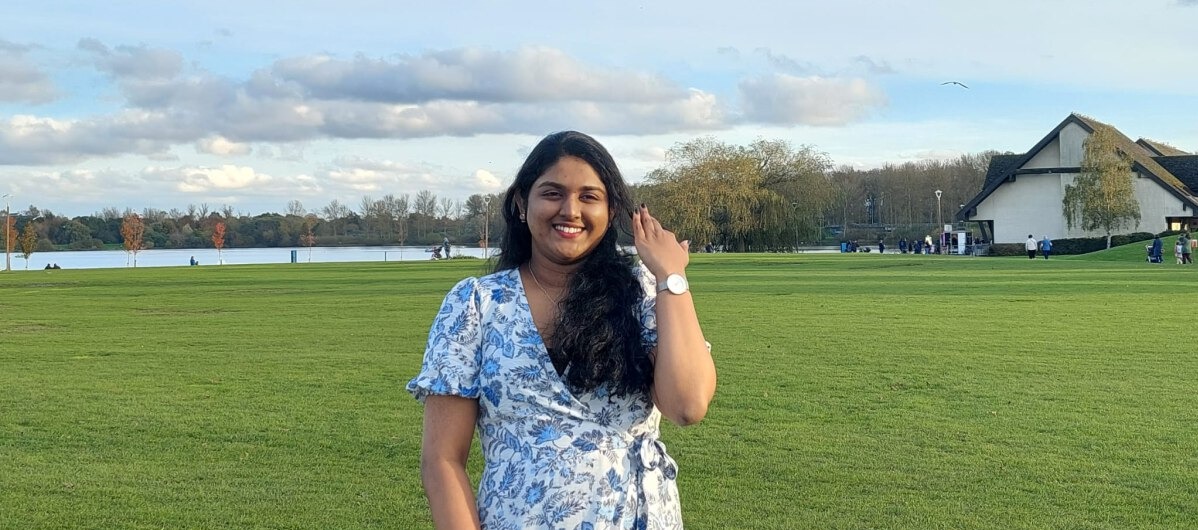
Have you ever looked at a complex machine and felt a surge of curiosity, wanting to not just understand it, but to control it? That fascination with innovation and automation is what drove me, a woman in STEM from India, to pursue a career in one of the most exciting fields today: robotics.
Hi, I’m Natasha Robin and here’s my story. My journey led me to Cranfield University, a postgraduate-only institution in the UK that’s renowned globally for its research and innovation, particularly in mechanical, aeronautical, and manufacturing engineering. By choosing the MSc in Robotics – a course I completed in 2025 – I found the focused, practical environment I needed to turn my passion into a profession.
Why a focused, postgraduate environment matters
Cranfield stood out immediately because it’s built for serious research and innovation. It’s a university that doesn’t just teach theory; it demands application. I was looking for a course that would immerse me in the field, and the MSc in Robotics offered exactly that.
The programme was intensely rewarding because it achieved a perfect balance: robust theoretical knowledge paired with extensive hands-on practical experience. This practical focus is what makes Cranfield’s approach to smart technology so impactful. My interest in developing intelligent systems deepened because I was constantly gaining hands-on experience with real industrial equipment and software, learning to program and control complex robotic systems.
“My aspiration is now clear: to develop smart robotic systems that can safely work alongside humans, reducing the workload and improving efficiency.”
The freedom to innovate: project-based learning
One of the most powerful highlights of the MSc Robotics course was its unique structure: there were no formal exams. The course was entirely assignment-based.
This approach was liberating. It gave me the freedom to research and learn at my own pace, encouraging independent research and problem-solving in a way that traditional exams simply can’t. Every assignment became an opportunity to delve into new topics, explore them in depth, and develop a genuine mastery of the subject. It wasn’t about memorisation; it was about true accomplishment through application.
The structure of the year reflects real-world project cycles:
- The first four months were structured classes to build the foundation.
- The next three months involved a Group Project, which honed my essential teamwork skills by collaborating closely with classmates.
- The final three months were dedicated to an Individual Research Project, giving me full control and ownership over my work and timing.
Global growth, technical confidence
My experience studying in the UK, and especially at Cranfield, has been incredibly positive and enriching. The UK’s education system encourages critical thinking and practical application, which is crucial in a rapidly evolving field like robotics.
Crucially, the multicultural environment at Cranfield broadened my horizons. Interacting with students from diverse backgrounds not only improved my communication skills but also prepared me to work confidently in international and interdisciplinary teams – a non-negotiable skill for any modern robotics engineer.
Studying here provided me with more than just technical knowledge; it equipped me to step confidently into a global workforce.
Advice for the next generation of women in STEM
If you’re fascinated by smart technology and dreaming of a career in engineering, my strongest advice is to take advantage of the hands-on opportunities at Cranfield.
The lab sessions, the group projects, and the research work are your chance to move beyond the textbook and understand real-world applications. Don’t be afraid to dive in, get your hands dirty with the code and the equipment, and fully engage with the tools that will define your career.
“Your future starts with action. Embrace the learning environment at Cranfield, use the resources, and prepare to build the intelligent systems of tomorrow!”


Categories & Tags:
Leave a comment on this post:
You might also like…

Keen to develop your study skills?
Alongside the technical skills and academic knowledge that you will gain on your course, as a Cranfield student you have the opportunity to develop a range of other skills that can enhance your learning experience. ...
The V-conomy: powering the sixth wave of global economic growth
The world could be on the verge of a major surge in economic growth and development, driven by the convergence of AI and clean energy technology. Waiting to ride the K-wave The Russian ...

Need help using the Python programming language?
We know some of our students are currently trying to learn Python, so we wanted to make you aware of some great LinkedIn Learning videos that can help. But don't you have to pay for ...

What does it really take to become a Chevening Scholar?
Say “Turkmenistan” to most people and you’ll get a blank look. That was true when I left Ashgabat for the UK to study an MSc in Logistics and Supply Chain Management at Cranfield University ...

Get a head start on referencing and plagiarism
We offer a module on Referencing And Avoiding Plagiarism which you can find on your Canvas dashboard. It explains the role and importance of citing references and how to incorporate the work of other authors ...

How Cranfield shaped my journey as an Aerospace Engineer
If I'm being specific about the moment it clicked, it was reading a paper called "On the Role and Challenges of Computational Fluid Dynamics (CFD) in the Aerospace Industry" by two Boeing engineers, P. ...