


Abby’s Forensic Archaeology and Anthropology MSc gave her a choice of pathways
29/05/2025
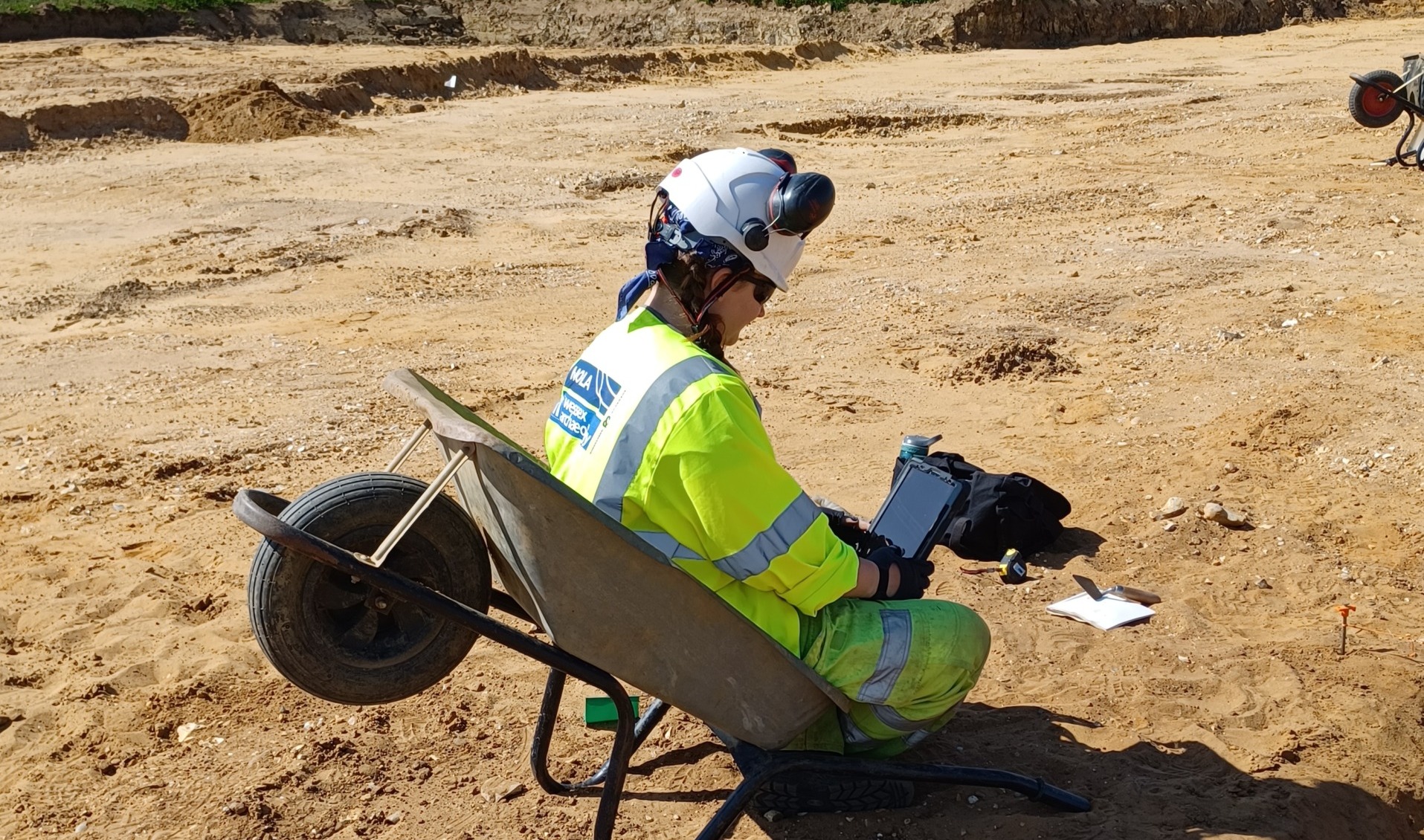
Pursuing a master’s gives you the opportunity to refine your career and academic pathway, honing in on the aspects that light you up, and gaining clarity on those that don’t. For recent alumna, Abby, the pathway through her Forensic Archaeology and Anthropology MSc gave her a clear direction of travel, leading to her role with MOLA – the Museum of London Archaeology and new role at AOC. We can’t wait to celebrate with Abby at Graduation 2025!
Let’s hear about Abby’s Cranfield experience…
What inspired you to pursue a Forensic Archaeology and Anthropology MSc? Was there a defining moment or experience that made you say, ‘This is the path I want to take’?
I suppose it was during my second year at the University of Derby. My undergraduate was in Forensic Science and we had optional courses to take. I saw they were running a Forensic Anthropology module and just thought I’d give it a go. I adored the course, the material we covered and the idea that if I pursued this career I could one day help identify people with a police force, like missing people cases. I talked with the module lecturer and she gave me some recommendations on what else to do to try and advance my path towards Forensic Anthropology, which included taking the optional modules in my third year of Disaster Victim Identification and Forensic Archaeology.
I think my ‘this is what I want to do’ moment was a mixture of completing my dissertation, which mainly covered Forensic Taphonomy, the study of what happens to the human body post-mortem, and the Forensic Archaeology module. The idea of helping identify a missing person or a freshly recovered body to unite them back with their loved ones and giving them back the identity they once had though science and investigation just felt like what I wanted to do.
What drew you specifically to Cranfield for your MSc journey? What stood out to you about the programme, and how did it align with your goals?
Cranfield was recommended to me my dissertation supervisor during one of our first one-to-ones. I knew what I eventually wanted to do and that I wanted to start a master’s in Forensic Anthropology and wasn’t sure where to start.
She recommended Cranfield and suggested I start looking as applications would soon begin.
Once I started looking into Cranfield it was the modules that focused on the recovery of remains took my interest. For example, Recovery of Buried Remains, Mass Graves Excavation and Temporary Mortuary Operations.
Coming from your bachelor’s, what was the transition like from undergrad to postgrad? How did you adapt to a new academic environment, and what kind of support, whether from your peers, faculty, or university services helped you settle in?
At first I found Cranfield terrifying. I don’t think I’ll forget sitting in our induction week, listening to my peers about what they had already achieved to get to Cranfield, who they where and what they had studied.
I felt overwhelmed at first but, as I began to make friends and work closer with lecturers, it didn’t matter what my background was or what did or didn’t know.
I was supported by lecturers and peers when I didn’t at first understand a concept and helped others when I could, especially when it came back to forensics.
Eventually, I worked out I wasn’t too great at Forensic Anthropology, but I found a good flow during the modules Forensic Archaeology Recovery of Buried Remains (FARBR), Forensic Archaeology Mass Grave Excavation (FAMGE) and Practical Archaeological Excavation (PAE). Both the Forensic Archaeological modules seemed to be what I had set out to do when I joined Cranfield. Recovering a body to eventually be reunited with their loved ones and identifying finds or personal possessions that gave someone, who was once lost, an identity.
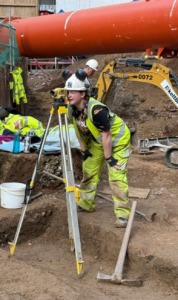
PAE lit up the fire to continue in Archaeology. Working on uncovering a Roman Structure and the finds that belonged to its occupants was just life changing. It was the module that really solidified for me that Forensic Archaeology was what I wanted to do.
Tell us about your position at MOLA, and soon to be role at AOC, what is your day to day like in the field? How have the skills you learned at Cranfield helped you so far in your career?
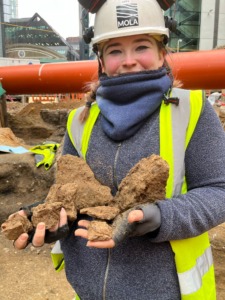
Cranfield prepared me quite a lot for my job at MOLA, from explaining running matrixes to basic tool work and critical analysis. As an Archaeologist, working day to day to hand excavate and record contexts to be used to build up a story of the people and buildings of the past. I like that idea, that the people and stories lost in history slightly get uncovered and told by the work Archaeologists and the Post Excavation Team do.
It’s what I’m hoping to do in my next job with AOC as a Post Excavation Technician. Find out what happens after an excavation and piece together the parts of a story.
If you had to sum up your Cranfield experience in just a few words, what would they be and why?
Terrifyingly brilliant.
Cranfield truly helped me understand my skills when in the field and solidifying this is what I’m meant to do in life.
Looking back, what’s been the standout moment or highlight of your experience? What lesson or impact do you think will stay with you long after graduation?
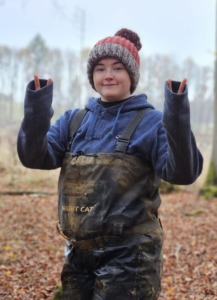
I think the most stand out moment was getting the confirmation that I was selected to go on a Cranfield Recovery and Identification of Conflict Casualties (CRICC) dig. An experience that now is so close to my heart as it’s exactly what I want to eventually do full time. And knowing the efforts that the core team push though only make me hope to be able to join them once again.
How are you feeling about coming back to Cranfield and graduating? Have you kept your connection to Cranfield as an alumna?
I’m excited to graduate and see my friends from the other forensic courses. They have walked their own paths since leaving Cranfield last summer and I’m eager to fully catch up with them.
Finally, for someone considering whether to take the leap into an MSc, especially at Cranfield, what advice would you give them?
To anybody thinking of continuing into Forensic Anthropology and Archaeology, I can’t recommend Cranfield enough. An MSc is challenging on its own, but it seems at Cranfield the connections and friendships you make while there will support you not only though the postgraduate but after as well.
Don’t be afraid to push though when it gets tough, and trust me it will get tough. But you will find support here, build an amazing skill set and find the path that’s right for you.

Categories & Tags:
Leave a comment on this post:
You might also like…

Keen to develop your study skills?
Alongside the technical skills and academic knowledge that you will gain on your course, as a Cranfield student you have the opportunity to develop a range of other skills that can enhance your learning experience. ...

The V-conomy: powering the sixth wave of global economic growth
The world could be on the verge of a major surge in economic growth and development, driven by the convergence of AI and clean energy technology. Waiting to ride the K-wave The Russian ...

Need help using the Python programming language?
We know some of our students are currently trying to learn Python, so we wanted to make you aware of some great LinkedIn Learning videos that can help. But don't you have to pay for ...
What does it really take to become a Chevening Scholar?
Say “Turkmenistan” to most people and you’ll get a blank look. That was true when I left Ashgabat for the UK to study an MSc in Logistics and Supply Chain Management at Cranfield University ...

Get a head start on referencing and plagiarism
We offer a module on Referencing And Avoiding Plagiarism which you can find on your Canvas dashboard. It explains the role and importance of citing references and how to incorporate the work of other authors ...
How Cranfield shaped my journey as an Aerospace Engineer
If I'm being specific about the moment it clicked, it was reading a paper called "On the Role and Challenges of Computational Fluid Dynamics (CFD) in the Aerospace Industry" by two Boeing engineers, P. ...
Comments are closed.