


Three reasons to study Additive Manufacturing at Cranfield
30/01/2024
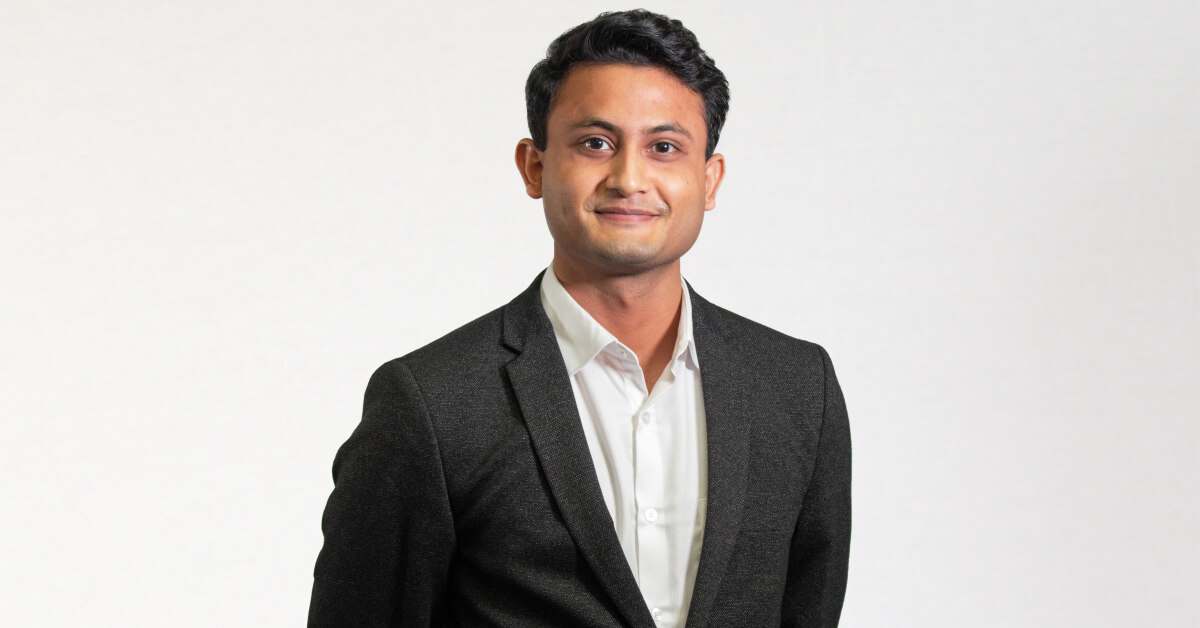
“Do not hesitate. Additive manufacturing is a booming industry that is still at a primitive stage and promises a significant amount of novel work and research and development.”
Part-time boxer, Shantanu Mitra was first introduced to 3D printing during his undergraduate degree. He quickly became intrigued by its possibilities and Cranfield was his first choice when deciding on postgraduate study. Here Shantanu shares his main reasons for choosing Cranfield to study the Metal Additive Manufacturing MSc and why he has never regretted his choice.
The infrastructure and accreditation
“The course modules are well organised and include industrial visits that give you the chance to explore the fundamentals that you have learned during the assignments and lectures and to see how they are put into practice in the workplace.”
Shantanu was impressed with the Cranfield infrastructure in additive manufacturing and its reputation in the global transformation of direct energy deposition. The Metal Additive Manufacturing MSc is accredited by the Institution of Mechanical Engineers (IMechE) and Royal Aeronautical Society (RaeS), which can help to obtain chartered status, making it the perfect course to help fulfil his career aspirations.
A place to focus on your future goals
The course intensity was a welcome aspect for thrill-seeker Shantanu…

“It can be intense – you only have one year to complete your modules, group project and individual research. The course prepares you for the industry you will work in, so you can step into your new role after graduating with ease.”
The pursuit of academic excellence
Shantanu is focused on undertaking a PhD next, working towards and ultimate goal of becoming a professor. His current research is around a project that focuses on developing new materials for slurry pump components in mining, addressing issues with current materials. It aims to use wire and arc additive manufacturing (WAAM), a method offering advantages like shorter lead times and design flexibility.
Sponsored by the Weir Group, the project aims to understand metallurgy in WAAM, optimising processes for desired mechanical performance. A typical day for Shantanu includes lab work and experiments, followed by weekly meetings with his supervisor and the sponsoring company to keep track of the advances they make. He also gets the opportunity to travel for work with WAAM3D and The Weir Group, which gifts him with opportunities to work with and learn from others.
Shantanu feels the research impact includes technological innovation, industry transformation, global collaboration with companies like the Weir Group, Boeing, Airbus, WAAM3D, Rolls Royce, and the education of future experts, contributing to a positive global influence coming from different parts of the world.
After his studies, he would like to continue his research in the field of additive manufacturing, and contribute to building more spin-off companies and collaborations, and ultimately become a professor.
Find out more about Shantanu’s course:


Categories & Tags:
Leave a comment on this post:
You might also like…

Engineering Tomorrow. Part two: Can we move around the world without emissions?
Moving people and goods around the world is essential to modern life. But every journey has an environmental cost, and reducing the emissions associated with transport is one of the major engineering challenges of ...
Following in the footsteps of aerospace pioneers
I came to Cranfield to understand how aircraft stay in the sky. Months later, I was measuring the performance of aircraft engines in flight aboard the National Flying Laboratory Centre's Saab 340B. My ...
From looking up at jet engines to powering the future of flight
From flying aboard Cranfield's Saab 340B flying classroom to rebuilding a gas turbine component by component, Jouni Kailouh's journey shows how specialist, hands-on experience can turn a fascination with propulsion into a future career ...
Engineering Tomorrow. Part one: Can we power the future without costing the Earth?
The world needs energy. To power homes, industries, transport and the technologies shaping our future. But as demand grows and the pressure to reduce emissions increases, how do we generate the energy we need ...
Looking ahead: Building foresight skills for a more sustainable future
As sustainability challenges become more complex and uncertain, organisations need people who can look beyond today's pressures and think strategically about the future. From changing regulations and emerging technologies to supply chain disruption and ...

Brazil to Cambridge: How Cranfield helped me build a career in data analytics
I was hungry for something bigger. Before Cranfield, I was living in São Paulo, Brazil, working as a Data and Market Intelligence Analyst in the trading division of Raízen. My background is actually ...
Comments are closed.