


Jumping into the Time Machine
09/03/2023
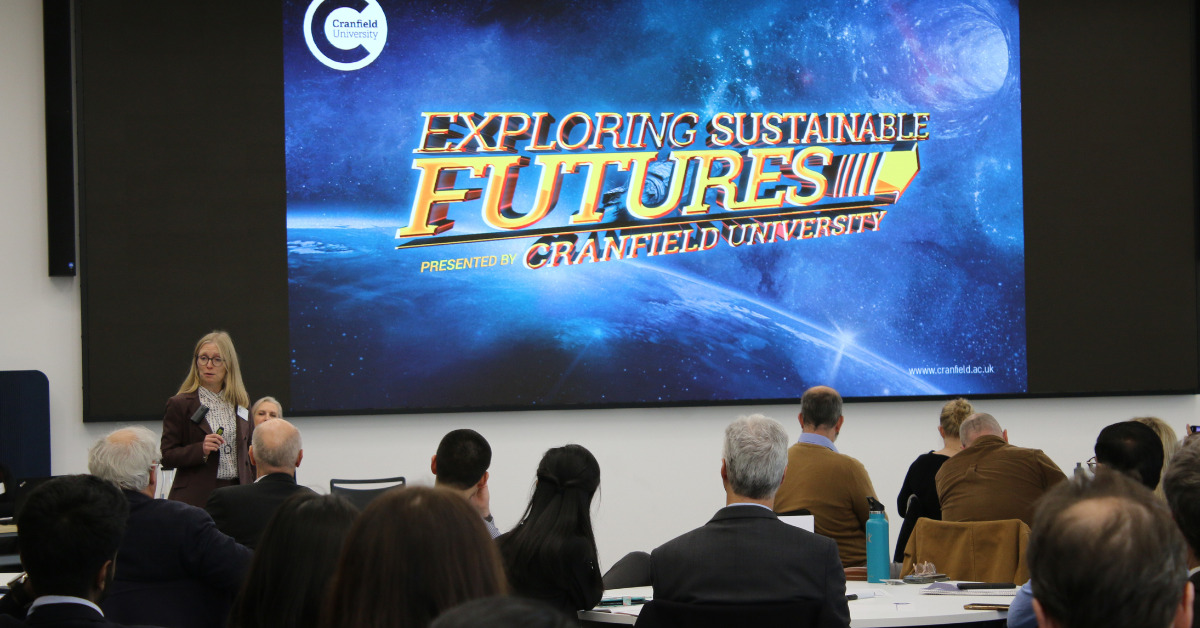
Having seen and heard the excitement generated online and around campus about the Exploring Sustainable Futures game, it was with great anticipation that I accepted a recent invitation to participate. Developed within the Cranfield School of Management and partially funded by Cranfield Alumni, Tomorrow Brighter, the game has been recognised by the Financial Times as being an example of best practice in teaching about sustainability and was even played at COP26 in Glasgow.
Walking from our office to the always impressive DARTEC building, I was unsure what to expect. I had deliberately decided to join the game with an open mind and avoid the temptation for prior research, but I was apprehensive about how my experience would fit with others in the room, and about the aspect of ‘role playing’ that I had heard was included – I am not a natural actor!
Upon entering the building, I was greeted by members of the Sustainable Business Team and given a colour-coded ticket which would be my allocation for a role within the game. As I took up a place at my table, I discovered that I was to be transformed into the role of a key decision-maker at a not-for-profit training provider for the construction industry. I soon learnt that the other tables were to be our fellow stakeholders for the industry with each one representing either local government, private philanthropy, or a large construction company. Towards the back of the room were two other groups representing the final key stakeholder groups for the game, one being investors (with a financial interest in the development of the industry) and the other being the public voice – those for whom the decisions made by industry impact their lives in ways often out of their control.
As the game began with an introduction to the current state of the industry and the threats to sustainability, we quickly assumed our roles and any prior concerns about being able to play a part quickly disappeared! Debates were soon underway within our group about how we would allocate the resources given to us within the game to build a successful and sustainable future for our organisation.
As we jumped into the ‘time machine’ for the first time (you will have to play the game for your own turn!) and disembarked in 2030, we were immediately presented with a newsreel of what had changed in the time we had been away. No spoilers here but suffice to say that the decisions made in the 2020s did not always show up in the best light when analysed with a decade of context.
For me, this was the point at which the real learning for the day began. Our group and others immediately recognised that to see a better future in our next trip in the time machine, we would have to start collaborating with the other key groups across our industry, and we would also wherever possible need the support of investors and the wider public.
During this part of the game representatives from each group began organically visiting other tables, starting new debates, discussions, and alliances. As the next process of resource allocation and planning began it became very clear that a new perspective had taken hold amongst the players. Ideas that had previously been focused on the information given to us in our roles at the start of the game now included the needs and support of others, working together to take on the issues highlighted by the 2030 newsreel.
From here the game progressed quickly through the decades with greatly increased collaboration and listening between groups driven by our new perspective. Finally arriving in 2050 we were presented with some profound scenarios for how the world may look 30 years from now and reflected on how our behaviour and decisions may contribute to this.
I was surprised by how quickly the game took me out of my established comfort zone and immersed me in the perspective of someone with a completely different focus. It really made me think about how a sustainable future in the real world will require productive collaboration. Most stakeholders are acting in the way that they see as the best way forward from their own perspective, without realising the wider effects of their decisions.
During the game the shift in my group’s role and perspective once we allowed outside influence and debate into our thinking was fascinating, and we were able to expand our positive results through this – this is definitely something I will be taking with me to my day-to-day life and I recommend anyone who gets the chance to join the sustainable futures game!


Categories & Tags:
Leave a comment on this post:
You might also like…

5 budgeting mistakes students make (and how to avoid them)
Good financial planning isn't about how much money you have. It's about the habits you build. We asked Dr Lakshmy Subramanian, Course Director for the Banking, Economics and Finance MSc, about the budgeting mistakes ...
Finding your reading materials
Use Library Search Library Search is the first place to start when you are trying to find academic sources for your work. This is the search box on the library website homepage. It allows you ...

Formula 1 was the dream and Cranfield was the conduit
I still remember the exact moment Formula 1 (F1) got its hooks into me. I was in my first year of an aerospace undergraduate engineering degree when I watched a video about the sport ...
Introducing Barrington Library
Welcome to all our new students! Barrington Library supports all the students and staff at Cranfield Defence and Security on the Shrivenham site. We are looking forward to meeting you all soon, in person or ...

About to start your journey at Cranfield? We’re here to help!
Congratulations on accepting your offer to study at Cranfield! If you’re keen to get a head start before your course begins, our Library Services team is here to support you every step of the way. ...

Bank holiday hours for Library Services: Monday 31 August
Library Services staff will be taking a break on Monday 31 August for the bank holiday. You will still be able to access all the resources and help you need via our library website. The 24/7 ...
Comments are closed.