


Is it time to “call time” on talking sustainability?
15/09/2022

Let me paint you a picture. You’re in the pub and you ask people around you what ‘sustainability’ means to them. It depends on the crowd, but you’d probably be met a combination of with rolling eyes, “oh, you’re going to be all preachy!”, glazed over expressions, “How boring!”, confused looks, “sustain-a-what?”, and perhaps some anger, “I suppose you’re one of those activists!”, as well as the odd polite smile as they excuse themselves to go to get another drink.
I was reflecting on this at the start of my MSc at Cranfield University, when one of my first pre-work assignments was to identify the person, or people who had most inspired me when it comes to sustainability. It’s a random list, but it ranges from an author, a poet, a storyteller, my geography teacher, and my mum. And the common theme among them is that none of them ever used the word ‘sustainability’. For my mum, it was just about common sense and making the most of resources. For the poet, it was about conveying a sense of beauty in the world. My geography teacher explained the impacts of human activity on the planet and what needs to change, and the storyteller helped me want to get involved in the ongoing challenge of helping animals, planet and humans to live better lives. Sustainability is the thread that runs through it all, and it’s engaging, it’s practical, it’s optimistic and for the left-brainers out there like me, it’s expansive and it’s about possibilities. So for me, there’s nothing wrong with that word because it sums up all that I want to strive for. And for people working in the field, we love the word as it has so many positive connotations. But that’s where the problem comes in – it can disengage as many people as it engages.
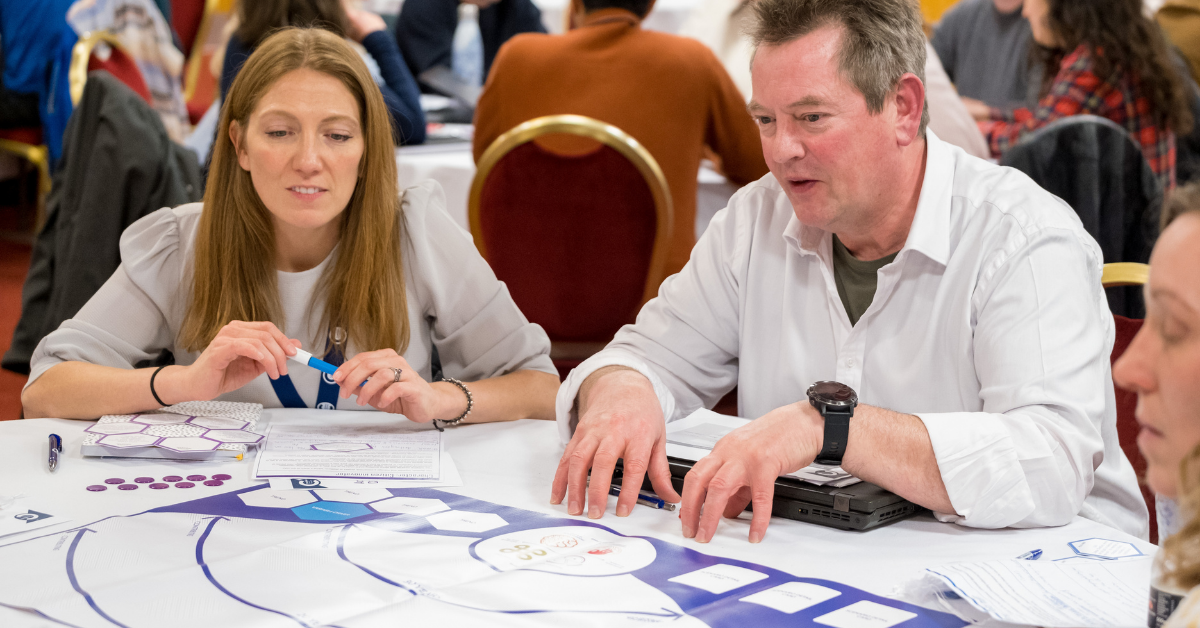
The good news is that sustainability has gone pretty mainstream in business, but the bad news is that it seems pretty dull, reductionist, and let’s face it, it can be quite alienating. From carbon jargon to certifications, data and reporting frameworks, zero waste to net zero, let’s face it, it’s hardly a page-turner unless you’re a greenhouse gas auditor. We need all this stuff, because that’s how we measure progress and create transparency, but maybe that talk needs to stay behind sustainably-sourced closed doors most of the time.
Go back to that pub a second. (Do you need any encouragement?!). Ask people what a ‘good life’ means to them and their family. You’ll get loads of answers. Health, wellbeing, decent work and education, affordable food, less inequality, peace, nature, a healthy planet, clean air, safety, rewarding employment, economic growth, I could go on.
Suddenly, there’s a shift change. We can talk animatedly about what that possible future looks like; we can see clearly that we all have a role to play. We can see how we can make a difference.
But wait, surely that list above coincides with the subjects of the 17 UN Sustainable Development goals?! Suddenly we’ve found common ground. A case of same product, different label.

I’ve applied this principle within work, when talking to people. Admittedly, the word “sustainability” is in my job title, so it has a bit of a spoiler effect in terms of people knowing my agenda before I open my mouth, but if we talk about health and wellbeing, giving something back to the community, about protecting future food supplies, making the most of resources, employee engagement and looking after our suppliers, (the list goes on), then it seems to logically resonate with people. They can see the commercial benefit of doing these actions, and it just makes sense. You can almost see the penny drop when you then make the explicit link between these goals and sustainability.
By and large, we all want the same things, we just need to change the language to suit the audience, and reframe the picture. Let’s talk about that better future; what it looks like, what it would feel like, and crucially what needs to change to make it happen. We can then mobilise a wider audience to get on with the job in hand – without alienating people before they even start.

Categories & Tags:
Leave a comment on this post:
You might also like…

Keen to develop your study skills?
Alongside the technical skills and academic knowledge that you will gain on your course, as a Cranfield student you have the opportunity to develop a range of other skills that can enhance your learning experience. ...

The V-conomy: powering the sixth wave of global economic growth
The world could be on the verge of a major surge in economic growth and development, driven by the convergence of AI and clean energy technology. Waiting to ride the K-wave The Russian ...

Need help using the Python programming language?
We know some of our students are currently trying to learn Python, so we wanted to make you aware of some great LinkedIn Learning videos that can help. But don't you have to pay for ...

What does it really take to become a Chevening Scholar?
Say “Turkmenistan” to most people and you’ll get a blank look. That was true when I left Ashgabat for the UK to study an MSc in Logistics and Supply Chain Management at Cranfield University ...

Get a head start on referencing and plagiarism
We offer a module on Referencing And Avoiding Plagiarism which you can find on your Canvas dashboard. It explains the role and importance of citing references and how to incorporate the work of other authors ...

How Cranfield shaped my journey as an Aerospace Engineer
If I'm being specific about the moment it clicked, it was reading a paper called "On the Role and Challenges of Computational Fluid Dynamics (CFD) in the Aerospace Industry" by two Boeing engineers, P. ...
Comments are closed.