


How do I reference financial data… in the APA7 style?
08/09/2022

We all know how to cite and reference from books, journals, the internet and even blog posts, but what about financials? Just like information from other sources, data retrieved from a specialist finance resource should be acknowledged in the same way.
The format for referencing financials in APA7 style – whether a set of financial data, accounting or financial dataset – is essentially the same.
Here’s what you need to include in your reference:
- Author or authorising organisation.
- (Date of publication include day and month if available).
- Title or section of report OR Title of data extract in italics. Follow this with a description of the work in square brackets, e.g. [Financial Data].
- Platform or website where the materials are located.
- URL – include a URL if the materials are available online (only include if the material has come from a platform that will be available to the reader of your work) – or Retrieved Month, Date, from database/source name.
And how your references should look:
Bloomberg L.P. (2017). Tesco PLC daily share price (2011-2016) [Financial Data]. Retrieved March 2, 2017, from Bloomberg terminal.
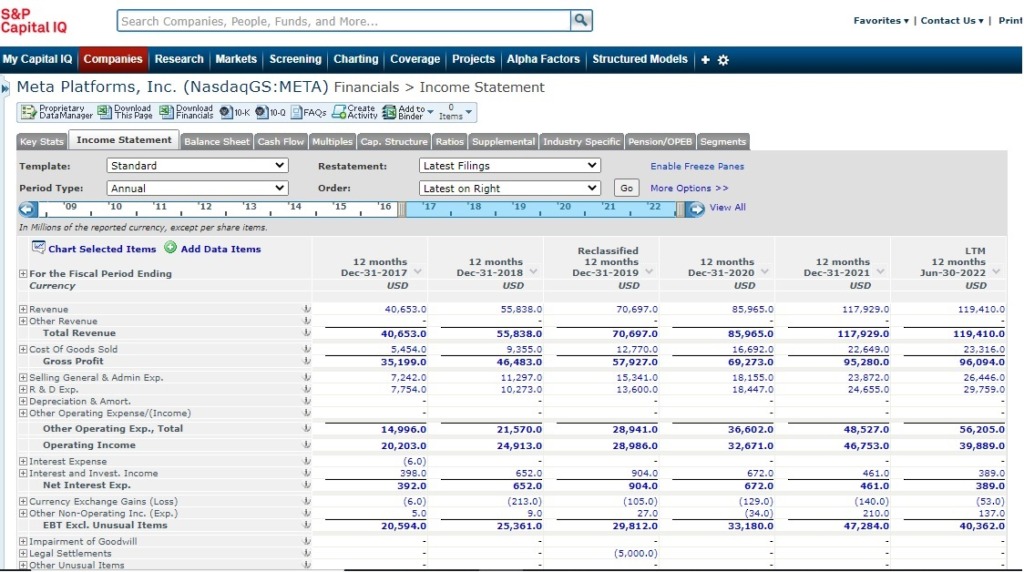
S&P Capital IQ (2022). Meta Platforms, Inc. annual income statement 2017 to 2022 [Financial Data]. Retrieved August 11, 2022, from S&P Capital IQ platform.
What about your in-text citations?
Where you make reference to these in your text, follow the normal ‘name and date’ conventions and simply follow any mention with (Bloomberg, 2017) or (S&P Capital IQ, 2022) or a variation thereon.
Any questions?
As always, if you have any questions about referencing, please contact the Library.
Please note: Cranfield supports two different referencing styles – APA7 (Author-date) and Numbered (NLM). Please make sure you use the style preferred by your supervisor or lecturer. The advice above relates only to the APA7 style. If you have any questions about referencing, please contact the Library.
Feature image from Pixabay. Available at: https://pixabay.com/photos/business-stock-finance-market-1730089/

Categories & Tags:
Leave a comment on this post:
You might also like…

Finding your reading materials
Use Library Search Library Search is the first place to start when you are trying to find academic sources for your work. This is the search box on the library website homepage. It allows you ...

Formula 1 was the dream and Cranfield was the conduit
I still remember the exact moment Formula 1 (F1) got its hooks into me. I was in my first year of an aerospace undergraduate engineering degree when I watched a video about the sport ...
Introducing Barrington Library
Welcome to all our new students! Barrington Library supports all the students and staff at Cranfield Defence and Security on the Shrivenham site. We are looking forward to meeting you all soon, in person or ...

About to start your journey at Cranfield? We’re here to help!
Congratulations on accepting your offer to study at Cranfield! If you’re keen to get a head start before your course begins, our Library Services team is here to support you every step of the way. ...

Bank holiday hours for Library Services: Monday 31 August
Library Services staff will be taking a break on Monday 31 August for the bank holiday. You will still be able to access all the resources and help you need via our library website. The 24/7 ...

The real cost of studying in the UK – what international students need to budget for
Moving overseas to pursue a postgraduate degree is one of the most exciting investments you can make in your future. It's also one of the most significant financial commitments you and your family will ...