


Introducing… the UK Data Service (UKDS)
06/03/2025

If you’re looking for a gateway to key economic and social data, then you might like to take a look at the UK Data Service (UKDS).
What’s included?
Offering a wide range of secondary data from a variety of sources, the UKDS includes:
- Large-scale UK Surveys: These include major government surveys that provide insights into various aspects of UK society, such as health, employment, and social attitudes.
- Cross-national Surveys: These surveys compare data across different countries, allowing for international comparisons on topics like education, health, and economic conditions.
- Longitudinal Studies: These studies track the same individuals over time, providing valuable data on how people’s lives and circumstances change.
- International Macrodata: This includes large datasets that cover economic and social indicators at the country level, useful for macroeconomic analysis and policy-making.
- Census Data: Detailed data from UK censuses, which provide comprehensive information about the population and its characteristics.
- Business Microdata: Data from businesses, including financial performance, innovation, and employment practices.
- Qualitative and Mixed Methods Data: These datasets include interviews, focus groups, and other qualitative research methods, often combined with quantitative data for a richer analysis
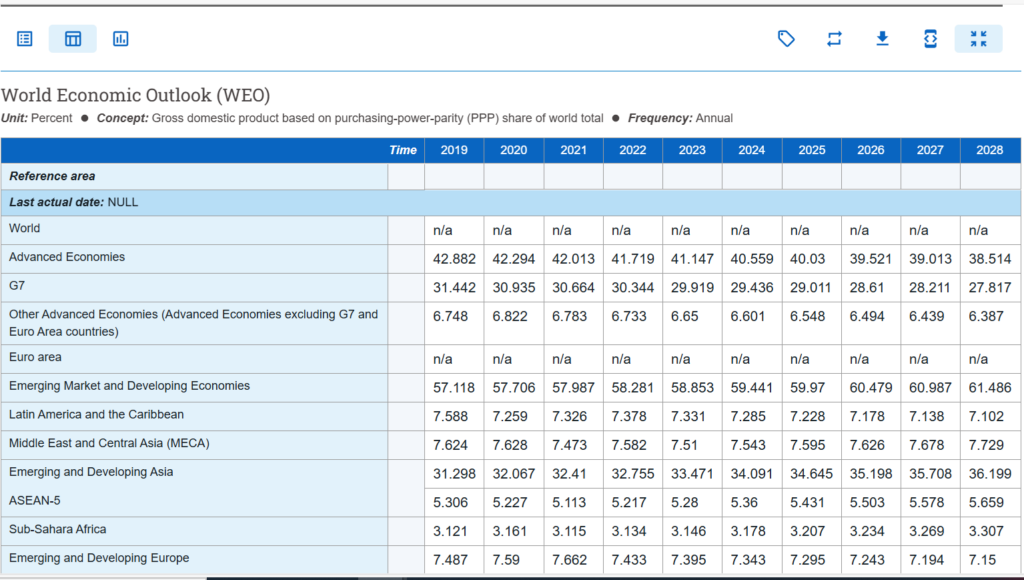
IMF World Economic Outlook 1980-2028
Not sure where to start?
Then take a look at some of the datasets our current and previous students have found useful. Most UKDS data tables can also be customised and exported into a variety of formats.
- IMF International Financial Statistics – Excellent source of international financial statistics for most countries. Includes time series data on exchange rates, balance of payments, interest rates, prices, international transactions, and much more.
- World Bank World Development Indicators – Look here for statistical data for over 600 development indicators (covering social, economic, financial, natural resources and environmental indicators) for over 200 countries and 18 country groups.
- OECD Main Economic Indicators – Provides annual, quarterly and monthly data for a range of short-term economic indicators for OECD member countries and some non-member countries.
- IMF Direction of Trade Statistics – Useful database for looking at the value of exports and imports between countries and all their trading partners.
How do I search the UKDS?
- Use the Search Bar: Efficiently find datasets by using keywords in the main search bar on the landing page. Or click on ‘Find data’ in the menu bar at the top of the page for a video guide to searching the data catalogue.
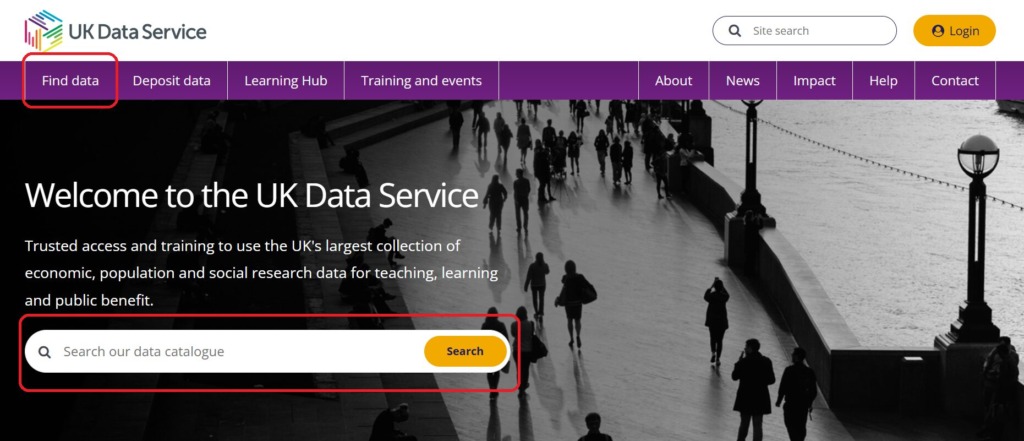
- Find Data: also under this menu choice, you can browse and access key data by themes, data types and teaching datasets.
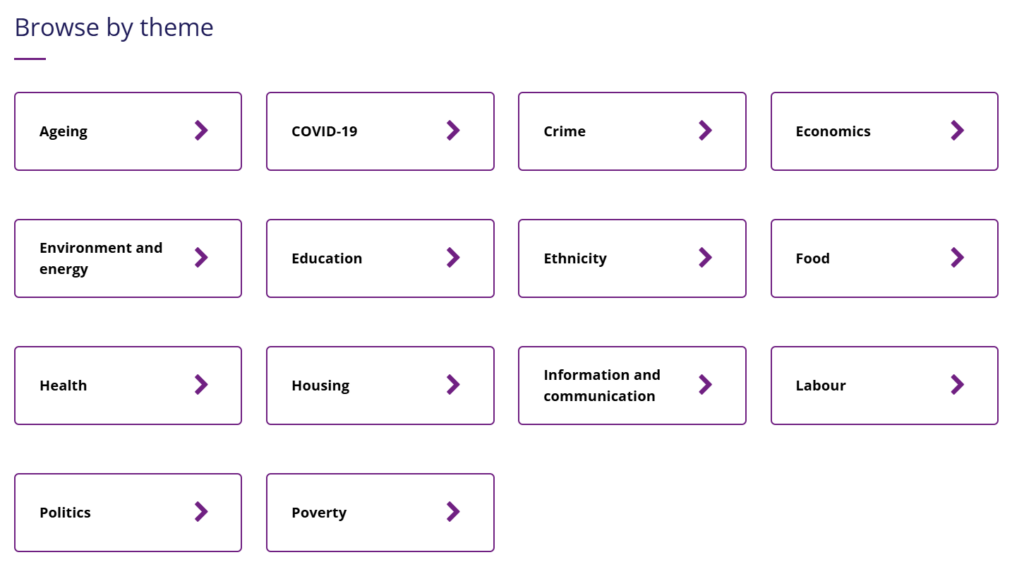
- Explore Data Types: Familiarise yourself with different data types (e.g., surveys, census data) to find what best suits your research.
- Check Documentation: Always read the dataset documentation for details on methodology and variables.
- Utilise Support: Take advantage of UKDS support services, including helpdesks and training sessions. You can check these out in the UKDS Learning Hub
- Start with Tutorials: UKDS offers great online tutorials and webinars to help you get started so you might want to begin with these. They have a range of training videos on their YouTube site.
You might need to register with the UK Data Service (UKDS) depending on the type of data you want to access:
- Open Data: No registration required. These datasets are freely available.
- Safeguarded Data: Registration is required. You’ll need to accept the End User Licence.
- Controlled Data: Registration and additional requirements are necessary. Access is granted through the UKDS SecureLab
If you have any further questions about UKDS, then please get in touch with us.
Public domain image by Pixabay https://pixabay.com/en/shopping-business-retail-1165437/, CC0

Categories & Tags:
Leave a comment on this post:
You might also like…

Keen to develop your study skills?
Alongside the technical skills and academic knowledge that you will gain on your course, as a Cranfield student you have the opportunity to develop a range of other skills that can enhance your learning experience. ...

The V-conomy: powering the sixth wave of global economic growth
The world could be on the verge of a major surge in economic growth and development, driven by the convergence of AI and clean energy technology. Waiting to ride the K-wave The Russian ...

Need help using the Python programming language?
We know some of our students are currently trying to learn Python, so we wanted to make you aware of some great LinkedIn Learning videos that can help. But don't you have to pay for ...

What does it really take to become a Chevening Scholar?
Say “Turkmenistan” to most people and you’ll get a blank look. That was true when I left Ashgabat for the UK to study an MSc in Logistics and Supply Chain Management at Cranfield University ...

Get a head start on referencing and plagiarism
We offer a module on Referencing And Avoiding Plagiarism which you can find on your Canvas dashboard. It explains the role and importance of citing references and how to incorporate the work of other authors ...

How Cranfield shaped my journey as an Aerospace Engineer
If I'm being specific about the moment it clicked, it was reading a paper called "On the Role and Challenges of Computational Fluid Dynamics (CFD) in the Aerospace Industry" by two Boeing engineers, P. ...