


Water and sanitation – why community is so important
25/02/2016
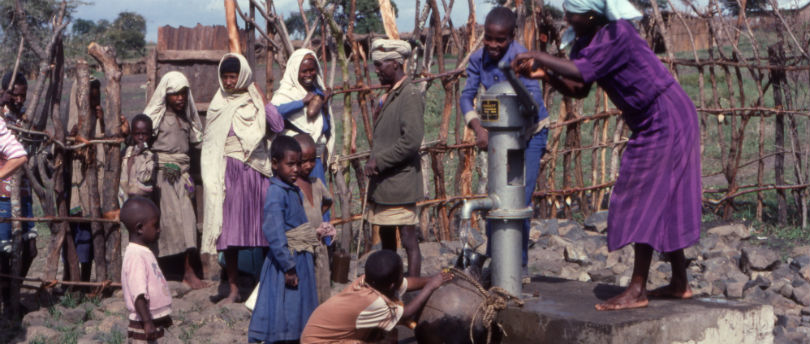
Today we attended Buckingham Palace to pick up a Queen’s Anniversary Prize for our research into water and sanitation. It is a real privilege to be recognised in this way, but what is most rewarding is knowing that our research is helping to change the lives of the most impoverished people in the world. Through our work with partners, NGOs, governments and more, water and sanitation researchers at Cranfield have already helped hundreds of thousands of people get access to clean and safe water supplies and sanitation facilities.
Water and sanitation challenges
With over 2.5bn people still without access to sanitation, the work is as important as ever. Children and adults are still dying needlessly because they can only access dirty water. But with this happening in different countries, climates and cultures, the issues are incredibly varied. In dense urban settlements, the challenge is where to site sanitation solutions in a space with no room to install conventional plumbing. For those living in rural areas like farmers in Africa, the challenge is how to maintain and service their supply in a cost-effective way.
More than a tap
Science and engineering developments have the potential to produce some truly innovative solutions that can overcome water and sanitation challenges. But I have worked in India and Africa, and what became abundantly clear to me is how important – vital, in fact – the community is in implementing solutions. Just as in the old proverb, if you give a man a fish he will eat that day, but if you give him a net and teach him how to fish, he will eat for a lifetime. Give a man a tap and he will have access to water until the tap breaks, the pipeline corrodes, and the pump bringing the water from the ground fails…
The work my colleagues and I are doing is very much about delivering the most appropriate technical solutions to social problems. But the social aspect is as important as the technical aspect to deliver a solution that actually works for the people we are trying to help. This is why we call our MSc programme an MSc in Community Water and Sanitation – community needs to be at its heart.
Talking and doing
And, we are not only talking about these issues, we are doing them. Most students on our MSc course do field work and this year, the students I am currently teaching will travel to countries like Ghana, Madagascar or India to work with organisations like WaterAid, IRC and Water and Sanitation for the Urban Poor. I feel strongly that our students should leave with more than just their Master’s – they should also truly appreciate that technical solutions are only part of what needs to be done.

Categories & Tags:
Leave a comment on this post:
Comments are closed.
You might also like…

Keen to develop your study skills?
Alongside the technical skills and academic knowledge that you will gain on your course, as a Cranfield student you have the opportunity to develop a range of other skills that can enhance your learning experience. ...

The V-conomy: powering the sixth wave of global economic growth
The world could be on the verge of a major surge in economic growth and development, driven by the convergence of AI and clean energy technology. Waiting to ride the K-wave The Russian ...

Need help using the Python programming language?
We know some of our students are currently trying to learn Python, so we wanted to make you aware of some great LinkedIn Learning videos that can help. But don't you have to pay for ...
What does it really take to become a Chevening Scholar?
Say “Turkmenistan” to most people and you’ll get a blank look. That was true when I left Ashgabat for the UK to study an MSc in Logistics and Supply Chain Management at Cranfield University ...

Get a head start on referencing and plagiarism
We offer a module on Referencing And Avoiding Plagiarism which you can find on your Canvas dashboard. It explains the role and importance of citing references and how to incorporate the work of other authors ...
How Cranfield shaped my journey as an Aerospace Engineer
If I'm being specific about the moment it clicked, it was reading a paper called "On the Role and Challenges of Computational Fluid Dynamics (CFD) in the Aerospace Industry" by two Boeing engineers, P. ...
So instead of carrying that water that last mile (or more) why not work with us to provide rotary water barrels into communities that make the differecne immediately? http://www.rotb.co.uk
Happy to discuss ways of working with you Adrian! Can you get in touch with me at a.parker@cranfield.ac.uk ?