


How drones will change our cities
04/10/2016
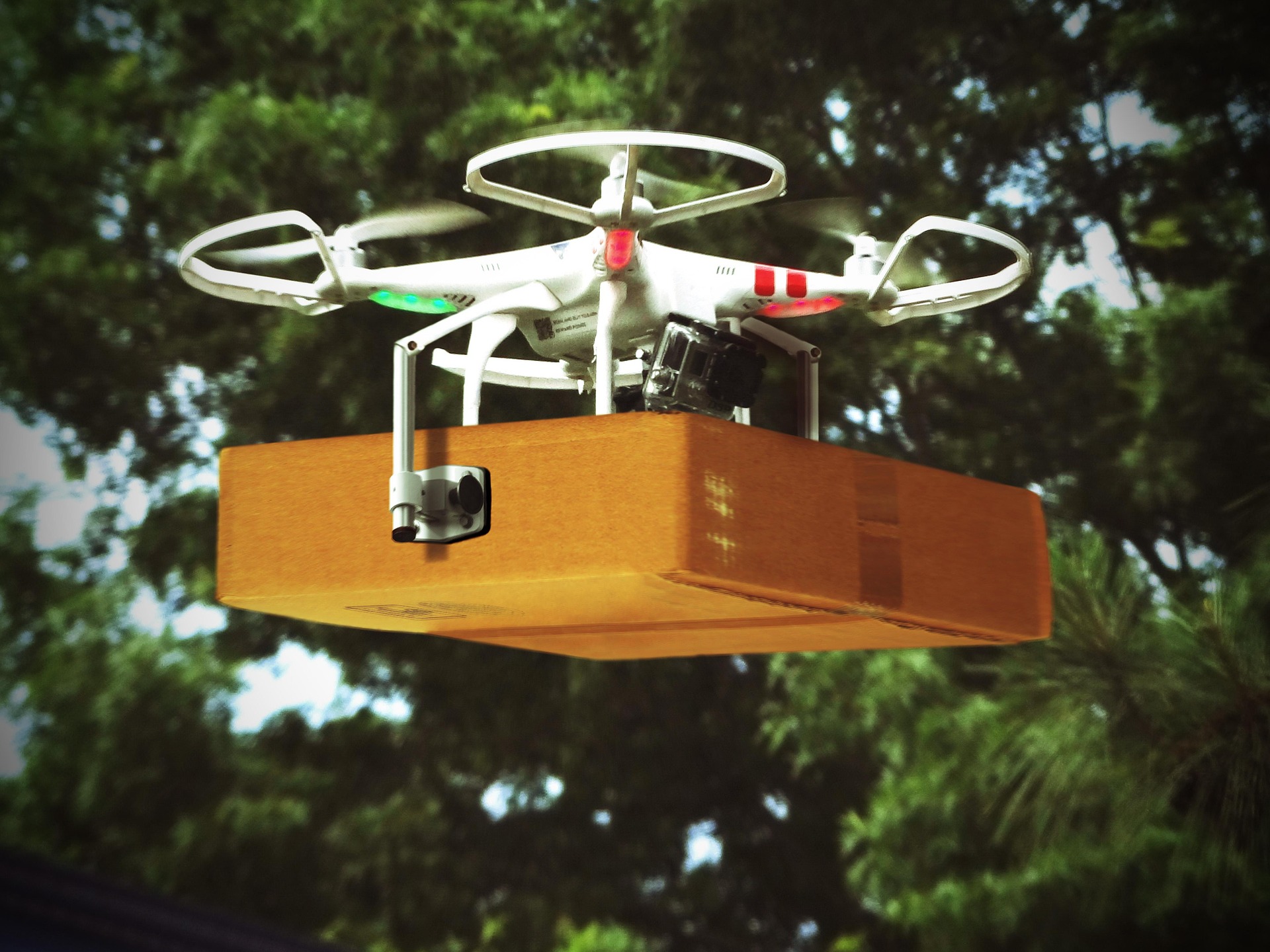
Amazon’s promise of a 30 minute drone delivery service might look like click-bait PR – but it’s one early sign of significant changes coming in how our everyday world works. For the moment, all the language around drones and the Prime Air service itself is full of caveats. Safety is always the first priority and no-one knows the full extent of what’s possible and how new services can weave their way through airspace and other regulations. Prime Air is likely to take four to five years to become a mainstream service, a common enough sight not to be just a novelty or a threat. But in the meantime there’s going to be a tidal wave of changes in technology and attitudes.
Autonomous aerial vehicles are similar to the first motorised cars, starting out as a toy, and a sometimes hazardous toy at that, before becoming the norm and the basis of a new way of living and working. There’s not the scope for the same scale of transformation from UAVs but changes will be many and far-reaching, and there will be opportunities in jobs, business and for all of us in our daily lives.
Beyond delivery services, applications are already being worked out for monitoring structures like wind turbines, keeping a check on the environment – riverbank and coastal erosion, water levels and threats from flooding – in agriculture for monitoring crop growth and spotting any problems, for accident investigation, security and military uses. All of these rely on highly-skilled UAV pilots, people capable of operating groups of UAVs at any one time. There’ll be all the opportunities for associated businesses and services growing around UAV provision, the development and management of vehicle, communications and safety technologies (meeting the need for ultra-reliable and more sophisticated tech such as ‘first person’ vision goggles to control UAVs at a distance), as well as maintenance and systems for testing and licensing of pilots. Some roles and systems have the potential be replaced: traffic wardens, speed cameras, some forms of policing. The UAV infrastructure – locally, nationally, internationally – also has real potential for transforming operations for overseas aid and development, enabling a greater understanding of changing situations and needs, and pinpointing the delivery of support and supplies. Linked to pilot training will be the need for formal, accredited education and skills in UAV services management. Being able to handle a UAV will become a useful life skill for people generally.
Our physical environment will be adapted. The pressure on airspace will lead to a push towards decluttering and removing any unnecessary ‘sky furniture’, telecommunications wires, electricity lines, advertising hoardings, and ways to re-position or make obstacles like street lighting and transmitter masts more easily navigable. Networks of UAV landing pads, re-charging hubs and virtual air traffic control stations will be created across the country in both urban and rural areas. ‘UAV-ready’ features will become a standard part of homes – a new selling point for property with the space to offer straightforward UAV access. While the digital revolution has made it more practical to live and work in remote areas, UAV services will provide the physical link and make rural living viable and attractive for more people. In urban areas, residents living in flats, for example, will need to rely on more communal arrangements. Just as the motor engine led very quickly to motor sports, the availability of new tech and new skills will lead to competition. Drone racing is already gaining interest in the US and the future landscape will include UAV racing courses, with local racers but also participants and audiences who could be anywhere in the world.
We need high-profile trailblazers like Prime Air for the technology to realise its potential. The hard work, though, is going to be behind the scenes, creating the safety mechanisms for each stage of UAV use, and piece by piece, putting in place the legislation that gets the balance right between control and allowing the tech the chance to grow and demonstrate its ability to solve some basic problems of modern life.

Categories & Tags:
Leave a comment on this post:
You might also like…

Keen to develop your study skills?
Alongside the technical skills and academic knowledge that you will gain on your course, as a Cranfield student you have the opportunity to develop a range of other skills that can enhance your learning experience. ...
The V-conomy: powering the sixth wave of global economic growth
The world could be on the verge of a major surge in economic growth and development, driven by the convergence of AI and clean energy technology. Waiting to ride the K-wave The Russian ...
Need help using the Python programming language?
We know some of our students are currently trying to learn Python, so we wanted to make you aware of some great LinkedIn Learning videos that can help. But don't you have to pay for ...

What does it really take to become a Chevening Scholar?
Say “Turkmenistan” to most people and you’ll get a blank look. That was true when I left Ashgabat for the UK to study an MSc in Logistics and Supply Chain Management at Cranfield University ...

Get a head start on referencing and plagiarism
We offer a module on Referencing And Avoiding Plagiarism which you can find on your Canvas dashboard. It explains the role and importance of citing references and how to incorporate the work of other authors ...
How Cranfield shaped my journey as an Aerospace Engineer
If I'm being specific about the moment it clicked, it was reading a paper called "On the Role and Challenges of Computational Fluid Dynamics (CFD) in the Aerospace Industry" by two Boeing engineers, P. ...