

My sortie with ‘aviation’s best kept secret’ at Farnborough 2018
20/07/2018
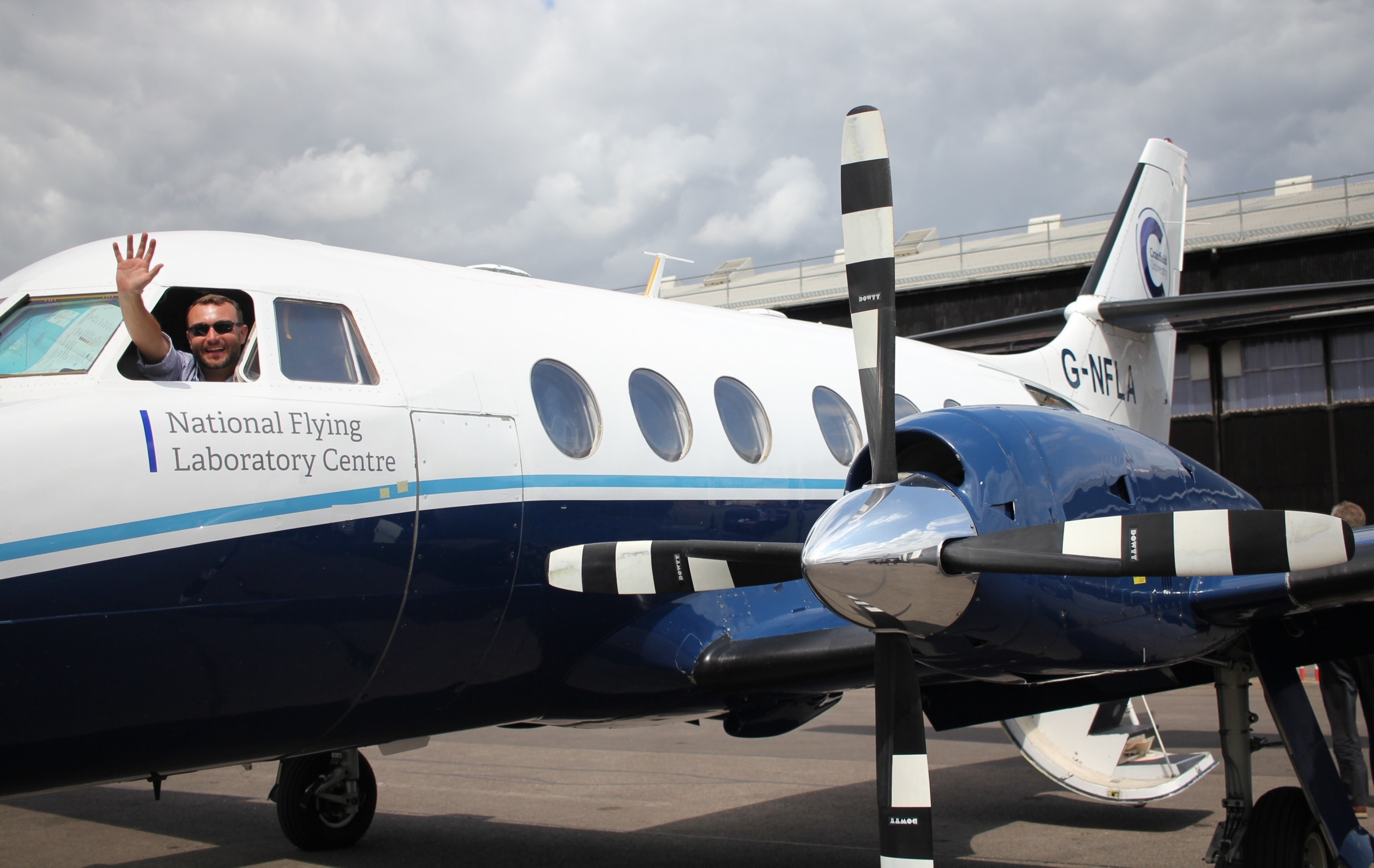
It’s not every day that you get to go for a ride in a plane used to train flight test engineers.
“We’re the best kept secret in aviation,” Joe Brown, Senior Management Pilot at the National Flying Laboratory Centre (NFLC), tells me as we sit in a temporary hut airside at Farnborough waiting for our flight.
The NFLC operate Cranfield University’s fleet of aircraft and are at Farnborough International Airshow 2018 to raise their profile with industry and illustrate the range of research services they can offer.
“We’re a viable alternative to flight test and research work using simulators, wind tunnels, or other planes,” says Joe. “Once jet aircraft become involved, the price tends to go up phenomenally.”
More than 1,500 aeronautical students from over 25 universities around the world fly in the NFLC’s Jetstream 31 each year as part of their degree courses.
The fully instrumented aircraft can supply students with real-time data about a range of performance parameters, allowing them to become flight test engineers during their flight.
After a briefing on the experiments that we’ll be doing on the flight and my role as a task specialist (the NFLC don’t take ‘passengers’) I’m allowed to sit right at the front of the cabin and have a fly-on-the-wall view of what the pilots are doing.
With pre-flight checks complete and clearance for take off from the tower, Joe cranks up the Jetstream’s two turboprop engines and we race down the Farnborough runway and climb swiftly up to 5,000 feet.
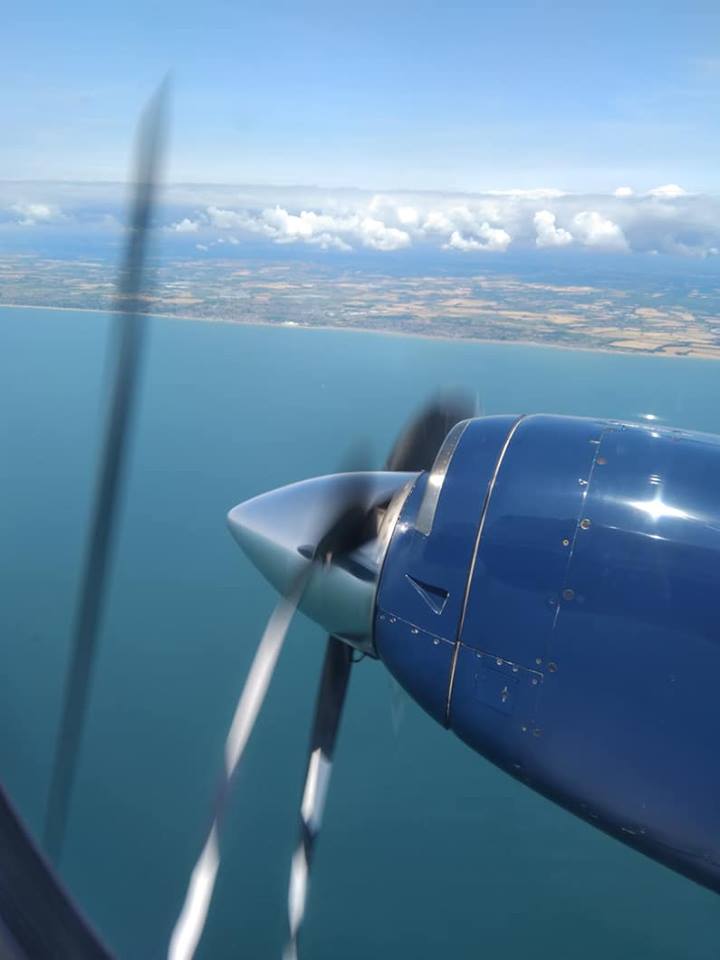
We cruise down to the south coast and head out into the Channel over Portsmouth and the Isle of Wight in around 10 minutes. It’s a clear sunny summer’s day and the views are spectacular.
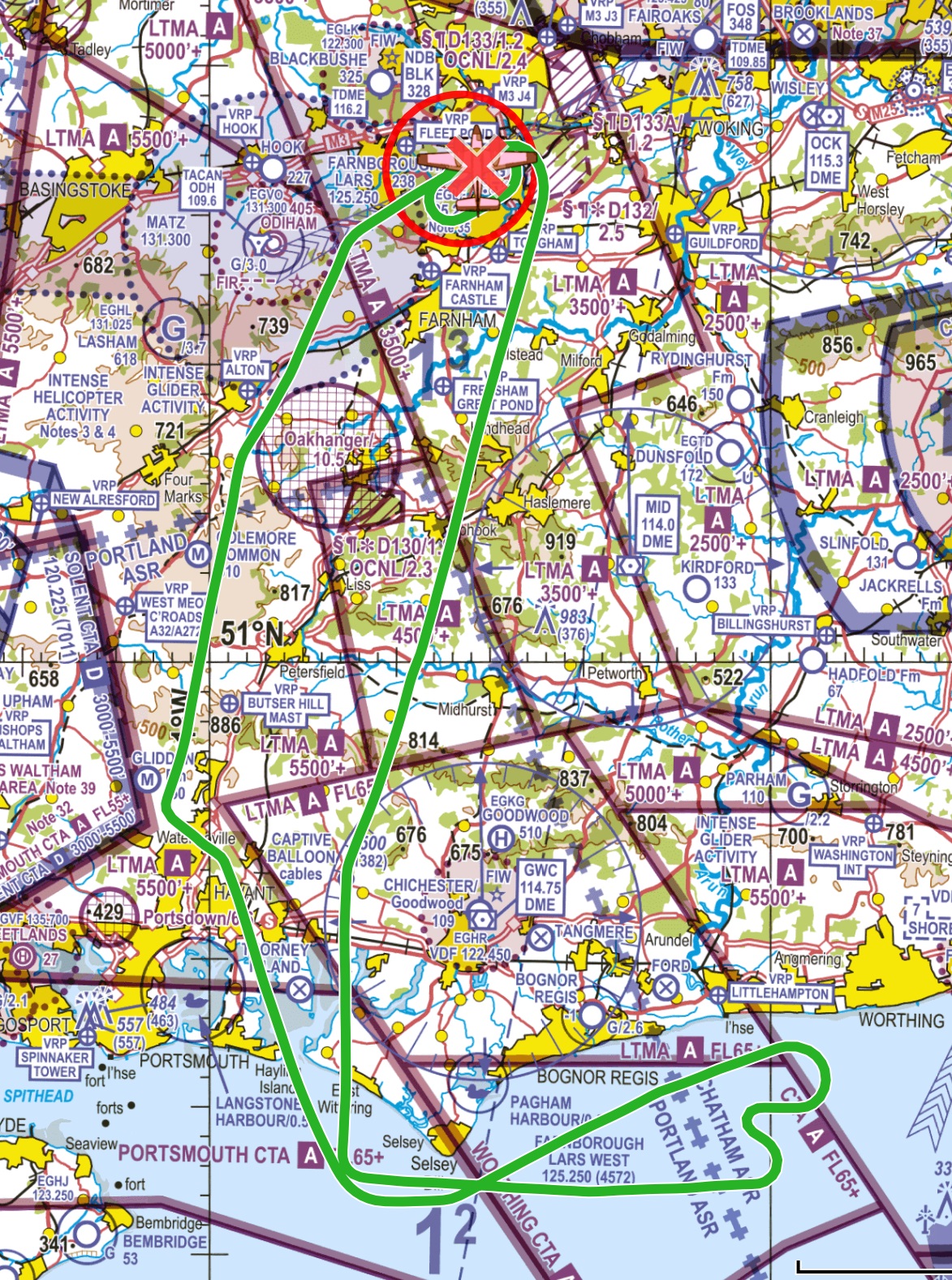
Our route down to the south coast and back to Farnborough
We don’t have long to enjoy the scenery as it’s quickly into a demonstration of the various lift, drag and pressure tests that the NFLC take students through in order for them to gain the necessary flight experience to complete their courses with the Royal Aeronautical Society.
Joe puts the plane through a series of manoeuvres and data from the aircraft’s instruments is displayed on screens around the cabin so students are able to see immediately how changes in flight controls affect performance.
A few sick bags can be heard ruffling at the back of the cabin after the Dutch roll, where the aircraft banks and yaws sharply from side to side to experiment with stability.
In a test to demonstrate changes in G-force, Joe rolls the plane to 45 degrees and puts it into a turn. You get to experience around 1.5G, which doesn’t sound like a lot, but certainly gives a strange sensation which I have never felt before. Commercial flights don’t usually exceed 1.2G, even when banking in a holding pattern, and I can’t imagine what it feels like for fast jet pilots who can pull up to 9G.

Coming back into Farnborough, Joe takes us for a low pass straight down the flight line over the runway, giving us a sense of what it must be like for the pilots who display to the thousands of visitors at the show.
He then puts the Jetstream into a tight turn and steep descent, and within seconds we’re back down on the tarmac.
Everyone on the flight is exhilarated and it’s great to have experienced the work that the NFLC does, which also has other light aircraft used to give students hands-on flying experience.
“We’ll have to get you up in the two-seater Bulldog and do some aerobatics,” Joe says with a smile after we have landed.
Read more about the NFLC here.

Categories & Tags:
Leave a comment on this post:
You might also like…

Keen to develop your study skills?
Alongside the technical skills and academic knowledge that you will gain on your course, as a Cranfield student you have the opportunity to develop a range of other skills that can enhance your learning experience. ...

The V-conomy: powering the sixth wave of global economic growth
The world could be on the verge of a major surge in economic growth and development, driven by the convergence of AI and clean energy technology. Waiting to ride the K-wave The Russian ...

Need help using the Python programming language?
We know some of our students are currently trying to learn Python, so we wanted to make you aware of some great LinkedIn Learning videos that can help. But don't you have to pay for ...

What does it really take to become a Chevening Scholar?
Say “Turkmenistan” to most people and you’ll get a blank look. That was true when I left Ashgabat for the UK to study an MSc in Logistics and Supply Chain Management at Cranfield University ...

Get a head start on referencing and plagiarism
We offer a module on Referencing And Avoiding Plagiarism which you can find on your Canvas dashboard. It explains the role and importance of citing references and how to incorporate the work of other authors ...
How Cranfield shaped my journey as an Aerospace Engineer
If I'm being specific about the moment it clicked, it was reading a paper called "On the Role and Challenges of Computational Fluid Dynamics (CFD) in the Aerospace Industry" by two Boeing engineers, P. ...