


Cranfield’s New products – Polymers for Pharmaceuticals
05/10/2021
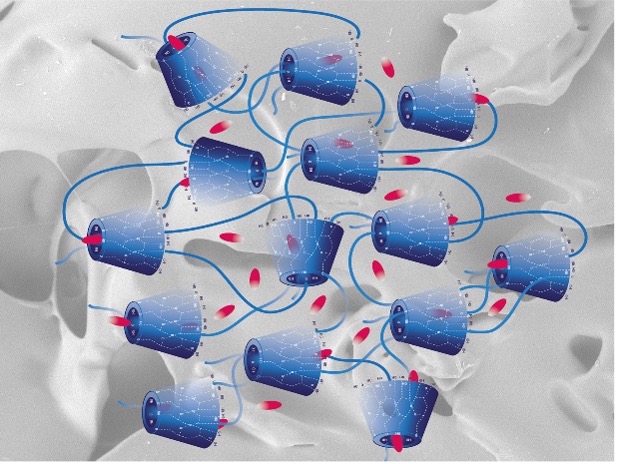
Figure 1 – Schematic representation of cross-linked β-cyclodextrin and entrapped molecules. SEM image of the amorphous polymer as background (15.0kVx50 BSE-3D 60Pa, 1 mm). Image by C. Pratchett, Cranfield University.
Polymers are very important constituents for therapeutic applications as well as the largest and versatile class of biomaterials [1,2]. Synthetic polymers can be designed and synthesised to have a broad variety of structures and appropriate physical and chemical properties; they are used in a wide range of biomedical applications as diverse as tissue engineering, drug delivery, therapeutics, diagnostics, and other applications.
Since the last century, methods of polymer synthesis, processing, and characterisation have been developing rapidly, which bring both challenges and opportunities to design novel polymeric biomaterials and to understand the biological interactions between biological systems and polymeric materials [3].
Polymers possess significant potential since their chemical flexibility gives rise to materials with diverse physical and mechanical property diversity. Degradable polymers are of utmost interest since these biomaterials are able to be broken down and excreted or resorbed without removal or surgical revision [4].
Special attention is paid by scientists and engineers on polymers that occur in nature and can be extracted and modified. Polysaccharides are used as biomaterials and become much more common as new biological functions are identified for these materials. They are natural polymers composed of monosaccharide units joined together by glycosidic linkages. Furthermore, the array of materials that can be investigated has increased due to new synthetic routes that have been developed for modifying polysaccharides. Their biodegradability, processability, and bioactivity make polysaccharides a very promising natural biomaterials [4,5].
Cyclodextrins (CDs), a family of cyclic polysacchararides produced from starch by enzymatic conversion have been widely investigated as a drug delivery vehicle due to their ability to envelop guest molecules [6]. The three best-known CDs are α-cyclodextrin (αCD), β-cyclodextrin (βCD), and γ-cyclodextrin (γCD), which are toroidal macrocycles of six, seven and eight glucopyranose units, respectively. CDs have been chemically modified to adjust their solubility, bioavailability and inclusion complex stability. There is great interest in these compounds, reflecting their ability to form supramolecular structures with exploitable guest-host interactions [6].
Semi-synthetic polymeric systems based on cyclodextrins are manufactured for the first time at Cranfield University in the UK [7-11] from renewable resources and by “green chemistry” processes. The Green Chemistry concept applies throughout the entire life cycle of a chemical product, from its design and manufacturing to its use and final disposal [12] and relates to the chemicals, process and products.
The properties of crystalline β-cyclodextrin have been modified by cross-linking in water with a family of non-toxic diepoxides having variable length of polyethylene glycol spacers. Two different polymeric systems with large hydrodynamic volume were obtained:
- Soluble cross-linked polymers;
- Hydrogels [13,14].
The reaction parameters were tuned to obtain water and alcohol soluble products, which are malleable and suitable for processing and can also be easily further modified by subsequent substitution reactions. The thermal and thermo-mechanical properties of the cross-linked products are directly dependent on the content and length of the polyethylene spacer. The glass transition temperature (Tg) as low as -30 °C, which extends the operative range at which the cross-linked cyclodextrins can be processed as soft polymers. The cross-linked material with the longer polyethylene spacer and its nitrated analogue can restore their integrity by self-healing. The high hydrodynamic volume of this polymer in solution enhances the solubilisation and complexation of small molecules such as curcumin [15]. Further cross-linking reaction in the oven produced insoluble network structures with good physical integrity and important swelling power up to 200%.
The new polymeric cyclodextrin-based systems developed through green chemistry are promising passive and/or active ingredients for a variety of biomedical applications, just to mention some:
- Drug delivery systems
- Heart diseases
- Vaccine adjuvants
- Toxin’s absorption
- Coatings.
References
- E. Mathiowitz, Encyclopedia of Controlled Drug Delivery (2-Volume Set), E. Mathiowitz ed. 1999, ISBN: 0-471-14828-8.
- M.F Maitz, Biosurface and Biotribology 2015, 1, 161, https://doi.org/10.1016/j.bsbt.2015.08.002.
- R. Blagoeva, A. Nedev, Bioautomation 2006, 4, 80. ISSN 1312–451X.
- B. D. Ulery, L. S. Nair,C. T. Laurencin, J Polym Sci B Polym Phys. 2011, 49, 832. DOI: 10.1002/polb.22259.
- J. Kost, Encyclopedia of Controlled Drug Delivery (2-Volume Set), E. Mathiowitz ed. 1999, p. 445. ISBN: 0-471-14828-8.
- C. Palomino-Durand, M. Lopez, F. Cazaux, B. Martel, N. Blanchemain, F. Chai, Polymers (Basel, Switzerland) 2019, 11. DOI:10.3390/polym11020214.
- F. Luppi, H. Cavaye, E. Dossi, Propellants, Explosives, Pyrotechnics 2018, 43, 1023. https://doi.org/10.1002/prep.201800137.
- F. Luppi, G. Kister, M. Carpenter, E. Dossi, Polymer Testing 2019, 73, 338. https://doi.org/10.1016/j.polymertesting.2018.11.034.
- F. Luppi, N. Mai, G. Kister, P.P. Gill, S.E. Gaulter, C. Stennett, E. Dossi, Chemistry A European Journal 2019, Early view. https://doi.org/10.1002/chem.201903945.
- E. Dossi, G. Kister, M.E. Bolton, Oral contribution at 6th European Conference on Cyclodextrins 2019, Santiago de Compostella, 2-4 October.
- E. Dossi, M.E. Bolton, G. Kister, A. Afsar, 2021, Accepted for publishing (July 2021) in ChemistrySelect.
- United States Environmental Protection Agency. Basics of green chemistry 2017. Available at: https://www.epa.gov/greenchemistry/basics-green-chemistry (Accessed: 6 June 2020)
- A. M. Lowman, N. A. Peppas, “Encyclopedia of Controlled Drug Delivery” (2-Volume Set) E. Mathiowitz ed. 1999, p 397. ISBN: 0-471-14828-8.
- N. A. Peppas, J. Zach Hilt, A. Khademhosseini, Robert Langer, Adv. Mater. 2006, 18, 1345. Doi: 10.1002/adma.200501612.
- Á. Haimhoffer, E. Dossi, V. Fejes, J. Váradi, G. Vasvári, I. Bácskay, F. Fenyvesi, 2021, in preparation for submission in Pharmaceutics.

Categories & Tags:
Leave a comment on this post:
You might also like…
Library services over Easter, 3-6 April
Kings Norton Library will remain open for study 24/7. You will need your University ID card to enter the building and can use the self-service machines to borrow and return items as usual. Barrington Library ...

How do I access the full-text of Harvard Business Review (HBR)?
This is a frequently asked question, and it's worth knowing how to access this key management journal. So, how do you access HBR in full-text? The short answer is via our eJournals finder. You can find ...

Engineering problem to solve? Let Knovel help you find a solution
Did you know that Knovel provides you with more than just eBooks? Knovel is a key database for many engineering, mechanical and materials courses here at Cranfield University, and contains content from an extensive range ...
What happens when female scholars meet influential leaders?
On the 5 March 2026, our British Council Women in STEM Scholars had the privilege of sitting down with two excellent role models of industry and academia: Professor Dame Karen Holford, ...

From MSc to CEO: Igniting a research revolution
For many, a master’s degree is achieving a big milestone. Kilyan Ocampo, Computational Fluid Dynamics alumni shares how studying at Cranfield helped launch his career in the energy sector. Today, Kilyan ...
Commuting, collaborating and growing: My first term experience at Cranfield
My first term at Cranfield University has been an extremely positive and rewarding experience. While the course has been intense at times, it has pushed me in the best possible way and allowed me ...