


From theory to leading the way: Simrat Singh’s robotics journey
14/11/2025
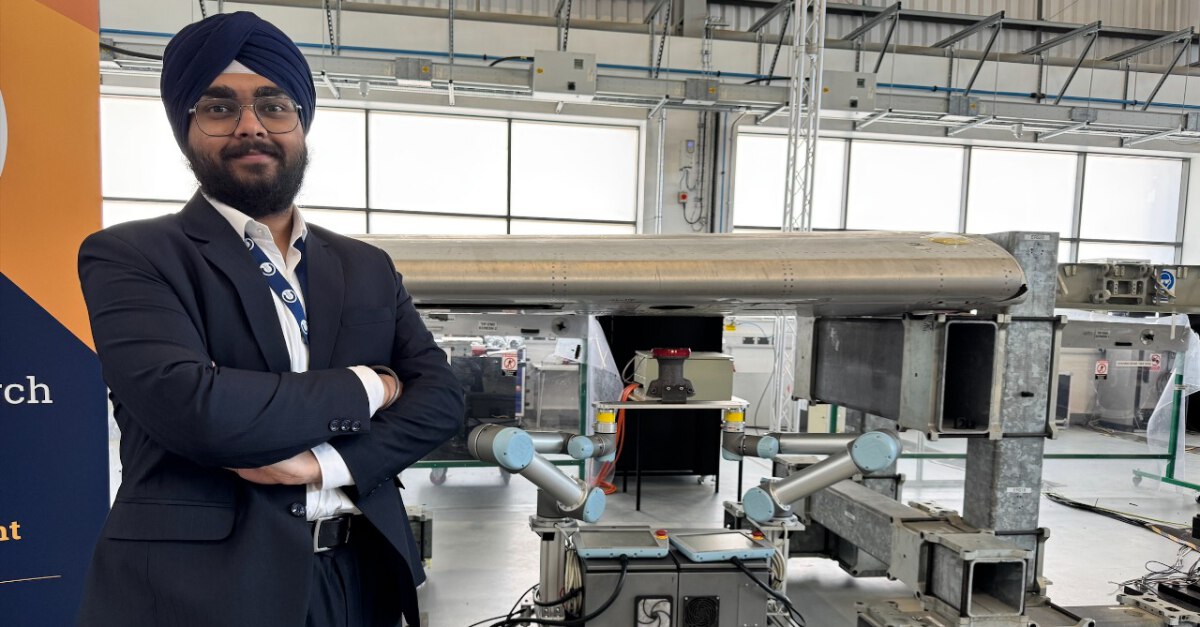
Simrat Singh, an Indian national, came to the UK to pursue an MSc in Robotics at Cranfield University. Now, he’s a Lead Robotics and AI Engineer at Swift Robotics, applying everything he learnt. We caught up with him to talk about his transformative experience, the power of hands-on learning and his ambitions to define the future of human-robot collaboration.
Why Cranfield? Beyond the classroom
For Simrat, the choice to study at Cranfield wasn’t just about the name; it was about the applied experience. “I chose Cranfield because of its strong reputation for industry-focused research and its close collaboration with leading technology and robotics companies. The hands-on learning, including labs and real-world projects, was a major draw.”
Specifically, the MSc in Robotics was the perfect fit. “I wanted a course that goes beyond just programming robots, focusing instead on designing intelligent systems that can collaborate safely and effectively with humans,” Simrat explains. The curriculum’s balance, which included no exams and a focus on assignments and projects, perfectly aligned with his desire for practical application and deep understanding.
Real-world experience: The Cranfield difference
Simrat found the course to be highly engaging, balancing essential theory (kinematics, autonomy, AI) with extensive practical work. A key highlight was the emphasis on real-world problem-solving and collaboration.
“The industrial group project gave me a great insight into the industry and the freedom to choose my thesis project helped me implement those insights later.”
This practical focus immediately translated into his career. “The course prepared me for the real world by giving me direct exposure to industrial practices from the very beginning. In the first week itself, we were interacting with and coding real industrial robots.” he recalls. “This, combined with guest lectures from industry leaders like Airbus, provided the confidence and skills to excel in an industrial environment.”
Simrat’s career ambitions were significantly influenced by Cranfield’s focus on smart technology. “This perspective has motivated me to pursue a career in developing human-centred robotic systems that combine automation with adaptability and learning.” he says. That motivation now sees him leading a team in the exciting field of Human-Robot Interaction.
Life as a Robotics Engineer
Simrat is currently the Lead Robotics and AI Engineer at Swift Robotics. “It’s a very exciting role where I’m responsible for developing and integrating intelligent robotic systems.” he says. The role is fast-paced, innovation-driven, and demands constant learning -a perfect extension of his studies.
Looking ahead: Innovation and entrepreneurship
Simrat’s journey is far from over. His future aspirations include pursuing a PhD in Robotics and Artificial Intelligence, specifically to deepen his research into human-robot collaboration. Alongside this, he plans to launch his own robotics start-up. “My long-term vision is to bridge the gap between academic research and commercial innovation, turning advanced robotics ideas into practical technologies that improve people’s lives.” he states.
His advice to future students in smart technology is simple yet crucial: “Don’t rush through the learning process.” He encourages students to master the fundamentals, make full use of the world-class labs, and not hesitate to explore personal projects. “Taking initiative and being curious are what really help you grow in this field.”

Categories & Tags:
Leave a comment on this post:
You might also like…

How do I access the full-text of Harvard Business Review (HBR)?
This is a frequently asked question, and it's worth knowing how to access this key management journal. So, how do you access HBR in full-text? The short answer is via our eJournals finder. You can find ...
Engineering problem to solve? Let Knovel help you find a solution
Did you know that Knovel provides you with more than just eBooks? Knovel is a key database for many engineering, mechanical and materials courses here at Cranfield University, and contains content from an extensive range ...
What happens when female scholars meet influential leaders?
On the 5 March 2026, our British Council Women in STEM Scholars had the privilege of sitting down with two excellent role models of industry and academia: Professor Dame Karen Holford, ...
From MSc to CEO: Igniting a research revolution
For many, a master’s degree is achieving a big milestone. Kilyan Ocampo, Computational Fluid Dynamics alumni shares how studying at Cranfield helped launch his career in the energy sector. Today, Kilyan ...
Commuting, collaborating and growing: My first term experience at Cranfield
My first term at Cranfield University has been an extremely positive and rewarding experience. While the course has been intense at times, it has pushed me in the best possible way and allowed me ...

Sourcing country analysis – a guide to Library sources
For those researching a country, you will find that country information tends to take two forms: Analysis - country reports are descriptive reports covering most areas of interest on a country. They contain an analysis ...
Comments are closed.