


Want to know more about research methods?
19/05/2025

Research methods are the strategies and tools used to gather, analyse and interpret data or evidence to uncover new information or create better understanding of a topic.
Research methodology is the theory, justification and assumptions behind the selection and use of research methods.
When we talk about research methods we mean:
- using techniques and procedures as part of a research process to study and solve a problem
- including the creation of a hypothesis or research question
- using qualitative, quantitative or mixed methods to gather data
- analysing the data we collect
- making conclusions based on collective facts
- communicating and disseminating our research to others.
We have many resources providing guidance and support for these processes and we have summarised some of them for you in this post.
1. Research ethics and integrity
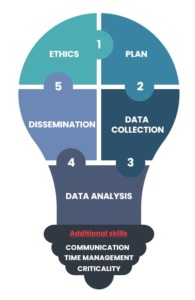
Maintaining high quality and robust practice across the whole research process, including gaining ethical approval.
2. Planning and preparation
Defining a research question, critical review, planning and conducting your literature review, assessing the impact of your research, research design.
3. Data collection and management
Data collection methods, data visualisation, open research and reproducibility, data management and storage considerations and security.
4. Data analysis
Qualitative/quantitative methods, data analysing and presenting your data, data analysis tools, as well as survey design considerations.
5. Communicating and dissemination
Writing your thesis, structuring the argument, presenting your research, and general thesis guidance.
Want to know more? More details on research methods can be found in the Research methods section on our Study Skills Hub.

Categories & Tags:
Leave a comment on this post:
You might also like…

How do I access the full-text of Harvard Business Review (HBR)?
This is a frequently asked question, and it's worth knowing how to access this key management journal. So, how do you access HBR in full-text? The short answer is via our eJournals finder. You can find ...

Engineering problem to solve? Let Knovel help you find a solution
Did you know that Knovel provides you with more than just eBooks? Knovel is a key database for many engineering, mechanical and materials courses here at Cranfield University, and contains content from an extensive range ...
What happens when female scholars meet influential leaders?
On the 5 March 2026, our British Council Women in STEM Scholars had the privilege of sitting down with two excellent role models of industry and academia: Professor Dame Karen Holford, ...

From MSc to CEO: Igniting a research revolution
For many, a master’s degree is achieving a big milestone. Kilyan Ocampo, Computational Fluid Dynamics alumni shares how studying at Cranfield helped launch his career in the energy sector. Today, Kilyan ...

Commuting, collaborating and growing: My first term experience at Cranfield
My first term at Cranfield University has been an extremely positive and rewarding experience. While the course has been intense at times, it has pushed me in the best possible way and allowed me ...

Sourcing country analysis – a guide to Library sources
For those researching a country, you will find that country information tends to take two forms: Analysis - country reports are descriptive reports covering most areas of interest on a country. They contain an analysis ...
Comments are closed.