

“I’m designing the mattress of the future thanks to the Cranfield Sustainability MSc”
26/06/2025
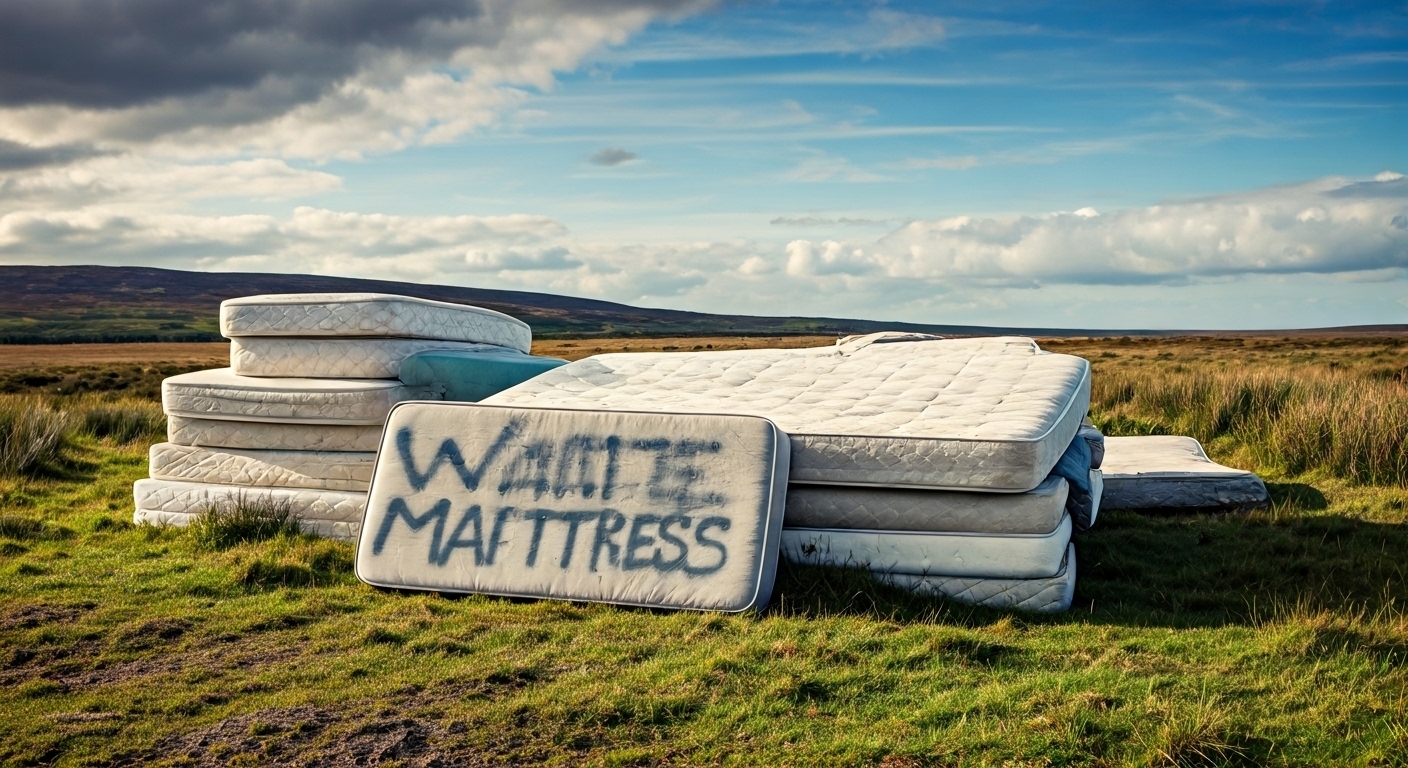
Imagine the scenario: the mattress on your bed, which has been quietly getting on with its job for as long as you can remember, suddenly isn’t quite as comfortable as it once was.
Cue shopping for a new one. Selecting the right level of comfort and support, choosing your price point, and then getting rid of the old one – somehow. But what if there was a better way? Well, through his Cranfield studies, Richard Naylor believes he’s found one.
A graduate of the Sustainability MSc, Richard has launched the world’s first modular, upgradeable and fully repairable mattress, promising circular design, zero compromise and comfort that lasts a lifetime. And he credits his Cranfield studies with helping him along the way.
Solving an everyday problem
“A mattress is a mainstay item in the home,” Richard explains. “It’s one of the first things people buy and, depending on how much you want to spend, it can be quite a big investment. “But, essentially, a mattress is designed to fail. Somewhere between 7-10 years in, it’s going to start to sag, or there’s going to be a spring digging in your back.
“Buying a new one isn’t difficult – there is a lot of choice out there – but getting rid of the old one can be quite problematic from a sustainability perspective.
“In a best-case scenario, it will be recovered, shredded, the metal parts removed and then incinerated to generate energy. But often it will go to landfill.”
The mattress of the future
Richard’s mattress is designed to be purchased once and owned for life. Made without traditional glue or staples, it is easy to take apart for cleaning, maintenance and when upgrades are required. The modular design also allows for greater personalisation for individual sleep comfort preferences.
“At the end of the day, a mattress is a functional product,” Richard says. “It has to be comfortable and hygienic. But we’ve found that we can be commercially successful and equally responsible at the same time.
“The design enables us to try new things from a comfort point of view. We can preference to a fine detail for those who prefer all natural materials; for hot sleepers and cold sleepers; for different sizes, weights and heights; and for couples.
“We’re also looking at providing leasing and servicing, carrying out cleaning and upgrades as needed so people only have to buy one mattress in their lifetime.
“We’re aiming to be disruptors in the mattress market in the same way Dyson did with the vacuum cleaner. We don’t want to be doing the same things as everyone else. We’re here to make things better: to improve the customer experience and do the right thing for people and planet.”
A life-changing journey that began at Cranfield
Richard’s entrepreneurship journey started when he came to Cranfield to study for the Sustainability MSc.
As a mattress industry design and development veteran, he wanted to learn more about product innovation and sustainable waste management so he could help the industry do better for future generations. Cranfield’s course provided the perfect opportunity for him to do just that, while also making use of his then employer’s apprenticeship levy. Returning to formal education after nearly three decades was a daunting prospect, but Richard fully embraced the opportunity, winning two prizes including the best thesis award. He said:
“The whole Cranfield experience and environment was and is completely inspiring. I was hesitant about the course being primarily online, but the production was fantastic, and the content was really well thought-through. My cohort was full of bright people from across different industries and age profiles and we quickly built up a really good group culture which still carries on today in our group WhatsApp chats.”
Looking to the future
Ahead of his formal graduation ceremony this month, Richard has already begun the initial stages of a five-year plan to grow his business. He’s had plenty of support from Cranfield along the way, including financial backing from the university’s Future Frontiers Fund.
Alongside his work, he plans to continue his studies, undertaking a PhD in Design Engineering at Cranfield to support his commercial endeavours.
“There’s a lot of positive attention around the business already and I’m so grateful for all the support I’ve received,” he said. “It’s been a lot of hard work, but we’ve proved that our design is going to work, we have patents pending, and we’re starting to access the funding we need to grow.”
Richard’s mattress design has been shortlisted in the Momentum Valley ‘most valuable pitch’ contest, where companies compete for the chance to pitch live for up to £1 million in investment.
“I came to Cranfield wanting to broaden my horizons and I certainly did that,” he added. “I’m very grateful that the course directors saw something in me and chose me to be part of their first cohort.
“I’m now living my best life, doing something I never thought I would get to do. I hope that, when I get to the end of my career, I can look back and be proud of what I’ll have achieved. I’m really fulfilling my best purpose and it’s amazing.”
About the Sustainability MSc
Designed in consultation with industry the Sustainability MSc aims to deepen knowledge of the theory and practice of organisational sustainability and help students build the personal competencies needed to lead and manage change towards improved sustainability performance.
The Sustainability MSc equips participants with professional recognitions as a Registered Environmental Practitioner and either Practitioner Member of the Institute of Environmental Management and Assessment (IEMA) or Chartered Environmentalist depending on their level of experience prior to attending the course. Participation in the programme can be self-funded or part-funded by eligible employers’ apprenticeship levy payments.
The course is primarily delivered online, with participants coming together annually for a three-day residential at Cranfield where they also get the chance to hear from previous and current students about their successes at work.

Categories & Tags:
Leave a comment on this post:
You might also like…

How do I access the full-text of Harvard Business Review (HBR)?
This is a frequently asked question, and it's worth knowing how to access this key management journal. So, how do you access HBR in full-text? The short answer is via our eJournals finder. You can find ...

Engineering problem to solve? Let Knovel help you find a solution
Did you know that Knovel provides you with more than just eBooks? Knovel is a key database for many engineering, mechanical and materials courses here at Cranfield University, and contains content from an extensive range ...
What happens when female scholars meet influential leaders?
On the 5 March 2026, our British Council Women in STEM Scholars had the privilege of sitting down with two excellent role models of industry and academia: Professor Dame Karen Holford, ...
From MSc to CEO: Igniting a research revolution
For many, a master’s degree is achieving a big milestone. Kilyan Ocampo, Computational Fluid Dynamics alumni shares how studying at Cranfield helped launch his career in the energy sector. Today, Kilyan ...
Commuting, collaborating and growing: My first term experience at Cranfield
My first term at Cranfield University has been an extremely positive and rewarding experience. While the course has been intense at times, it has pushed me in the best possible way and allowed me ...

Sourcing country analysis – a guide to Library sources
For those researching a country, you will find that country information tends to take two forms: Analysis - country reports are descriptive reports covering most areas of interest on a country. They contain an analysis ...
Comments are closed.