


Future of Marketing and Sales Practices Conference: A Cranfield Thought Leadership Initiative
08/05/2018
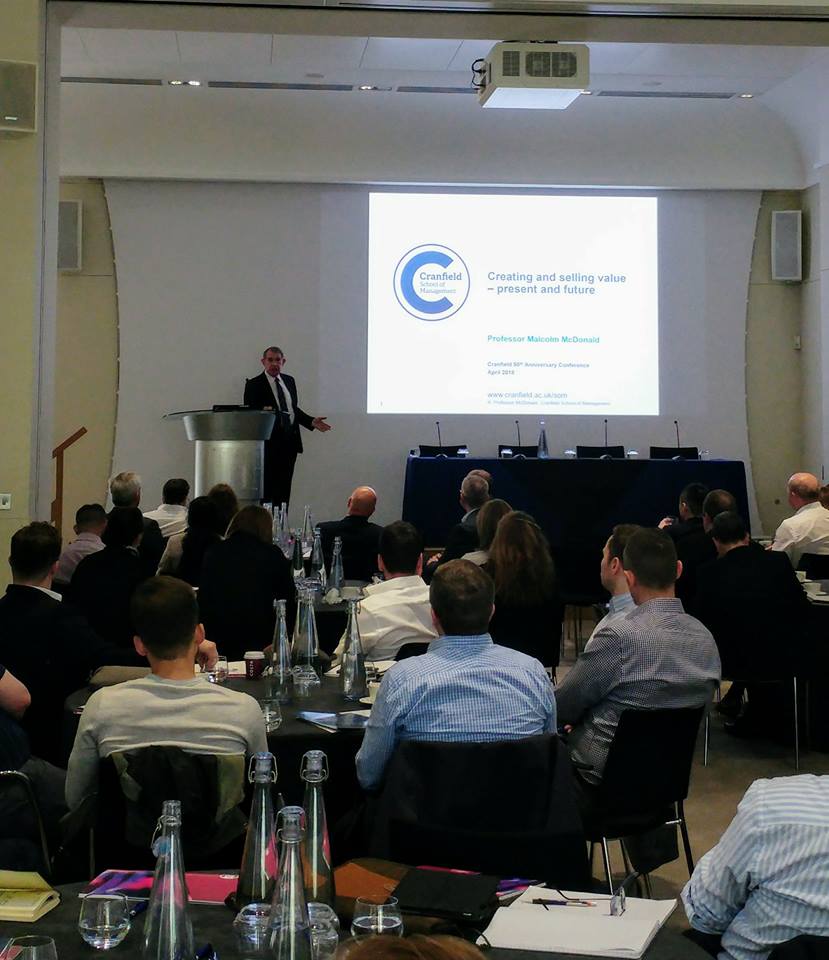
“Does the advent of artificial intelligence (AI) and big data analytics mean the end of marketing as we know it?”
“Will there be even fewer marketing directors in the executive board of organisations in the coming days?”
“What will be the skills demanded of a marketer in the digital age?”
These were some of the many questions floating around the corridors and halls of Royal Engineering Academy in London at the Future of Marketing and Sales Practices conference organized by Cranfield School of Management. The conference, held of April 26th, featured the who’s who of the UK marketing community. The speakers list featured industry leaders like John MacDonald-Gaunt, Vice President of IBM Global Business Services, Rebecca Robins, Global Director of Interbrand, Fiona Blades, CEO of MESH, Dr David Walker, Founding Partner of HAPPEN! Innovation Agency. Several professors from Cranfield University’s Centre for Strategic Marketing and Sales also shared their opinions based on research work and experience.
The day started with an energetic session from John MacDonald-Gaunt who said, in no uncertain terms, that a storm is coming at the general direction of marketers. He exemplified how artificial intelligence, big data analytics, robotics, quantum computing etc. are changing the business landscape at a pace that has never been seen before. However, marketers have two options in this scenario, he opined. Either to face the challenge head on and get ahead of the upcoming task or to bury their head in the sand and hope that the storm will simply pass, which is bound to lead them to their own demise. He stressed sales leaders, especially in B2B arena to focus on four key strategies:
- Having authentic conversation with their clients
- Having tailored strategy for all major clients
- Ensuring full delivery capacity before making any promise
- Entering into deep and mutually beneficial partnership with clients
He was followed by Rebecca Robins, an ardent practitioner and advocate of branding strategies. Rebecca reminded everyone how valuable branding is with the statistics that 75% of all firm values in the US market is intangible, i.e. an output of their brand equity. She focused on building strong brands with a strong purpose behind it, not simply words and advertisements.
Then, Professor Malcolm McDonald, the 80-year old legend of British marketing community and Professor Emeritus at Cranfield, came on the stage. His thoroughly enjoyable presentation circled around how marketing managers should create real values for their customers. He frivolously argued how important it has become for marketers to be financially educated, so that they can justify their efforts and initiatives to the executive board with financially quantified value propositions. He also reminded everyone how the basics of marketing still remains the same: identifying the right target segment and then designing value propositions specifically suitable for them.
Next, there was a presentation by Fiona Blades on MESH’s real-time experience tracking (RET). This unique way of capturing how customers experience the brand throughout different channels, most beyond the organisation’s control, opened doors for many new insights and opportunities. She highlighted some key principles from their learning:
- Brands need to take responsibility of all customer touchpoints, even those beyond their control like social media or third-party retailers.
- The new key metric for marketers is share of experience, not share of voice.
- If content is king for communication, context is the queen.
- Treating customer experience as a journey where the destination is not sales or profit, rather fulfilling the goals of customers.
The last presentation of the day was from David Walker, who talked about the nature of innovation and how that impacts modern marketers. He said the fight big brands like Coca-Cola are facing now is not with other giants like Pepsi, rather with new and agile start-ups like Ugly and Innocent (later acquired by Coca-Cola). He suggested marketers not to jump into the bandwagon of innovation without analysing the company’s current scenario. He proposed an S curve of innovation with three stages of “protect, grow, and transform”, and suggested strategies based on the firm’s position on the curve.
After this, there was a breakout session where all the participants, divided in groups of 6, discussed the next big challenges for marketing. Finally, the closing session and Q&A, led by Professor Stan Makalan, summarised the whole day’s discussions. The core points coming out of his discussion were:
- Marketing is changing as a field, mostly due to technology. However, this is as much an opportunity as it is a threat.
- Marketers will slowly become more and more involved in strategic level decision-making, rather than regular daily activities. This might mean a smaller community of marketing professionals, however the modern marketers will be more skilled and so more rewarded.
- Despite all the changes, the basics of marketing remain same: Identify the most lucrative target segments, design tailored value propositions for them, build brands based on a true purpose, and then monitor customer’s brand experience as closely as possible.
- Innovation is a tricky bandwagon, so approach with caution and after fully analyzing own firm’s situation.

Categories & Tags:
Leave a comment on this post:
You might also like…

How do I access the full-text of Harvard Business Review (HBR)?
This is a frequently asked question, and it's worth knowing how to access this key management journal. So, how do you access HBR in full-text? The short answer is via our eJournals finder. You can find ...

Engineering problem to solve? Let Knovel help you find a solution
Did you know that Knovel provides you with more than just eBooks? Knovel is a key database for many engineering, mechanical and materials courses here at Cranfield University, and contains content from an extensive range ...
What happens when female scholars meet influential leaders?
On the 5 March 2026, our British Council Women in STEM Scholars had the privilege of sitting down with two excellent role models of industry and academia: Professor Dame Karen Holford, ...

From MSc to CEO: Igniting a research revolution
For many, a master’s degree is achieving a big milestone. Kilyan Ocampo, Computational Fluid Dynamics alumni shares how studying at Cranfield helped launch his career in the energy sector. Today, Kilyan ...

Commuting, collaborating and growing: My first term experience at Cranfield
My first term at Cranfield University has been an extremely positive and rewarding experience. While the course has been intense at times, it has pushed me in the best possible way and allowed me ...

Sourcing country analysis – a guide to Library sources
For those researching a country, you will find that country information tends to take two forms: Analysis - country reports are descriptive reports covering most areas of interest on a country. They contain an analysis ...