


The Future of Operational Performance Management – Part 3
01/03/2017

Eleanor Roosevelt, an inspiring leader in her own right who, amongst other things, helped found UNICEF, is reported as saying “Learn from the mistakes of others. You can’t live long enough to make them all yourself”. Seems like common sense to me, but when it comes to looking at what things people measure in the hope of improving business processes, it appears they purposefully go out of their way to ignore her sound advice.
In our previous posts, we considered 3 questions regarding what a standard way of reporting Operational Performance Management (50 years of other people’s mistakes) might look like, comparing this with standard accounting ways of assessing an organisation’s Financial Performance Management (500 years of people’s mistakes)?
- Would it contain just a standard set of measures?
- Would it be presented in a standard way?
- Would it be presented on a monthly basis?
And in our post of last week, we introduced the concept of 4 standard core Process Types (C2D or C2M, P2P, L2C and T2R) seen across public and private sector organisations, and likened them to the standard tools of the Finance profession such as P&L, Balance Sheet and so on. We’re going to take one of these 4 as an example to follow, namely T2R. Examples of T2R (Trouble to Resolve) processes are in Police, Ambulance, Asset/Infrastructure Management, IT Operations / Service Management – and we’ll take an example from the last of these to follow our line of thought. Specifically, let’s look at the typical IT Help Desk, something we have probably all experienced in our connected lives. “My laptop refuses to let me log in”, “I can’t get this letter printed”, “I need a new application loaded”, etc.
A high-level view might look like (breaking the process into 4 transformative or value-add Stages):
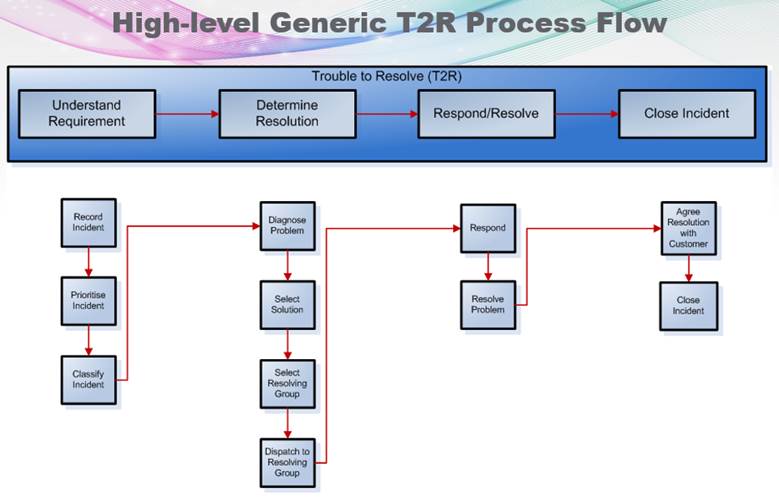
You might recognise some of these value-add Stages in the IT Help Desk context – Recording the Incident (Stage 1) will get you a so-called “Trouble-Ticket” as a reference and started along the process. You’ll be asked some questions about the problem, and it will be prioritised and so on. And now applying Ms Roosevelt’s advice, we have found after many 10s of years’ experience, that there are only up to 10 things that need to be measured for performance improvement:
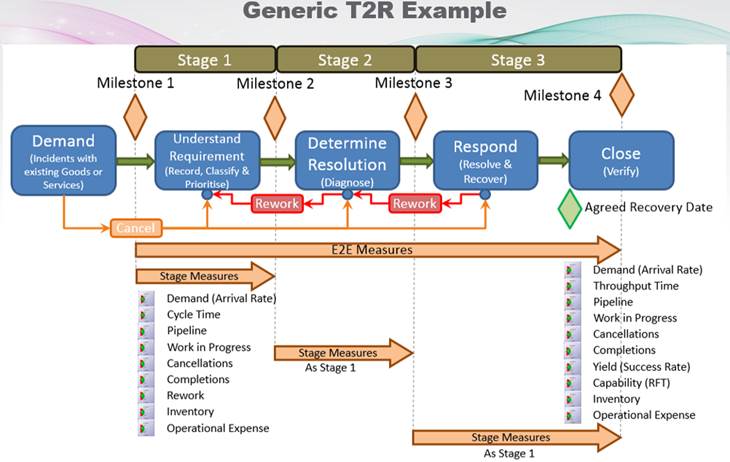
Some Measures may not be relevant in certain contexts, but the principle is that the End2End measures and the Stage by Stage measures are very similar and count no more than 10. And our experience to date shows that these are all that are required for improving performance. Yes, there are other Measures that may be required for achieving Budgets and Targets (where they exist), or for Regulatory and Financial Reporting purposes. But the issue is, in order to know what levers to pull, it will always come back to one or more of the above. These are now akin to the Finance profession’s Revenue, Costs. Profit in a P&L sheet.
When accountants want to establish the financial health of an organisation, they don’t have a séance or a workshop about what they should measure. They go straight to their basic tools of the trade, and only where necessary deviate to more exotic measures. The proposition here is that the Measures above are the basic tools of the trade in Operational Performance Management. The problem is, people come up with all sorts of complex measures which can become impenetrable to find out what levers to pull, yet they will chase these measures month on month thinking they are somehow able to control performance. There are some organisations that offer libraries of 10s, 100s and even 1000s of so-called “standard” KPIs – you can’t live long enough …
We’ll look at some examples of what not to do and answer the final question above next time.

Categories & Tags:
Leave a comment on this post:
You might also like…

Engineering problem to solve? Let Knovel help you find a solution
Did you know that Knovel provides you with more than just eBooks? Knovel is a key database for many engineering, mechanical and materials courses here at Cranfield University, and contains content from an extensive range ...
What happens when female scholars meet influential leaders?
On the 5 March 2026, our British Council Women in STEM Scholars had the privilege of sitting down with two excellent role models of industry and academia: Professor Dame Karen Holford, ...
From MSc to CEO: Igniting a research revolution
For many, a master’s degree is achieving a big milestone. Kilyan Ocampo, Computational Fluid Dynamics alumni shares how studying at Cranfield helped launch his career in the energy sector. Today, Kilyan ...

Commuting, collaborating and growing: My first term experience at Cranfield
My first term at Cranfield University has been an extremely positive and rewarding experience. While the course has been intense at times, it has pushed me in the best possible way and allowed me ...

Sourcing country analysis – a guide to Library sources
For those researching a country, you will find that country information tends to take two forms: Analysis - country reports are descriptive reports covering most areas of interest on a country. They contain an analysis ...

The degree that launched my marketing career
Insights from Tayo George, Strategic Marketing MSc Alumni I chose the Strategic Marketing MSc at Cranfield because I wanted a programme that combined academic rigour with practical, commercial relevance. The emphasis on applied learning, ...