


Entrepreneurship and making water from waste: Bottles for Growth and the Social Venture Challenge
18/12/2015
Cranfield University’s Bettany Centre for Entrepreneurship recently organised the University’s first Social Venture Challenge, a start-up weekend aimed at encouraging students to ‘think like entrepreneurs’ about ways to solve complex social and environmental issues to create a more sustainable future. The objective of the challenge was to create ideas for new ventures that could have a genuine impact in the world and that could put the proposed solutions into action.
The challenge, set by the charity Centre for Global Equality, was based around securing water for food. Given recent headlines around food security in a changing world, this was particularly topical.
Can entrepreneurship solve global water scarcity?
To put things into context, 2.8 billion people are impacted by water scarcity in the world today. It is estimated that by 2050 the global demand for water will increase by 55%. And over 70% of global water use occurs in supplying food. While business model innovations that could reduce or help resolve water scarcity do exist, many are not reaching the developing countries where they are most needed.
After a brainstorming session 26 students from across the University chose their favourite start-up idea and formed small groups to develop the proposition. In total, six interdisciplinary teams competed for the Santander-sponsored prize of £5,000 that will be used to start a social venture based on the winning idea.
The judges – from the Centre for Global Equality, the Coins Foundation and Santander – were impressed by the excellent quality of the ideas and ranked the entries using the four main criteria:
- Innovation
- Forms of social and/or environmental value created
- Likelihood to succeed
- Communication of the idea
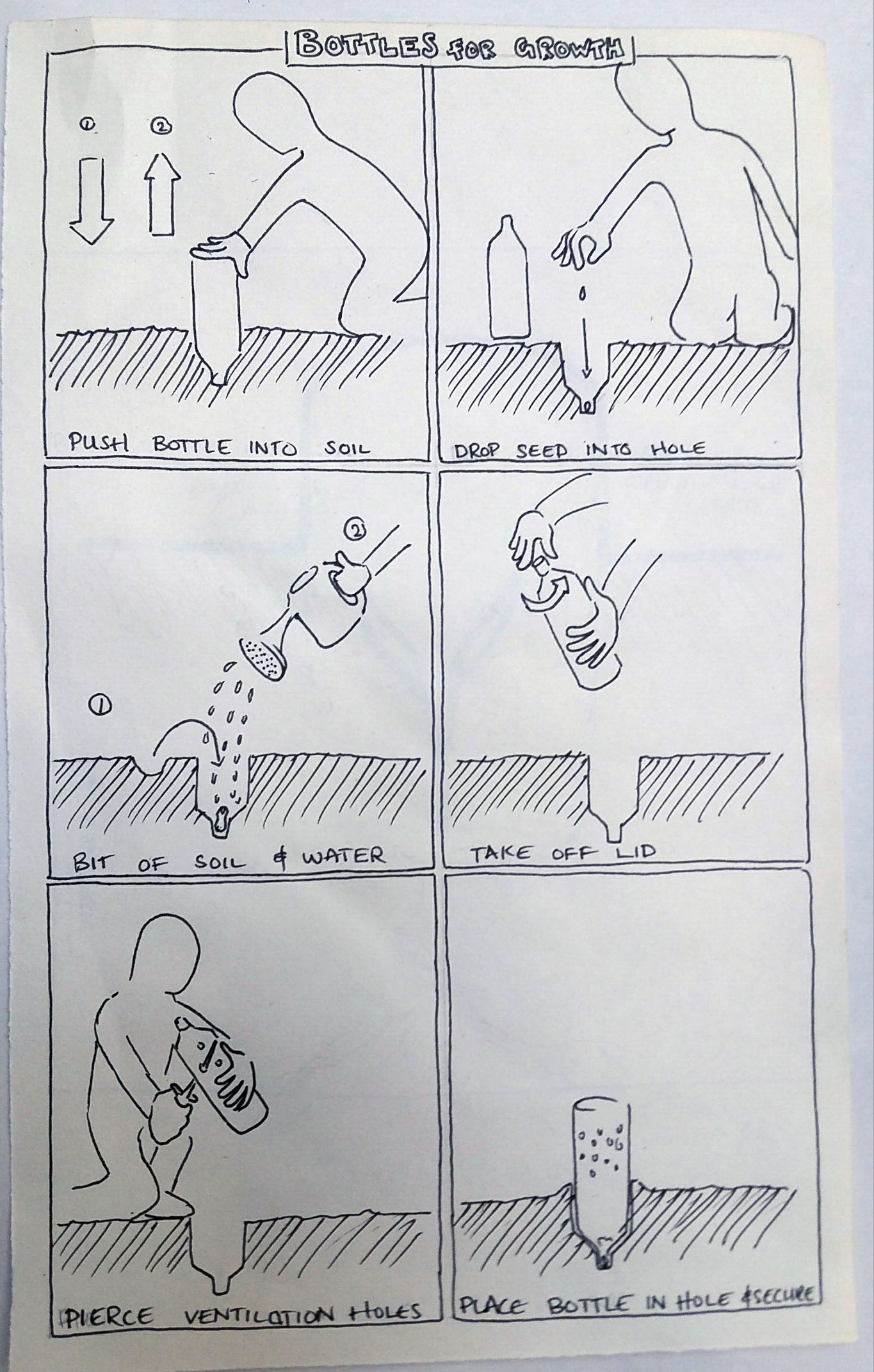
Bottles for Growth
The winning idea, Bottles for Growth, proposed to use empty Polyethylene terephthalate (PET) bottles as mini-greenhouses to capture water that would normally evaporate. This project stood out for the powerful simplicity of the idea, its approach to using waste in a productive way, and the fact that the team is looking to disseminate the innovation through an open-source model so that the solution can be implemented at scale very rapidly.
Bottles for Growth was thought up by four students:
- Ross Tierney – PhD student in the Cranfield University Centre for Competitive Creative Design
- Jenny Pater – MSc in Management and Entrepreneurship
- Johannes Gasser – MSc in Engineering and Management of Manufacturing Systems
- Lucas Kob – MSc in Thermal Power
The team are very keen to create their start-up, and are currently planning the next steps. I am sure that we will see a lot more of this venture over the coming months.
Personally, organising the weekend was an ideal opportunity to gauge student interest in innovative solutions to sustainability challenges. I am particularly pleased that the Santander funding will enable students to create a start-up and put their ideas into actions. I am also excited to mentor the Bottles for Growth team and I certainly hope to make the Social Venture Challenge an annual event so that the students can continue to work together to make a global impact.

Categories & Tags:
Leave a comment on this post:
You might also like…
Building more than research: Reflections from the ECRn Symposium 2026
There’s something quietly powerful about a room full of early career researchers. Not just the ideas, although there were plenty of those—but the conversations, the curiosity, and the sense that everyone is figuring things ...
Library services over Easter, 3-6 April
Kings Norton Library will remain open for study 24/7. You will need your University ID card to enter the building and can use the self-service machines to borrow and return items as usual. Barrington Library ...

How do I access the full-text of Harvard Business Review (HBR)?
This is a frequently asked question, and it's worth knowing how to access this key management journal. So, how do you access HBR in full-text? The short answer is via our eJournals finder. You can find ...

Engineering problem to solve? Let Knovel help you find a solution
Did you know that Knovel provides you with more than just eBooks? Knovel is a key database for many engineering, mechanical and materials courses here at Cranfield University, and contains content from an extensive range ...
What happens when female scholars meet influential leaders?
On the 5 March 2026, our British Council Women in STEM Scholars had the privilege of sitting down with two excellent role models of industry and academia: Professor Dame Karen Holford, ...
From MSc to CEO: Igniting a research revolution
For many, a master’s degree is achieving a big milestone. Kilyan Ocampo, Computational Fluid Dynamics alumni shares how studying at Cranfield helped launch his career in the energy sector. Today, Kilyan ...
Ask Bob at the Red Lion Salford.
We use this idea to water our plants in Spain when we are not there. the moisture from the air condenses over night and waters the plants.