


Entrepreneurship and making water from waste: Bottles for Growth and the Social Venture Challenge
18/12/2015
Cranfield University’s Bettany Centre for Entrepreneurship recently organised the University’s first Social Venture Challenge, a start-up weekend aimed at encouraging students to ‘think like entrepreneurs’ about ways to solve complex social and environmental issues to create a more sustainable future. The objective of the challenge was to create ideas for new ventures that could have a genuine impact in the world and that could put the proposed solutions into action.
The challenge, set by the charity Centre for Global Equality, was based around securing water for food. Given recent headlines around food security in a changing world, this was particularly topical.
Can entrepreneurship solve global water scarcity?
To put things into context, 2.8 billion people are impacted by water scarcity in the world today. It is estimated that by 2050 the global demand for water will increase by 55%. And over 70% of global water use occurs in supplying food. While business model innovations that could reduce or help resolve water scarcity do exist, many are not reaching the developing countries where they are most needed.
After a brainstorming session 26 students from across the University chose their favourite start-up idea and formed small groups to develop the proposition. In total, six interdisciplinary teams competed for the Santander-sponsored prize of £5,000 that will be used to start a social venture based on the winning idea.
The judges – from the Centre for Global Equality, the Coins Foundation and Santander – were impressed by the excellent quality of the ideas and ranked the entries using the four main criteria:
- Innovation
- Forms of social and/or environmental value created
- Likelihood to succeed
- Communication of the idea
Bottles for Growth
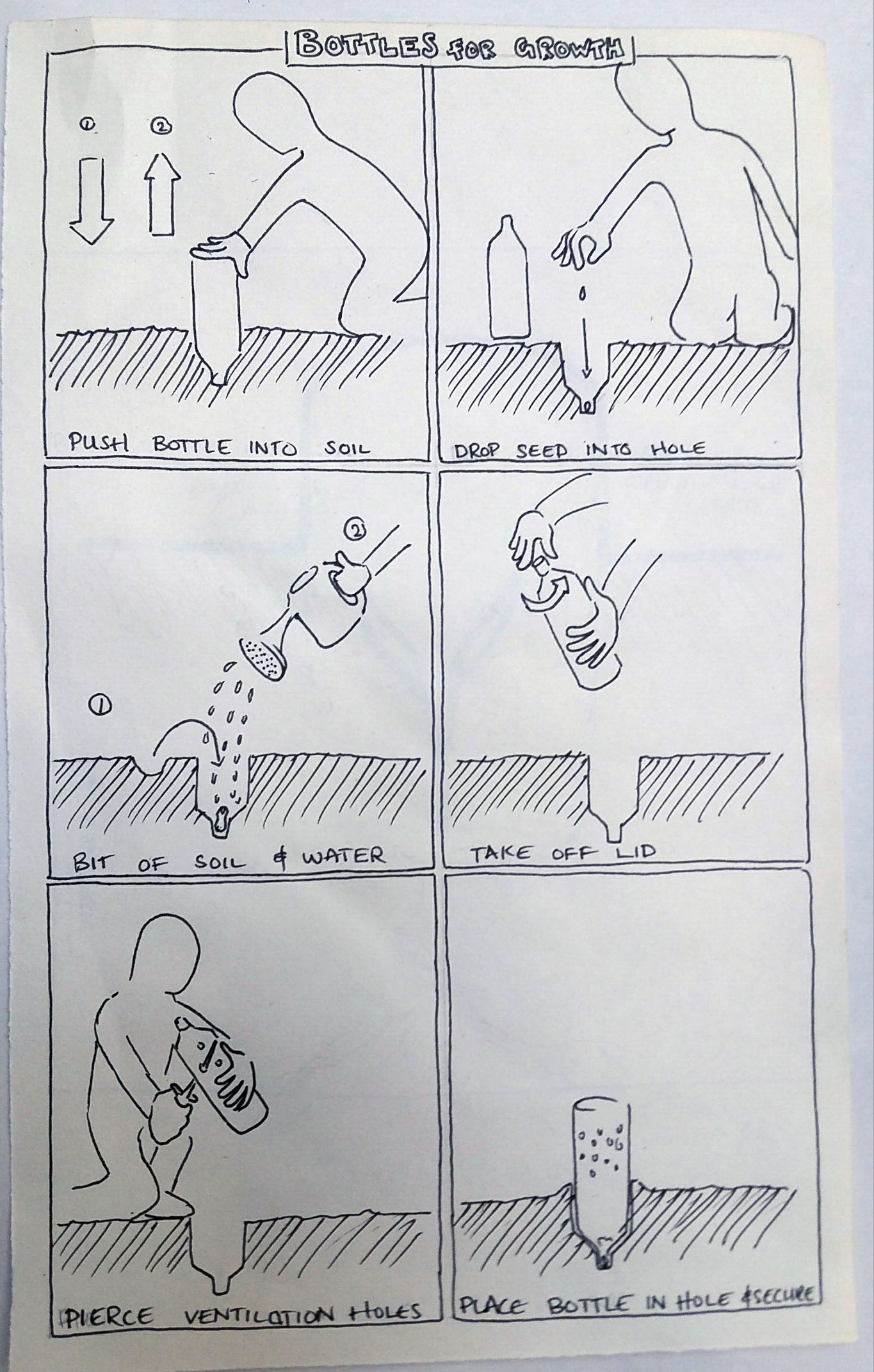
The winning idea, Bottles for Growth, proposed to use empty Polyethylene terephthalate (PET) bottles as mini-greenhouses to capture water that would normally evaporate. This project stood out for the powerful simplicity of the idea, its approach to using waste in a productive way, and the fact that the team is looking to disseminate the innovation through an open-source model so that the solution can be implemented at scale very rapidly.
Bottles for Growth was thought up by four students:
- Ross Tierney – PhD student in the Cranfield University Centre for Competitive Creative Design
- Jenny Pater – MSc in Management and Entrepreneurship
- Johannes Gasser – MSc in Engineering and Management of Manufacturing Systems
- Lucas Kob – MSc in Thermal Power
The team are very keen to create their start-up, and are currently planning the next steps. I am sure that we will see a lot more of this venture over the coming months.
Personally, organising the weekend was an ideal opportunity to gauge student interest in innovative solutions to sustainability challenges. I am particularly pleased that the Santander funding will enable students to create a start-up and put their ideas into actions. I am also excited to mentor the Bottles for Growth team and I certainly hope to make the Social Venture Challenge an annual event so that the students can continue to work together to make a global impact.

Categories & Tags:
Leave a comment on this post:
Comments are closed.
You might also like…

How Cranfield accelerated my career in Logistics and Supply Chain Management
After graduating from the MSc in Logistics and Supply Chain Management at Cranfield University, I've been reflecting on the experiences that made my journey so valuable and the impact it has had on my ...

Mendeley: a powerful tool to organise and manage your references
Are you looking for a way to manage your references, create in-text citations and reference lists for your assignments or thesis? If so, you may wish to consider using Mendeley. What is it? Mendeley is ...

Keen to develop your study skills?
Alongside the technical skills and academic knowledge that you will gain on your course, as a Cranfield student you have the opportunity to develop a range of other skills that can enhance your learning experience. ...

The V-conomy: powering the sixth wave of global economic growth
The world could be on the verge of a major surge in economic growth and development, driven by the convergence of AI and clean energy technology. Waiting to ride the K-wave The Russian ...

Need help using the Python programming language?
We know some of our students are currently trying to learn Python, so we wanted to make you aware of some great LinkedIn Learning videos that can help. But don't you have to pay for ...

What does it really take to become a Chevening Scholar?
Say “Turkmenistan” to most people and you’ll get a blank look. That was true when I left Ashgabat for the UK to study an MSc in Logistics and Supply Chain Management at Cranfield University ...
Ask Bob at the Red Lion Salford.
We use this idea to water our plants in Spain when we are not there. the moisture from the air condenses over night and waters the plants.