


Agrifood on tour: bringing science to life!
27/09/2017
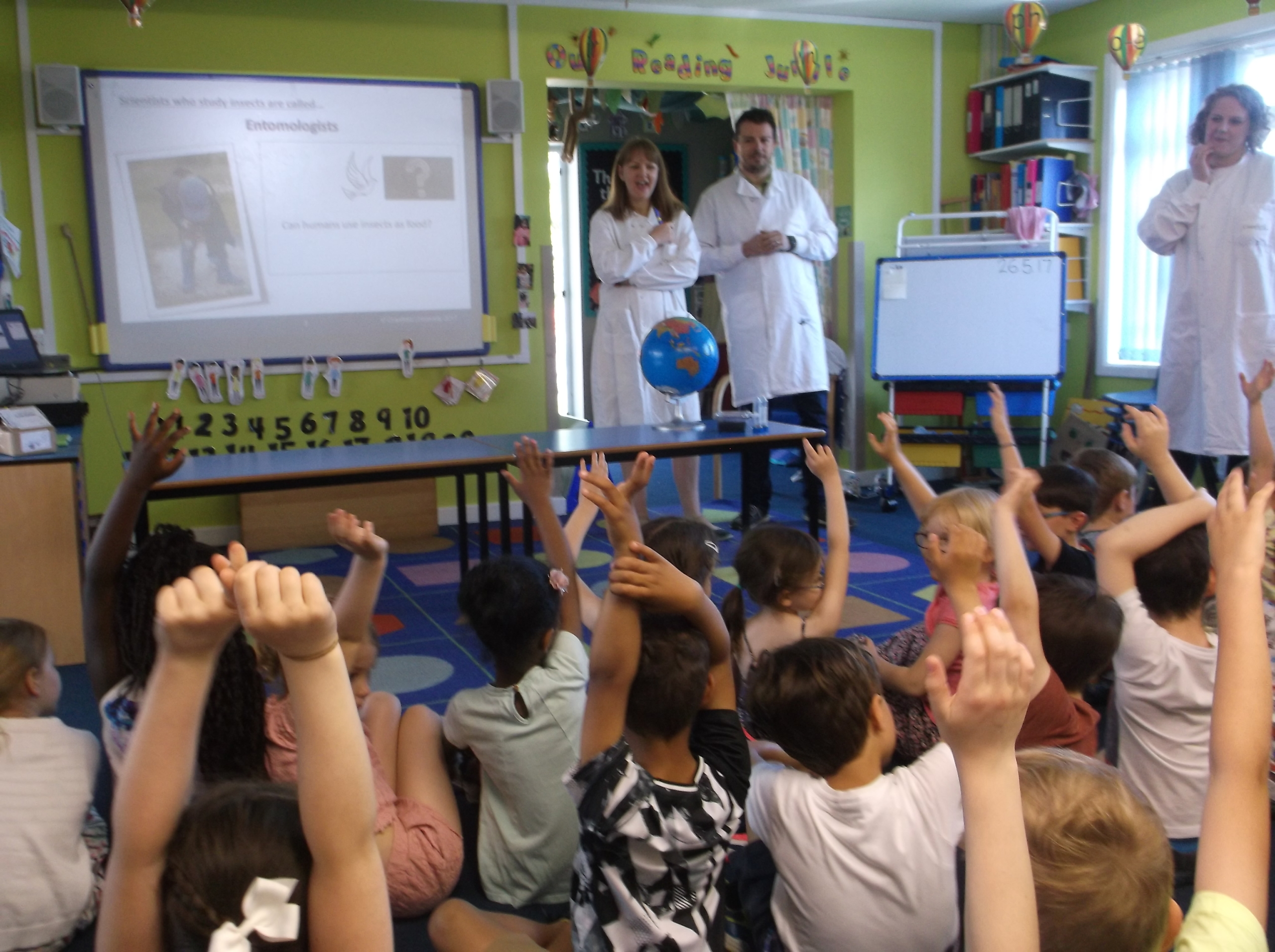
Throughout the year my Agrifood team and I travel around the world to raise awareness of Cranfield’s research and teaching expertise. Central to this is our participation in outreach activities, and this year has been no exception; we have attend events both nationally and internationally, and it’s great going out to meet potential new students, young and old.
One of the most exciting outreach experiences we’ve had this year was our visit to Sharnbrook Primary School (previously known as John Gibbard Lower School). Dr Sandra Messenger (a STEM Ambassador), Natalia Jawiarczyk and I went to talk to the children in Year 1 about the Innovate UK Insect project that we’re working on. The students were studying the topic of insects at the time so they were really engaged. We got them to wear lab goggles, gloves, grind fly larvae and look at them under a dissecting microscope. We also showed them some hissing cockroaches, just for fun!
These school visits help us to increase the awareness of the role agriculture and food will play in their lives, regardless of whether they are working or studying in the sector in the future. Connecting with our younger generation, and alerting them to the challenges we face, is essential if we are to attract the best and brightest students. And undoubtedly this is what we must do: with the global population expected to hit 9.8 billion by 2050, we’ll have a lot of mouths to feed in the decades to come.
ERASMUS+ action
Part of connecting with our younger generation is done through the Erasamus+ action project. The Erasmus+ is the European Union’s funding programme for education and training, youth and sport. The overall programme aims to boost skills and employability; modernise education, training and youth work; and improve opportunities for young people. Earlier this year I participated in an Erasamus+ action project in Austria.
During my time there, I was teaching at the University of Natural Resources and Life Sciences, Vienna (BOKU) as part of the teaching team of the Mycotoxin Summer Academy 2017 Module I. This was a great occasion to experience the Austrian teaching style and meet some great people from industry.

I also pursued the opportunity to strengthen research collaboration between the Cranfield Soil and Agrifood Institute and BOKU. We are now having discussion with BOKU academics for future projects together, which is a fantastic outcome.
At the end of my stay in Austria, I was as an invited speaker at their annual ‘Mycotoxin Summer Talks 2017’ conference, where I delivered a talk on our world-leading research in mycotoxins.
edie Live and EPP partner universities
As well as helping educate younger generations, we educate the older ones too. My team and I attended edie Live at the Birmingham NEC (photo right), which gave us a chance to network with prospective students, sponsors and partners. These types of events are a great opportunity for us to answer questions and discuss future problems, as well as showcase the work we are currently doing to find solutions. And it’s great when this leads to people being inspired and joining us on this journey! This can result in future partnerships for both the University and student projects.

Unsurprisingly, our group projects always generate a lot of interest and questions. For those who don’t know about them, Cranfield University group projects are consultancy-style projects, usually sponsored by industry partners. They provide students with experience working on real problems for a real client, gaining essential technical and transferable skills, such as team working, managing resources and developing reporting and presentation skills. Our sponsors and partners are important to us for these projects, as many of the projects are supported by external organisations and the experience gained is highly valued by both students and prospective employers.
We also like to take every opportunity to network, which is why we visited some of our European Partnership Programme partner universities including University of Lleida (photo below of Dr. Mari Carmen Alamar and I at Lleida University with Dr Isabel Odriozola (far left) and potential students from Lleida), Polytechnic University of Valencia, University “Cardenal Herrera CEU”, and Universidad de Santiago de Compostela. Building bridges with universities around the world is so important in this era of internationalisation of higher education – it not only means we can share knowledge and collaborate, but also gives prospective students an idea about the very specific, industry-focused work we do here at Cranfield. Sharing our knowledge can help create more solutions to the world food problems we face.

International Agroecology Summit in Florida (USA)
In my role as Programme Director for the Agrifood MSc course programme, I visited the University of Florida for the International Agroecology Summit, with the aim of increasing the relationship between our institutions. It was a great summit, but more importantly it has significantly strengthened our relationship with the institution, and as such what we can offer to our respective students.

We have also been involved in the development of new partnerships with higher education institutes in Korea, China and Thailand. This region of Asia is very important to us – we receive a great number of students from those countries already, and with that we are building bridges for the decades ahead as we work together to solve the growing problems facing our sector.
We’re always doing our best to increase our relationships with other institutions but when we do get five minutes of spare time we make the most of it!

While I was in Florida I visited five research centres in a bus tour of more than 600 miles, until we finally arrived at the main campus. As result of the visit we are now a part of the International Agroecology Consortium.
I also visited Mexico to strengthen the relationship with students there, and I spent time interviewing prospective students and also meeting alumni from Cranfield. It was a great experience as they showed me the most important areas of their city.
As part of our international activities we aren’t always the ones travelling, we also meet people here at Cranfield. One example is Professor Jainshe Chen who is the Associate Dean for International of the School of Food Science and biology, Zhejiang Gongshang University (photo below).

A new academic year starts
So all in all, a busy year, with many miles covered, and many new and old friends met. But more importantly, time spent with the next generation, alerting them to the food challenges that we will all face as the global population continues to rise. But also telling them about the fantastic and rewarding opportunities that arise from working together to tackle those challenges.
Soon we will be meeting our latest cohort of agrifood students here at Cranfield, as they come to learn about and help advance our expertise in the area, and I can’t wait to get started! It’s going to be another busy year, but that’s the way we like it!!

Categories & Tags:
Leave a comment on this post:
You might also like…
How Cranfield accelerated my career in Logistics and Supply Chain Management
After graduating from the MSc in Logistics and Supply Chain Management at Cranfield University, I've been reflecting on the experiences that made my journey so valuable and the impact it has had on my ...

Mendeley: a powerful tool to organise and manage your references
Are you looking for a way to manage your references, create in-text citations and reference lists for your assignments or thesis? If so, you may wish to consider using Mendeley. What is it? Mendeley is ...

Keen to develop your study skills?
Alongside the technical skills and academic knowledge that you will gain on your course, as a Cranfield student you have the opportunity to develop a range of other skills that can enhance your learning experience. ...

The V-conomy: powering the sixth wave of global economic growth
The world could be on the verge of a major surge in economic growth and development, driven by the convergence of AI and clean energy technology. Waiting to ride the K-wave The Russian ...

Need help using the Python programming language?
We know some of our students are currently trying to learn Python, so we wanted to make you aware of some great LinkedIn Learning videos that can help. But don't you have to pay for ...
What does it really take to become a Chevening Scholar?
Say “Turkmenistan” to most people and you’ll get a blank look. That was true when I left Ashgabat for the UK to study an MSc in Logistics and Supply Chain Management at Cranfield University ...