


Beyond Budgeting… A journey towards real customer service
18/07/2017

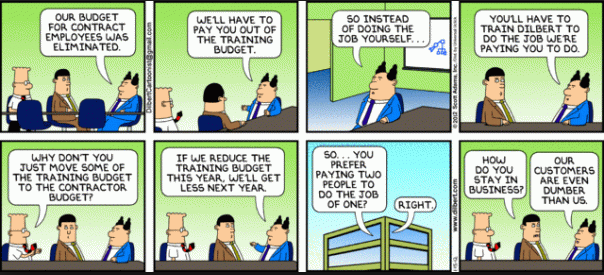
Over the past two years or so, a fellow Visiting Fellow – Steve Morlidge – has been introducing me to the term and benefits of “Beyond Budgeting”. This has provided one major “Ah-ha! Moment”. It also chimes with work we have done with Cranfield in developing what we call a “Systems Approach to Project Management” (more of that in a later blog).
Budgeting and Project Planning (particularly large projects) have a lot in common, four of which are:
- They lay out some form of forecast of revenue, costs, profit based on last year’s results plus expectations of stakeholders on the one hand, and on the other forecast of timeframe and spend, along with projected benefits both based on certain assumptions
- Both the Budget and the Project Plan assume that nothing changes in the system (e.g. the environment, markets, technology etc.) and that expectations and requirements remain cast in concrete over the life-time of the budget or the plan
- They are then used by the executive team to track, on the one hand, how revenue, costs and profit are varying (i.e. variance) from budget (like the budget was God-given and correct), and on the other how deliverables are being delivered along with consumption of effort, materials etc. (cost), and projected expenditure to completion against the project plan (like it was God-given and correct)
- By locking-in the budget or project plan in this way (where it is immoveable) THE ONLY PARAMETER YOU CAN ADJUST IS personal (or team) performance – and hence we get into the perversions of personal (or team) incentives and rewards! My Ah-ha! moment (many thanks Steve!)
So the crux to Beyond Budgeting (as well as Planning) is to accept that:
- Assumptions made may be wrong or change
- The world-system and expectations/requirements may change – particularly as budgets and plans span timeframes typically far longer than the timeframes in which the environment/requirements change
- That in budgeting and planning we, as humans (see Daniel Kahneman, Thinking Fast & Slow) always have an optimism bias
And the crux is that in order to be “agile” or “responsive” (as all the big four consulting firms are telling us we need to be IN ORDER TO STAY IN BUSINESS) we can only do so if budgeting and planning functions accept the above.
So how do you track progress in this moving feast – next blog…

Categories & Tags:
Leave a comment on this post:
You might also like…

Moving to the UK to study? How to plan for banking, exchange rates and transfers
Currency and banking are two of the most practical parts of financial planning for international students. They are also often the most overlooked. We asked Dr Lakshmy Subramanian, Course Director for Cranfield University's Banking, ...

Cranfield: an environment where innovation thrives
The latest Knowledge Exchange Framework rankings from UK Research and Innovation (UKRI) gives an insight into the real and meaningful impact that UK universities have. The seven categories that make up KEF6 cover everything ...

How Cranfield accelerated my career in Logistics and Supply Chain Management
After graduating from the MSc in Logistics and Supply Chain Management at Cranfield University, I've been reflecting on the experiences that made my journey so valuable and the impact it has had on my ...

Mendeley: a powerful tool to organise and manage your references
Are you looking for a way to manage your references, create in-text citations and reference lists for your assignments or thesis? If so, you may wish to consider using Mendeley. What is it? Mendeley is ...

Keen to develop your study skills?
Alongside the technical skills and academic knowledge that you will gain on your course, as a Cranfield student you have the opportunity to develop a range of other skills that can enhance your learning experience. ...

The V-conomy: powering the sixth wave of global economic growth
The world could be on the verge of a major surge in economic growth and development, driven by the convergence of AI and clean energy technology. Waiting to ride the K-wave The Russian ...