


Designing the future of space: My group design project experience at Cranfield
09/04/2026
For three years, I worked at Tata Consultancy Services (TCS) in India. While my time in the IT sector provided me with a strong analytical foundation, my true passion had always been anchored in the stars, sparked by childhood evenings spent watching Cosmos and Through the Wormhole with Morgan Freeman.
The transition from a professional career in IT to the specialised world of space engineering is a journey defined by both technical rigor and a shift in perspective. Last year, I decided to pivot and pursue a Master of Science in Astronautics and Space Engineering at Cranfield University.
The primary motivator for this change was a desire to use space expertise to improve life on Earth. Now, as I reflect on the completion of our Group Design Project (GDP), I can see how that goal is being realised through complex engineering and collaborative innovation.
The mission: What is a GEO-Swarm?
Our GDP, titled GEO-Swarm, was led by a distinguished team of faculty, including Dr. Nicola Garzaniti, Prof. Paul Febvre, and Prof. Saba Alrubaye. The core objective was to conduct a feasibility study and conceptual design of a geostationary satellite swarm. This swarm operates as a distributed sparse-aperture phased-array antenna, designed to provide persistent and secure communication for next-generation services.
Industry relevance and the architecture dilemma
In the current space economy, there is an unprecedented global surge in demand for secure and resilient communication. The industry currently faces an “architecture dilemma”: Low Earth Orbit (LEO) constellations provide low latency but lack regional control, while traditional Geostationary (GEO) satellites offer stable coverage but are historically inflexible and difficult to scale.
The GEO-Swarm project addresses this by proposing a distributed system that offers the persistence of a GEO orbit with the flexibility of a modern constellation. While our specific project was not officially tied to an industry sponsor, it is grounded in real-world potential and mimics the types of Massive MIMO and distributed aperture research currently being explored by organisations like the European Space Agency (ESA).
The technical “tightrope”: 20 satellites in a single slot
The engineering complexity of this project cannot be overstated. Our design involved a constellation of 20 satellites. For me, the single most difficult technical challenge was the orbital mechanics required to keep these assets functional within a highly restricted space.
The 140km challenge
In LEO, satellites have the luxury of vast orbital shells to move within. However, in Geostationary orbit, we are often restricted to a very specific, allocated orbital slot. For this project, we had to coordinate our swarm within a “box” only 140km wide.
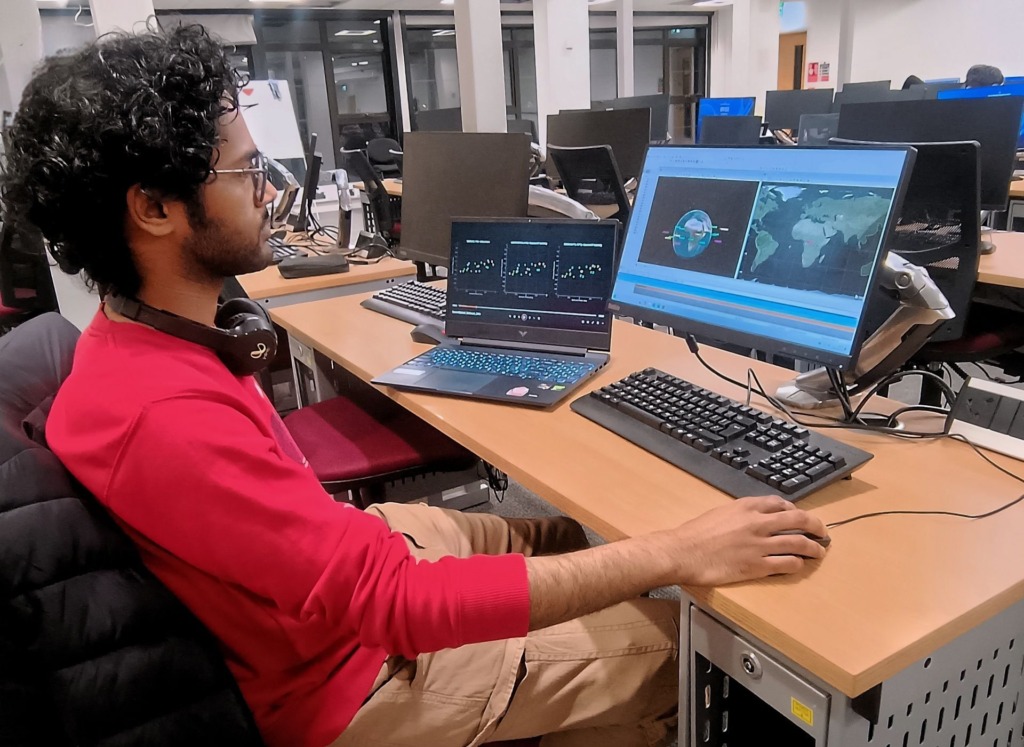
Attempting to pack 20 satellites into such a confined space while avoiding collisions was an immense task. We had to account for constant gravitational perturbations that threatened to pull the satellites out of their intended formation. To overcome this, I relied heavily on Cranfield’s high-computing lab. I utilised industry-standard software, including STK (Systems Tool Kit), MATLAB, and Python, to run a lot of simulations. This allowed us to define the precise station-keeping and formation-flying strategies necessary to ensure the swarm’s operational viability and safety.
How Cranfield supports the journey
Cranfield University provides a unique environment for this level of research. The support goes beyond just software access; it’s about the integration of industry standards into our workflow.
- Professional standards: We utilised high-level work breakdown structures (WBS) and adhered to standards such as the NASA Systems Engineering Handbook and ECSS-E-ST-10C Rev.1.
- Specialised facilities: The high-computing labs were essential for running the intensive simulations required for our 20-satellite constellation.
- Mentorship: Having direct access to lecturers and professors who are experts in space engineering and telecommunications was vital during the design process.
Presentation day: 24th March 2026
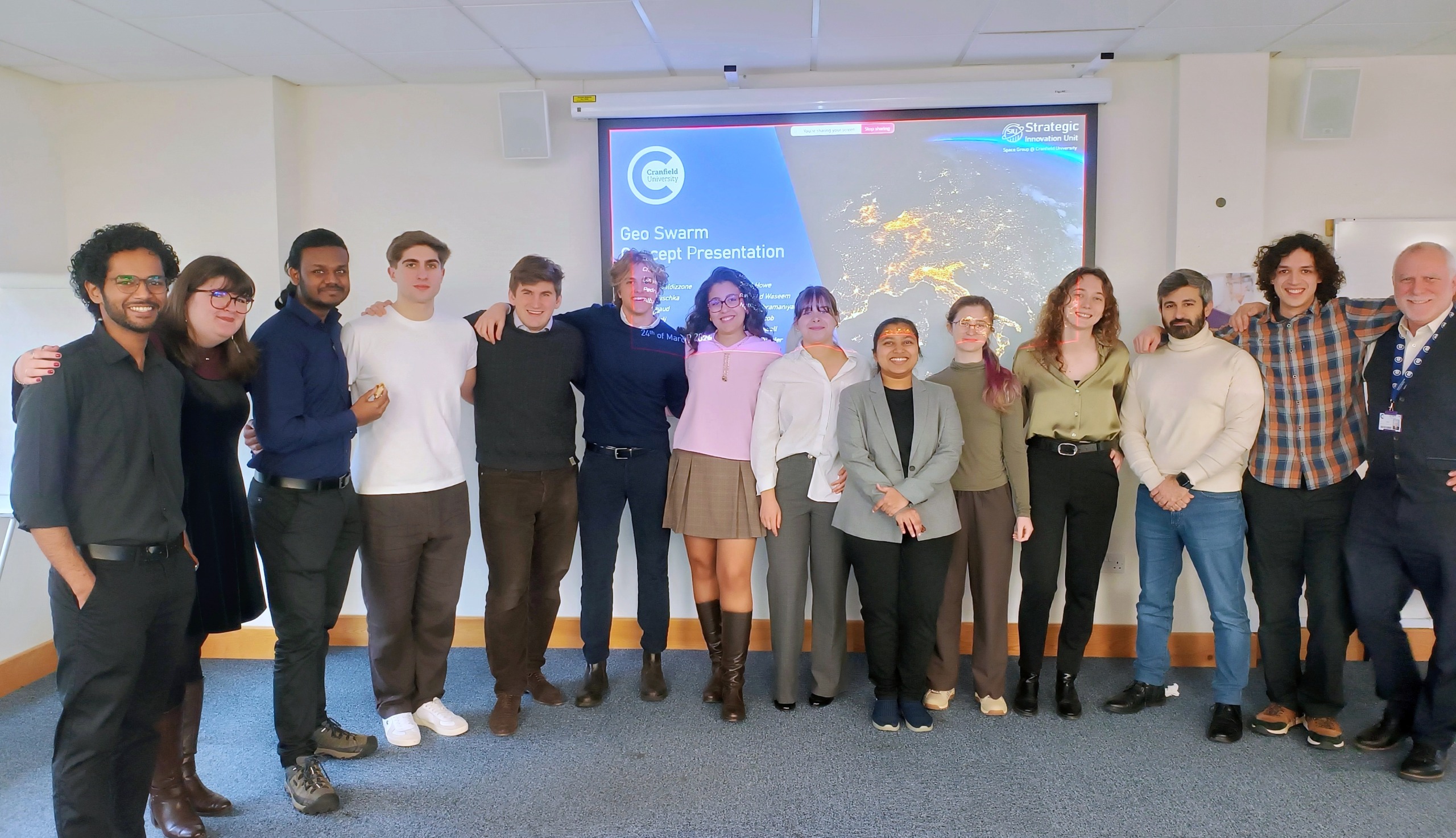
Everything we worked on since October culminated on presentation day on 24th March. We were presenting our feasibility study and conceptual design to a panel of experts who have spent their lives in this field. Walking into that room was an extraordinary experience. As an international student presenting in a new country, the atmosphere felt formal and, at times, overwhelming.
Despite the nerves, the experience was incredibly rewarding. Standing in front of our models and explaining our mission analysis and system requirements was a moment of immense pride. The panel didn’t just listen; they challenged us with interesting questions and provided specific updates on how we could improve our orbital models and system architecture. This direct feedback transforms a student project into a professional defence.
Finding balance: Beyond the GDP
While the GDP was the primary focus of the term, life at Cranfield is about more than just orbital math. To stay grounded during the intense “crunch” periods leading up to our March deadlines, I sought out standalone activities that offered a different perspective.
One of the highlights has been joining the Astronomy Club. Gaining access to the Astronomy Dome for training and practical observation was a personal highlight. It served as a great reminder of why I fell in love with space in the first place, seeing the celestial bodies we are designing satellites to explore. Additionally, staying active at the gym with boxing and joining the Music Society provided the necessary mental break from complex assignments.
Next steps: From swarms to sustainability
With the GDP now concluded, my focus is shifting toward my Individual Research Project (IRP). This is where my original vision of helping life on Earth truly comes to the forefront. I am taking the “swarm logic” and mission analysis skills I developed during the GEO-Swarm project and applying them to a different kind of swarm: locust monitoring in East Africa.
By using satellite data to track environmental conditions and predict the movement of locust swarms, we can help protect vital crops and improve food security for millions. The transition from managing 20 communication satellites to monitoring ecological threats is a direct result of the versatile engineering foundation I’ve built at Cranfield.
Reflection for future students
If you are a student considering a move into space engineering, perhaps even pivoting from an unrelated field like IT, here is my advice:
- Embrace the challenge: Moving from TCS to Cranfield was a big leap, but the analytical skills I developed in my professional life were essential for managing the complex data in our GDP.
- Master the tools: Don’t wait until the project starts to learn STK, MATLAB, or Python. These are your primary tools for success in the space industry.
- Build a community: Engage with standalone clubs and societies. Whether it’s the Astronomy Club or the Music Society, these groups provide the social support and balance needed to succeed in an intense master’s programme.
- Keep the big picture in mind: Remember why you chose this path. For me, it was about using space to make life on Earth more peaceful and sustainable.
The GEO-Swarm project was a testament to what can be achieved through collaboration and industry-standard tools. I am excited to carry these lessons forward into my IRP and my future career in the space sector.
On many of our master’s programmes, group projects put you at the centre of real-world, industry-linked challenges. You’ll work in teams to tackle complex problems, apply knowledge from your lectures, and think like a professional.
It’s your chance to push your ideas further, learn from others, and develop skills that prepare you for the workplace. Running at different points between October and May, it’s a highlight of many students’ journeys.
Working on a project now, or will this be you next year? Take a look at our top tips to help you master this stage of your MSc.


Categories & Tags:
Leave a comment on this post:
You might also like…

Formula 1 was the dream and Cranfield was the conduit
I still remember the exact moment Formula 1 (F1) got its hooks into me. I was in my first year of an aerospace undergraduate engineering degree when I watched a video about the sport ...
Introducing Barrington Library
Welcome to all our new students! Barrington Library supports all the students and staff at Cranfield Defence and Security on the Shrivenham site. We are looking forward to meeting you all soon, in person or ...

About to start your journey at Cranfield? We’re here to help!
Congratulations on accepting your offer to study at Cranfield! If you’re keen to get a head start before your course begins, our Library Services team is here to support you every step of the way. ...
Bank holiday hours for Library Services: Monday 31 August
Library Services staff will be taking a break on Monday 31 August for the bank holiday. You will still be able to access all the resources and help you need via our library website. The 24/7 ...

The real cost of studying in the UK – what international students need to budget for
Moving overseas to pursue a postgraduate degree is one of the most exciting investments you can make in your future. It's also one of the most significant financial commitments you and your family will ...
Seven things you should definitely prepare for before studying at Cranfield University
You're thinking about Cranfield. Maybe you've done the virtual tour, read through the course pages, spoken to the course director or attended a webinar. Now, you're trying to figure out what life here is ...