

Sustainable manufacturing and the factories of the future: small, smart and social?
21/03/2016
The future of factories is small, smart and social. We’ve come to assume that efficiency in manufacturing is the result of economies of scale from large, centralised operations, speed and standardisation. But a combination of new and existing pressures – the variability in the supply of resources, scrutiny from government on public health issues and changing consumer demands – makes the mass, homogenised approach look fragile.
Working in partnership with Coca-Cola Enterprises (CCE) we’ve been exploring what sustainable manufacturing looks like, what can replace the traditional model and how it can be done. The first stage of the research (published in June 2015), brought together experts from CCE and Cranfield, as well as wider industry and academia. This has been followed up with a second stage of research, a programme of quantitative and qualitative research involving face-to-face interviews and workshops with experts in the field of sustainability, and the creation of a roadmap for the future development of a sustainable ‘factory of the future’ by 2050.
Can sustainable manufacturing deliver great value to customers?
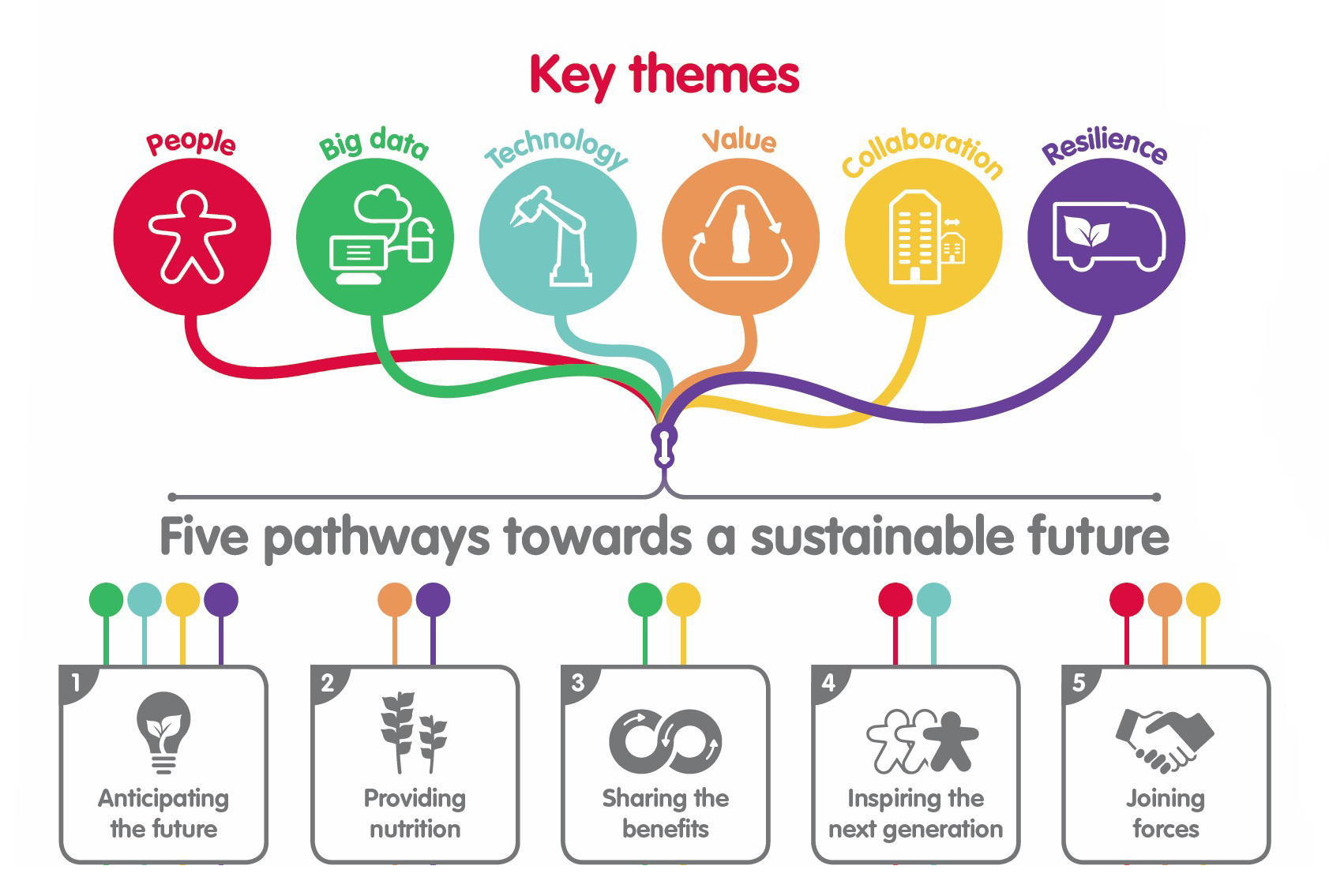
We found that food producers will need to focus on resilience and delivering the greatest value to customers, not just financially, but in the broadest, social sense. So manufacturers have to find ways to remove or alter ingredients that are considered unhealthy, continue to produce popular products, and balance this with the need to counter incidences of food over-supply and food waste. A constructive way forward will be to introduce models which are service-based and personalised to deliver convenience and value – moving away from mass production, and towards making personalised products to order. This will be achieved by small, local facilities that use technology to synchronise resource availability, supply and demand.
The use of sensors, big data analysis and the Internet of Things is already enabling real-time transparency across the supply chain, from ‘farm to fork’. Methods are being developed to exploit this data, be more transparent and to collaborate more with customers, suppliers and even competitors. This will help manufacturers to maintain a resilient and sustainable manufacturing business while meeting the needs of markets in general and, eventually, the needs of specific individuals. Some parts of the supply chain will use data to operate autonomously. Sensing technology will, for example, monitor the quality of farmland in real-time, ensuring that problems can be fixed immediately, keeping the land operating at maximum productivity and more sustainably. Similarly. in factories sensor technology will be used as a tool for monitoring quality and supporting real-time decision-making to keep manufacturing operating efficiently, identifying oncoming bottlenecks in the process. For consumers, data will be passed on, providing more detailed information about the provenance of food and the chains involved, as well as visibility about the use of fertilisers and their impact to the land and surrounding environment. ‘Smart tags’ on food products that indicate when it is no longer safe to eat and ‘smart kitchens’ will help manage the food available and reduce waste.
What does this mean for the food and drink industry?
The food and drink industry should work towards engaging society and sharing benefits when creating products. Well-being must be put at the centre of delivery and shared IP considered as a way to protect the environment. As collaboration increases, there will of course be more debate about the trade-off between, on the one hand, keeping data and intellectual property private and, on the other hand, the opportunities to minimise environmental impact by sharing big data and providing superior levels of service. It will be imperative that big companies take responsibility for leading the debate and acting ahead of consumer opinion. There’s even likely to be greater competition to work with sustainable farmers as manufacturers look to collaborate to secure quality resources. Customers will have a more direct role in collaboration and co-creation beyond just initial planning and product development.
How value and leadership is understood will change dramatically as companies join forces with each other, and with customers and society. This will become accepted as the only way to grow positively whilst reducing impact and footprint. It will require manufacturers to be key agents of change, as they have the capabilities and insight required to help educate and strengthen different aspects of the value chain. The concept of ‘loyalty’ has to extend beyond a company, into the supply chain and to further connect with consumers and promote the value of resources.
A manufacturing revolution?
Manufacturing has needed to undergo major transformations throughout its history. The next transformation looks to be one of the most testing, in terms of the need to open up, to fundamentally re-structure operations, form new partnerships, take on a new social role – but at the same time, brings all the opportunities and benefits related to sustainability, longer-term security and social integration.
—
The full report, Sustainable manufacturing for the future: The journey to 2050: research on the vision and pathways for sustainability in the food and drink industry in Great Britain, can be downloaded from the Coca Cola Enterprises website.

Categories & Tags:
Leave a comment on this post:
You might also like…
Keen to develop your study skills?
Alongside the technical skills and academic knowledge that you will gain on your course, as a Cranfield student you have the opportunity to develop a range of other skills that can enhance your learning experience. ...
The V-conomy: powering the sixth wave of global economic growth
The world could be on the verge of a major surge in economic growth and development, driven by the convergence of AI and clean energy technology. Waiting to ride the K-wave The Russian ...

Need help using the Python programming language?
We know some of our students are currently trying to learn Python, so we wanted to make you aware of some great LinkedIn Learning videos that can help. But don't you have to pay for ...

What does it really take to become a Chevening Scholar?
Say “Turkmenistan” to most people and you’ll get a blank look. That was true when I left Ashgabat for the UK to study an MSc in Logistics and Supply Chain Management at Cranfield University ...

Get a head start on referencing and plagiarism
We offer a module on Referencing And Avoiding Plagiarism which you can find on your Canvas dashboard. It explains the role and importance of citing references and how to incorporate the work of other authors ...

How Cranfield shaped my journey as an Aerospace Engineer
If I'm being specific about the moment it clicked, it was reading a paper called "On the Role and Challenges of Computational Fluid Dynamics (CFD) in the Aerospace Industry" by two Boeing engineers, P. ...