

From classroom to cockpit: What’s next after Cranfield
17/02/2026
The Air Transport Management MSc isn’t just about learning theory — it’s about preparing for a career in the aviation industry.
Adit shares his dream job, insights from classmates, and advice for prospective students.
This is the final blog post in the series:
- Part 1 – Landing at Cranfield: First-term experiences and life beyond the classroom
- Part 2 – Inside the Air Transport Management MSc: Classes, assignments, and group project work
- Part 3 – From classroom to cockpit: What’s next after Cranfield?
What was the highlight of your course?
“The way they have designed the course is truly amazing.”
It covers the fundamental aspects of airlines from a business perspective really well. For someone like me, with no prior experience in the aviation industry and who came here purely out of passion and interest, it was fascinating to study and discover what the aviation industry has to offer and how it’s structured. To future students, I’d recommend always communicating with professors when needed so you have everything you need for each module.
Do you get to fly in a plane as part of your course?
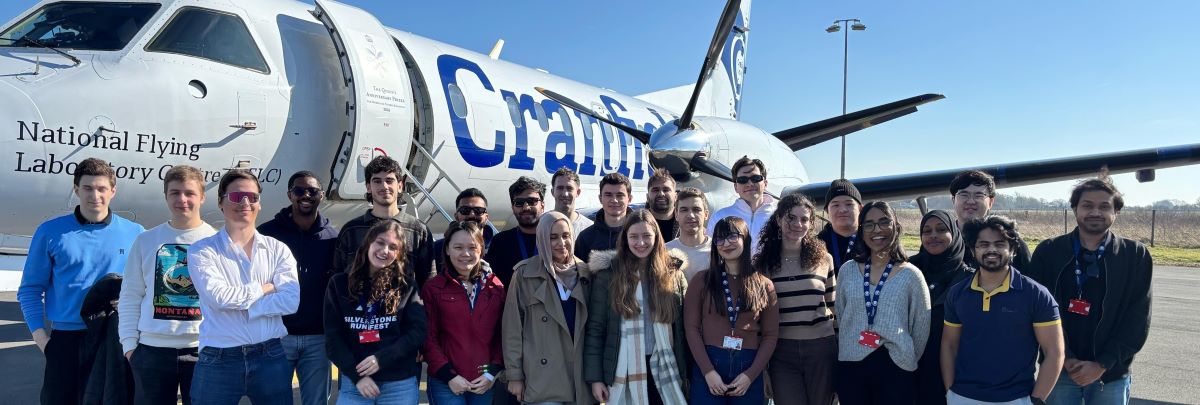
Not on the Air Transport Management programme, but there’s a Saab 340 based here that takes students on a flight from the aerospace courses (Aerospace Dynamics, Aerospace Vehicle Design, Astronautics and Space Engineering and Safety and Human Factors in Aviation). You get to observe different manoeuvres and feel G-forces from various parts of the aircraft.
What is your dream job after leaving Cranfield?
To be honest, my dream is to work for an airline. This course has taught me so much about the airline industry. It’s not just about pilots getting into the cockpit and flying, or maintenance personnel preparing the aircraft. There’s a huge management side to airlines that you don’t really see, and often don’t even think about when you’re standing in an airport watching aircraft take off.
So I’d love to work in one of those areas: with an airline, an aviation leasing company, or an aviation consultancy. Those are all roles I’d be very happy to move into.
Do you learn as much from your classmates as you do from faculty?
Absolutely! Many students come in with industry experience, and the insights they share are invaluable. Combined with the diversity of the course, you also get to learn about different cultures and how the air transport industry operates in other countries.
For me, this diversity has been particularly beneficial. I have classmates who share job opportunities and profiles from their home airlines, helping each other stay informed about potential career paths.
“That sense of camaraderie and mutual support is one of the most valuable aspects of the course — sometimes you learn just as much from your peers as you do from the faculty.”
Final words
If you’re still on the fence about applying, don’t hesitate to reach out. You can connect with student ambassadors on UniBuddy, who can help answer your questions and share their experiences. You also have access to professors’ email addresses and the administrative team at Cranfield, all of whom can provide guidance and support.
The key is to reach out — we’ll do our best to provide the information you need to make an informed decision about joining the course.
Update: Adit’s Success Story
We’re thrilled to share that since completing the Air Transport Management MSc, Adit Shah has successfully secured a role in the aviation industry in the Network Planning team at IndiGo!
Adit’s story highlights not only the academic and practical skills gained at Cranfield but also the strong network, industry exposure, and confidence you develop along the way. For prospective students, it’s proof that the MSc can truly open doors to exciting careers in airlines, consultancy, and aviation management.




Categories & Tags:
Leave a comment on this post:
You might also like…

Keen to develop your study skills?
Alongside the technical skills and academic knowledge that you will gain on your course, as a Cranfield student you have the opportunity to develop a range of other skills that can enhance your learning experience. ...

The V-conomy: powering the sixth wave of global economic growth
The world could be on the verge of a major surge in economic growth and development, driven by the convergence of AI and clean energy technology. Waiting to ride the K-wave The Russian ...

Need help using the Python programming language?
We know some of our students are currently trying to learn Python, so we wanted to make you aware of some great LinkedIn Learning videos that can help. But don't you have to pay for ...

What does it really take to become a Chevening Scholar?
Say “Turkmenistan” to most people and you’ll get a blank look. That was true when I left Ashgabat for the UK to study an MSc in Logistics and Supply Chain Management at Cranfield University ...

Get a head start on referencing and plagiarism
We offer a module on Referencing And Avoiding Plagiarism which you can find on your Canvas dashboard. It explains the role and importance of citing references and how to incorporate the work of other authors ...

How Cranfield shaped my journey as an Aerospace Engineer
If I'm being specific about the moment it clicked, it was reading a paper called "On the Role and Challenges of Computational Fluid Dynamics (CFD) in the Aerospace Industry" by two Boeing engineers, P. ...
Comments are closed.