


How do I reference… analysts’ reports in the APA7 style?
01/11/2024

Brokers’ and analysts’ reports can be invaluable sources if you are researching a company or industry. If you are are using any in your work, you will need to cite and reference them, just as you would with other sources. Because they are not traditional academic sources, you might be wondering which APA7 referencing format to use.
For these kinds of reports (also known as research reports), we would suggest that you use the format we already use for reports, but with some very minor tweaks. So, for this, we suggest the following format for your reference:
First of all, you need to collect together the following ‘elements’ to build your reference:
- Author or authors (in the format Surname, Initials.) This could also be a group author if no there are no named authors.
- Date of publication (Year, Month Day).
- Title of report [followed by type of report – Analysts’ report]. (MINOR TWEAK – Include only up to the first twenty words of the the report title).
- Publisher name. (If the publisher name matches the author name, exclude this element from your reference).
- URL or DOI (MINOR TWEAK – If there is no permalink available to your document, enter the URL for the database homepage).
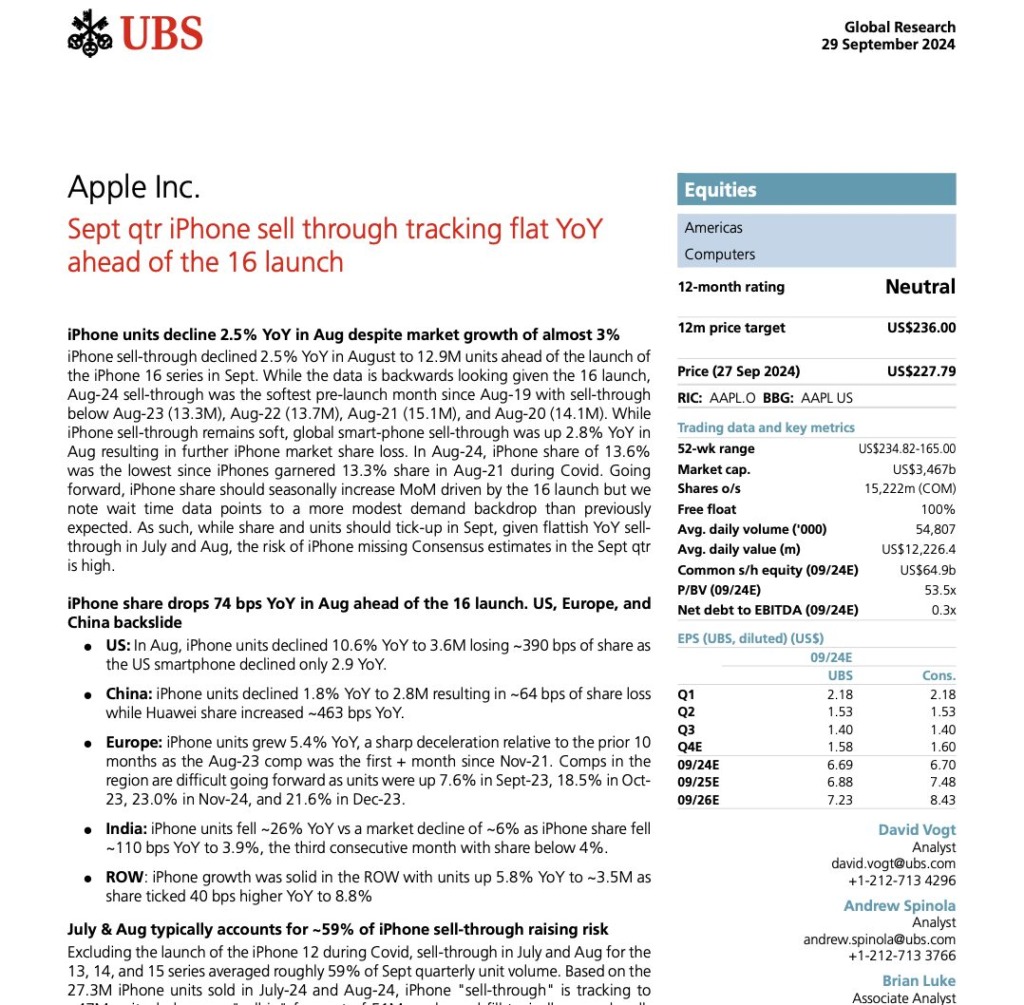
An analysts’ report from Capital IQ
So, the reference for this report would be:
Vogt, D., Spinola, A. & Luke, B. (2024, September 29). Apple Inc. Sept qtr iPhone sell through tracking flat YoY ahead of the 16 launch [Analysts’ report]. UBS Securities LLC. https://www.capitaliq.com
And, if I were citing this within my own text, I would use Vogt, Spinola & Luke, 2024 as my author-date citation.
Any questions about referencing? Consult our Referencing and Plagiarism pages or drop us an email here.
Please note: Cranfield supports two different referencing styles – APA7 (Author-date) and Numbered (NLM). Please make sure you use the style preferred by your supervisor or lecturer. The advice above relates only to the APA7 style. If you have any questions about referencing, please contact the Library.
Feature image from Pixabay. Available at: https://pixabay.com/photos/skyline-skyscraper-skyscrapers-1925943/

Categories & Tags:
Leave a comment on this post:
You might also like…

Introducing Barrington Library
Welcome to all our new students! Barrington Library supports all the students and staff at Cranfield Defence and Security on the Shrivenham site. We are looking forward to meeting you all soon, in person or ...

About to start your journey at Cranfield? We’re here to help!
Congratulations on accepting your offer to study at Cranfield! If you’re keen to get a head start before your course begins, our Library Services team is here to support you every step of the way. ...

Bank holiday hours for Library Services: Monday 31 August
Library Services staff will be taking a break on Monday 31 August for the bank holiday. You will still be able to access all the resources and help you need via our library website. The 24/7 ...

The real cost of studying in the UK – what international students need to budget for
Moving overseas to pursue a postgraduate degree is one of the most exciting investments you can make in your future. It's also one of the most significant financial commitments you and your family will ...

Seven things you should definitely prepare for before studying at Cranfield University
You're thinking about Cranfield. Maybe you've done the virtual tour, read through the course pages, spoken to the course director or attended a webinar. Now, you're trying to figure out what life here is ...

From insurance to aerospace: why I chose to study a PhD with Cranfield
My path to studying for a PhD wasn't exactly a straight line. I had just graduated with an MEng in Aerospace Engineering from the University of Surrey and, like a lot of people, wasn't ...