


ESDU – a fantastic resource for engineers!
07/12/2016

This is the first of a series of blog posts in which we will highlight some of our more specialist resources for engineers.
This one is all about ESDU. If you’re the kind of person who needs to find out how to calculate the strength of lugs under oblique load, or the lift-curve slope of swept and tapered wings, ESDU is the resource for you. It really is one of our ‘hidden gems’. It’s one of my favourite resources as it has helped me answer many tricky enquiries, and it gets such a great response when customers find the solution to their engineering design problem on it.
When I first started my Cranfield working life in the Kings Norton Library, ESDU stood for ‘Engineering Sciences Data Unit’ and comprised thousands of ‘data sheets’ which were filed away in hundreds of ring binders. Each time there was an update to a data sheet, ESDU sent us a new one and we would laboriously find the old version, throw it out and replace it with the new. Thankfully times have moved on and the service is now available online and is always up to date.
It contains fantastic information for engineers that really isn’t available elsewhere, and certainly not for free via a Google search. It’s a great place to go if you have an engineering problem that you want to solve, and it can save you lots of time and research by providing methods, worked examples and data. Its work is overseen by independent committees of technical experts (some of whom work at Cranfield), and is endorsed by the Royal Aeronautical Society, the Institution of Mechanical Engineers and the Institution of Chemical Engineers.
It contains equations, interactive graphs and software organised into 18 series. Experience has shown me that the best way to find what you need is to select the ‘Explore the ESDU series’ option and then browse to the information that you need.
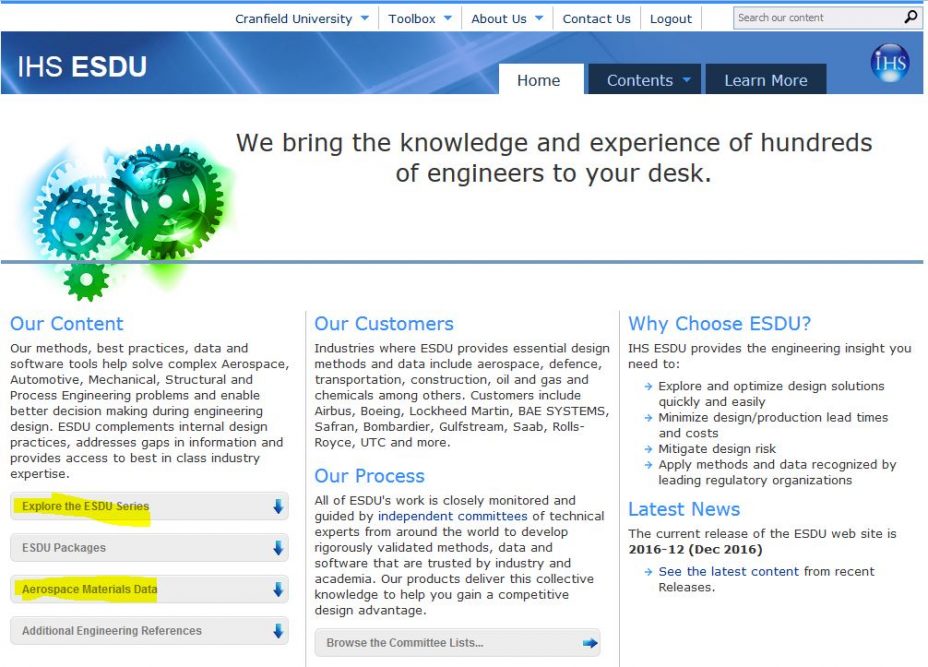
‘Explore the ESDU Series’ and ‘Aerospace Materials Data’ options highlighted on the ESDU home page
The series are: aerodyamics, aircraft noise, composites, dynamics, fatigue – endurance data, fatigue – fracture mechanics, fluid mechanics (internal flow), fluid mechanics (internal flow – aerospace), heat transfer, mechanisms, performance, phyiscal data (chemical engineering), stress and strength, structures, transonic aerodynamics, tribology, vibration and acoustic fatigue and wind engineering.
Alongside the data sheets is another handy resource. The Metallic Materials Data Handbook (MMDH) can be found behind the ‘Aerospace Materials Data’ link and is a great source of metals property data for aerospace engineers, bringing lots of information that has been evaluated and meets design requirements together in one place.
ESDU itself provides videos and help and I am always happy to advise you and answer your questions. Contact me at e.turner@cranfield.ac.uk.
Public domain image from Unsplash.com

Categories & Tags:
Leave a comment on this post:
You might also like…

Keen to develop your study skills?
Alongside the technical skills and academic knowledge that you will gain on your course, as a Cranfield student you have the opportunity to develop a range of other skills that can enhance your learning experience. ...

The V-conomy: powering the sixth wave of global economic growth
The world could be on the verge of a major surge in economic growth and development, driven by the convergence of AI and clean energy technology. Waiting to ride the K-wave The Russian ...

Need help using the Python programming language?
We know some of our students are currently trying to learn Python, so we wanted to make you aware of some great LinkedIn Learning videos that can help. But don't you have to pay for ...

What does it really take to become a Chevening Scholar?
Say “Turkmenistan” to most people and you’ll get a blank look. That was true when I left Ashgabat for the UK to study an MSc in Logistics and Supply Chain Management at Cranfield University ...

Get a head start on referencing and plagiarism
We offer a module on Referencing And Avoiding Plagiarism which you can find on your Canvas dashboard. It explains the role and importance of citing references and how to incorporate the work of other authors ...

How Cranfield shaped my journey as an Aerospace Engineer
If I'm being specific about the moment it clicked, it was reading a paper called "On the Role and Challenges of Computational Fluid Dynamics (CFD) in the Aerospace Industry" by two Boeing engineers, P. ...