


Phasing out HFCs – A big win for our climate
19/10/2016

Last week’s news from Kigali, Rwanda, that hydrofluorocarbons (HFCs) emissions are being phased out globally is truly excellent news for our students and their successors. This single measure will remove up to 0.5°C warming at a time when global temperatures are more than 1°C above pre-industrial levels. In last December’s Paris Agreement, the world’s countries agreed a target maximum warning of 2°C or, if possible, 1.5°C. Without this phasing out of HFCs, agreed by nearly 200 countries as part of the Montreal Protocol , this would not be possible.
As an expert on ozone depletion, I was the lead author on the Chapter on Scenarios and Information for Policymakers in the 2014 WMO/UNEP Scientific Assessment on Ozone Depletion. It was this report that acted as scientific basis for the discussions in Kigali, and so I am delighted to see this action having been taken.
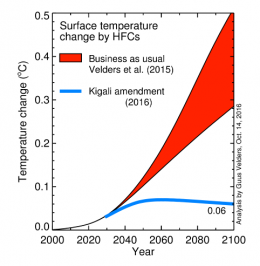
Source; Institute for Governance and Sustainable Development
The decision was reached in response to the Montreal Protocol on Ozone-Depleting Substances, whose goal is to protect the ozone layer, and represents a significant moment in the history of climate change talks and agreements.
Developed in the 1990s to replace ozone depleting substances, HFCs are powerful greenhouse gases and major contributors to global warming. Used mainly in air conditioners and refrigeration, they were listed among the seven greenhouse gases targeted by the UN Framework Convention on Climate Change.

Categories & Tags:
Leave a comment on this post:
You might also like…

5 budgeting mistakes students make (and how to avoid them)
Good financial planning isn't about how much money you have. It's about the habits you build. We asked Dr Lakshmy Subramanian, Course Director for the Banking, Economics and Finance MSc, about the budgeting mistakes ...
Finding your reading materials
Use Library Search Library Search is the first place to start when you are trying to find academic sources for your work. This is the search box on the library website homepage. It allows you ...

Formula 1 was the dream and Cranfield was the conduit
I still remember the exact moment Formula 1 (F1) got its hooks into me. I was in my first year of an aerospace undergraduate engineering degree when I watched a video about the sport ...
Introducing Barrington Library
Welcome to all our new students! Barrington Library supports all the students and staff at Cranfield Defence and Security on the Shrivenham site. We are looking forward to meeting you all soon, in person or ...

About to start your journey at Cranfield? We’re here to help!
Congratulations on accepting your offer to study at Cranfield! If you’re keen to get a head start before your course begins, our Library Services team is here to support you every step of the way. ...
Bank holiday hours for Library Services: Monday 31 August
Library Services staff will be taking a break on Monday 31 August for the bank holiday. You will still be able to access all the resources and help you need via our library website. The 24/7 ...