


We competed and won the Fourth Unilever Innovation Accelerator Competition
10/05/2022
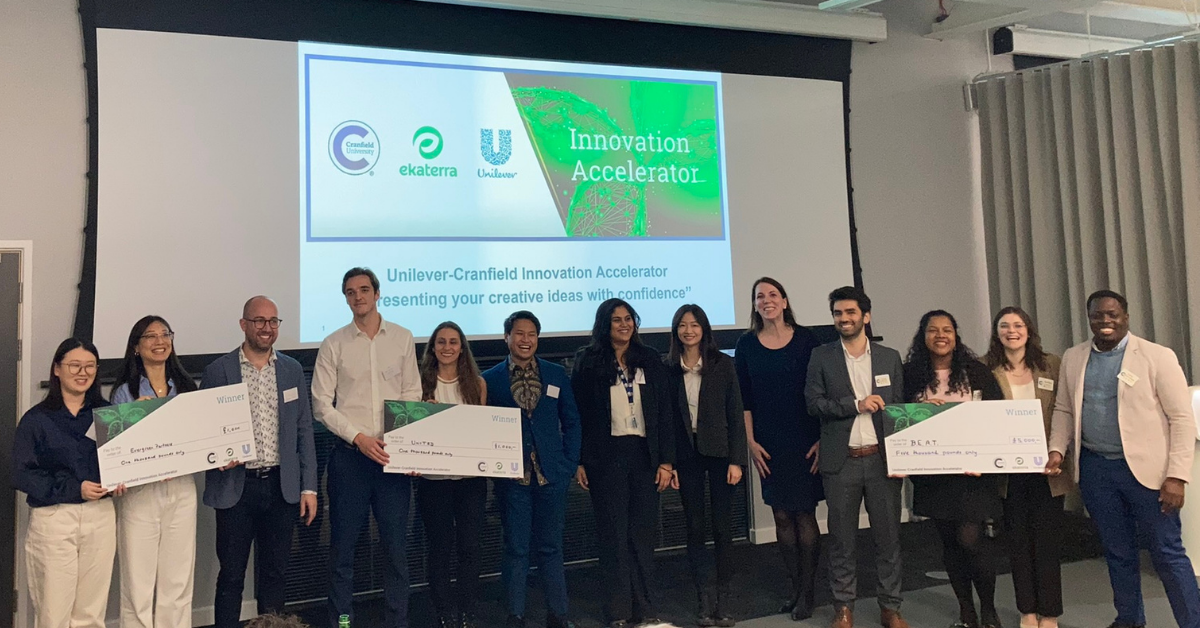
We are Bethan Lloyd and Axelle Lagaillarde from the Management and Corporate Sustainability Masters. Last month, as part of Team B.E.A.T, we competed and won the Fourth Unilever Innovation Accelerator Competition. We partnered with Elvis Mwesigwa and Tarek Kobrosli, who study an MSc in Water and Sanitation for Development and Management and Entrepreneurship, respectively. The aim was to propose a net-zero and community assisting ice cream cabinet for developing and emerging countries.
How did we approach it?
We wanted to use the frameworks and approaches we had learnt across our Sustainability modules such as Leading with Corporate Sustainability, Applied Sciences and Technology and Creating Sustainable Organisations. From the start, we wanted to focus on partnerships using a stakeholder model to benefit Unilever and the developing and emerging countries in which they operate. Our use of tools such as the Materiality Matrix helped in identifying the most pressing issues. For clarity, we used the Sustainable Development Goals (SDGs). Early on, we signposted Clean Water and Sanitation (No.6) and Affordable and Clean Energy (No.7) as our key goals.
We treated the process like an assignment, with research and took over a seminar room for old school process mapping on a white board. As a team, we were constantly in contact and held face to face discussions (with food!) which advanced our development process. Coming from diverse backgrounds, we capitalised on each other’s strengths whilst sharing and pushing each other’s knowledge.
As we were preparing for the pitch, we leveraged on our mentors from Unilever and Cranfield. Short regular meetings helped to refine our business case along with questions that made us think outside of the box.
What did we learn?
Growing an idea, working as a team to adapt an initial thought, and not being scared to change was critical to the process. We started off working on Challenge 2 which focused on spices, yet one of our teammates started discussing the possibility of exploring Challenge 1, which sounded more technical. As Sustainability students and not engineers, we were apprehensive about the technical details we would have to understand, but soon realised that Challenge 1 also had a scope to implement a community focused project. We understood this by identifying the problem statement and creating a customer centric solution for it.
The first stage of the application was a 3-page proposal, our first hurdle was squeezing all the required information in a cohesive manner. Bethan, who comes from a design and product development background, used her expertise with visual tools to synthesise a mock-up of our proposal. This allowed us to be more effective in communicating with the space we had.
When it came to expanding on the brief and preparing for the presentation, we focused on understanding the local context and why a social entrepreneurship scheme would benefit the community. After meeting with Dr Orsolya Ihasz, she outlined the best approach for a Dragon Den style pitch for the corporate minds of Unilever. This is when we realised, we had focused in too much on the emotions rather than the business case. Even though we knew our proposal would be profitable, we had not communicated that clearly.
For the presentation, one of the most practical tips we received was to understand that we only had 20 seconds to grab someone’s attention per slide. Mr Paul Lighterness, the Program Director for Design Thinking, assisted us in having clarity and uniformity across our slides and presentation.
How will we take the learnings forwards?
One of our key takeaways was following a project through from an initial brief to a presentation pitch. We are now equipped to run a similar type of consultancy job by taking ownership of a project as a team with strict deadlines.
We learnt a lot about Unilever’s Sustainability policy, particularly their compass which has the goal to make sustainable living a common place by integrating the pillars across a wide range of brands. As students, having an insight into an organisation that is at the forefront of sustainability within the FMCG industry, was an invaluable asset to our future careers.
We are planning to continue learning by re-investing part of the prize money with a Global Reporting Initiative (GRI) certification and Six Sigma Green Belt certificate.
We would highly encourage future students to participate in the Unilever Innovation Accelerator Competition to make the most of their experience at Cranfield.

Categories & Tags:
Leave a comment on this post:
You might also like…

Keen to develop your study skills?
Alongside the technical skills and academic knowledge that you will gain on your course, as a Cranfield student you have the opportunity to develop a range of other skills that can enhance your learning experience. ...

The V-conomy: powering the sixth wave of global economic growth
The world could be on the verge of a major surge in economic growth and development, driven by the convergence of AI and clean energy technology. Waiting to ride the K-wave The Russian ...

Need help using the Python programming language?
We know some of our students are currently trying to learn Python, so we wanted to make you aware of some great LinkedIn Learning videos that can help. But don't you have to pay for ...

What does it really take to become a Chevening Scholar?
Say “Turkmenistan” to most people and you’ll get a blank look. That was true when I left Ashgabat for the UK to study an MSc in Logistics and Supply Chain Management at Cranfield University ...

Get a head start on referencing and plagiarism
We offer a module on Referencing And Avoiding Plagiarism which you can find on your Canvas dashboard. It explains the role and importance of citing references and how to incorporate the work of other authors ...
How Cranfield shaped my journey as an Aerospace Engineer
If I'm being specific about the moment it clicked, it was reading a paper called "On the Role and Challenges of Computational Fluid Dynamics (CFD) in the Aerospace Industry" by two Boeing engineers, P. ...