


Looking back at Cranfield as an Alumna
29/04/2022
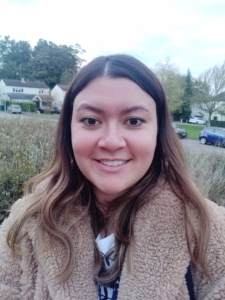 Grace Harland is a Cranfield alumna from Hertfordshire and studied a BSc in Geography at the University of Leeds. A year after graduation, she enrolled at Cranfield University to study Environmental Water Management MSc (now called Advanced Water Management MSc)
Why did you decide to pursue a postgraduate course?
I made the decision to pursue a postgraduate course during my time working as an Intern for Waterwise. I wanted to further my understanding in the field of Environmental Water Management and gain transferable skills which I could apply in my future career.
Why did you choose this postgraduate course and institution?
During my year of employment after completing my undergraduate degree, I received several recommendations from others who had attended the same course at Cranfield University. The insight I gained from discussions with them, and further research led me to choose the Environmental Water Management course at Cranfield. I was particularly interested in undertaking the group project, which other universities did not seem to offer an equivalent of, and the links with industry that this offered.
Did you take up further study immediately after your first degree? If not, what did you do? Please list any employment/travel/voluntary work you had.
After completing my degree at the University of Leeds, I worked for 9 months. I was offered a 3-month research assistant post at the University of Leeds. The role progressed the research I had undertaken for my dissertation. I then worked as an Intern for Waterwise for 6 months.
Please tell me a little bit about the course and what it involves, including details of your individual Master’s project.
The course was split up into modules, a group project and an individual thesis project. Each module lasted two weeks with the first week dedicated to teaching and the second week spent undertaking the module assessment. This format worked well as you could focus on one topic at a time. The group project followed the modules and lasted for approximately 3 months. There were a number of projects that we could choose between, and they were offered to students across three different courses, providing an opportunity to collaborate with other students on the other watercourses at Cranfield. The outputs of the project were a report and a poster presentation which were provided to the client. My individual project was on climate change modelling. This involved producing a number of greenhouse gas emission scenarios and assessing the future impact of the agriculture and forestry sector.
What have you done since you graduated e.g., job/further study/travel?
I have been working at Affinity Water as an Asset Scientist in the Water Resources & Environment team. The MSc was an important step forward in my career and helped me secure my role at Affinity Water.
What was the highlight of your Master’s degree?
My highlight was undertaking the group project. I was in a group with seven others from my course and we completed a project on diffuse pollution for Natural England, which included a field trip to Norfolk to collect the data for our report. As a group we analysed, interpreted and made recommendations from the data we had collected to produce the report. At the end of the project, we were tasked to produce a poster and present the findings. We also had the opportunity to present the key findings to the client. Throughout the project duration, I drew upon and improved on a number of transferable skills.
What tips would you give to others choosing a Masters’s degree?
Dedicate time to exploring a variety of Master’s courses and attend the open days so you can gauge whether the course is likely to be the right fit for you. I would advise using LinkedIn and other platforms to network with former students and students looking into further study. You might even come across a course or university that you had not previously considered.

Categories & Tags:
Leave a comment on this post:
You might also like…

Keen to develop your study skills?
Alongside the technical skills and academic knowledge that you will gain on your course, as a Cranfield student you have the opportunity to develop a range of other skills that can enhance your learning experience. ...

The V-conomy: powering the sixth wave of global economic growth
The world could be on the verge of a major surge in economic growth and development, driven by the convergence of AI and clean energy technology. Waiting to ride the K-wave The Russian ...

Need help using the Python programming language?
We know some of our students are currently trying to learn Python, so we wanted to make you aware of some great LinkedIn Learning videos that can help. But don't you have to pay for ...
What does it really take to become a Chevening Scholar?
Say “Turkmenistan” to most people and you’ll get a blank look. That was true when I left Ashgabat for the UK to study an MSc in Logistics and Supply Chain Management at Cranfield University ...

Get a head start on referencing and plagiarism
We offer a module on Referencing And Avoiding Plagiarism which you can find on your Canvas dashboard. It explains the role and importance of citing references and how to incorporate the work of other authors ...
How Cranfield shaped my journey as an Aerospace Engineer
If I'm being specific about the moment it clicked, it was reading a paper called "On the Role and Challenges of Computational Fluid Dynamics (CFD) in the Aerospace Industry" by two Boeing engineers, P. ...
Comments are closed.