


Submarine hunter by day, PhD student by night – an update: What I wish I’d known at the start…
21/04/2021
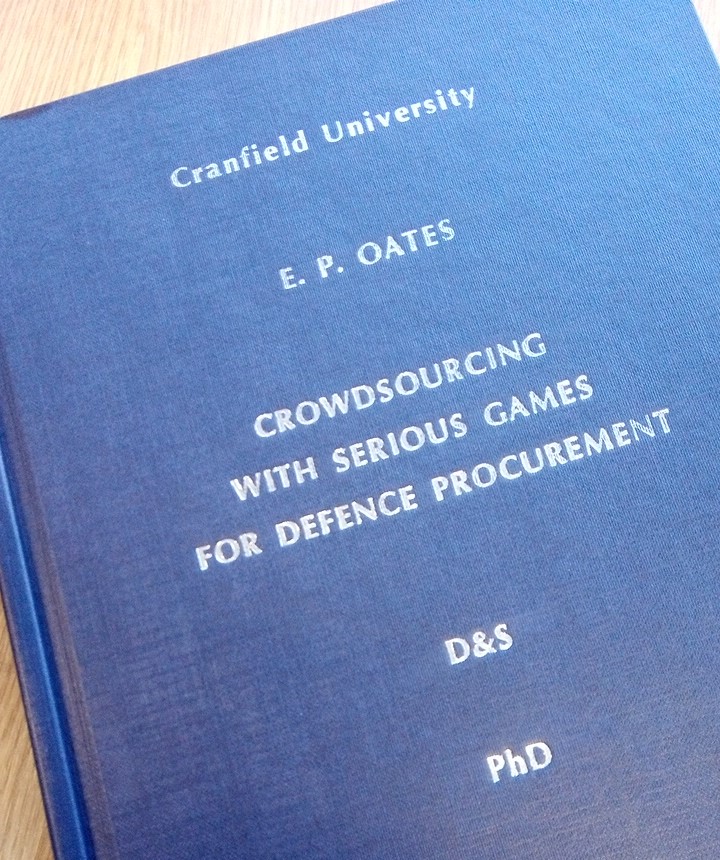
Lieutenant Commander Ed Oates wrote about his experiences while completing a PhD part-time at Cranfield Defence and Security in 2017. After recently successfully defending his thesis, Crowdsourcing with serious games for defence procurement, Dr Oates shares some reflective thoughts on the process, including his experience with funding:
Having completed a part-time PhD with Cranfield University, here are a few thoughts to inform those who follow on, or are thinking of following on. What I’ve experienced is, inevitably personal, but read a few of these experiences and pick out the bits that apply to you as well…
Towards the end of my studies which took a year and a half to plan, and six and a half years to implement, a book was published that covered a fair-sized chunk of what I was working on. I read the book and then went back to the Preface where the author stated: ‘… this is the book that I wish I’d had at the start of my career …’. I nearly fell off my chair – that was exactly what I was feeling!
For some, it might be a fear that as you work towards a final draft of your thesis, your work will be overshadowed by another student publishing on the same topic ahead of you. For a full-time thesis over three years this might be less of a worry, but research is moving at such a pace that you will almost certainly be working in parallel with someone else, somewhere in the world.
Don’t worry. If you’re working independently your work will always be unique and will withstand any other publication. You will have added to the store of academic knowledge on the subject and will be at least a comparator with anything else but more likely offer an alternative approach to the topic. For example, during the eight years I was working, a commercial version of my Serious Game started and then ran out of funds and was never completed, and another academic study took a different branch because they had greater funding. The end result was: do it this way if you’re short of funding or do it that way if you’re fully-funded, both options have value.
Having mentioned ‘funding’, I’d better address that aspect. If you can get funding from your employer then that’s great, but in my case, I thought I was going to be funded but then it came to nothing, so I started as a self-funded student. Then, three years into the study and with something to show for my work, I gained part-funding. You just don’t know how things are going to turn out. In my first week of the introductory programme, I was sitting next to an employer-funded student who wanted to know what arrangements were in place to cover their conference fees, and travel and subsistence costs. To me, that sounded so strange. I was fully invested in my thesis and so long as I could eat, I was prepared to invest in the pursuit of knowledge and personal development.
A PhD is a huge investment of time and money, and these are both finite resources but way more important than either of these is the personal will underpinned by a deep interest in the subject. Answer these questions to yourself: Is this subject your hobby, obsession, or deep abiding interest? Then ask yourself: Is there time in your lifestyle to give weekends, evenings, holidays and other odd-moments to this topic? Only after that, think about the funding because with a commitment to the subject and time to devote to it, you will bring others with you, including those who control the cash!

Categories & Tags:
Leave a comment on this post:
You might also like…

Engineering Tomorrow. Part two: Can we move around the world without emissions?
Moving people and goods around the world is essential to modern life. But every journey has an environmental cost, and reducing the emissions associated with transport is one of the major engineering challenges of ...

Following in the footsteps of aerospace pioneers
I came to Cranfield to understand how aircraft stay in the sky. Months later, I was measuring the performance of aircraft engines in flight aboard the National Flying Laboratory Centre's Saab 340B. My ...

From looking up at jet engines to powering the future of flight
From flying aboard Cranfield's Saab 340B flying classroom to rebuilding a gas turbine component by component, Jouni Kailouh's journey shows how specialist, hands-on experience can turn a fascination with propulsion into a future career ...
Engineering Tomorrow. Part one: Can we power the future without costing the Earth?
The world needs energy. To power homes, industries, transport and the technologies shaping our future. But as demand grows and the pressure to reduce emissions increases, how do we generate the energy we need ...

Looking ahead: Building foresight skills for a more sustainable future
As sustainability challenges become more complex and uncertain, organisations need people who can look beyond today's pressures and think strategically about the future. From changing regulations and emerging technologies to supply chain disruption and ...

Brazil to Cambridge: How Cranfield helped me build a career in data analytics
I was hungry for something bigger. Before Cranfield, I was living in São Paulo, Brazil, working as a Data and Market Intelligence Analyst in the trading division of Raízen. My background is actually ...