


Following in the footsteps of aerospace pioneers
26/11/2026

I came to Cranfield to understand how aircraft stay in the sky. Months later, I was measuring the performance of aircraft engines in flight aboard the National Flying Laboratory Centre’s Saab 340B.
My very first flight, taken as a small child, was enough to spark a fascination with all that flies. It was this fascination that led me to read engineering, in order to understand the principles that keep an aircraft on the sky. During my undergraduate studies I first encountered Cranfield, and I confess that my initial search left me somewhat puzzled as I had expected a traditional university campus and found instead an airport.
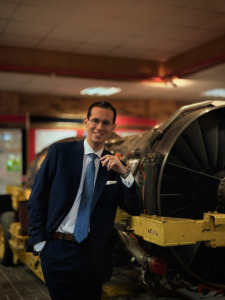 The more I learnt about Cranfield’s history, the more I came to admire its aeronautical heritage, which reaches back to its founding as the College of Aeronautics in 1946. The College’s very raison d’être was to educate the engineers Britain required at the time to build its aerospace industry, and the prospect of studying at an institution of such distinction was precisely what I sought. I vividly recall watching an old British Pathé film about the College, in which its students were shown boarding an aircraft for a test flight as part of their training; little did I imagine that I would one day do the same.
The first few months were demanding, as we were required to balance a full programme of lectures with preparation for our examinations. With the support of our lecturers and the wider staff, we persevered, not only passing our exams but also gaining a genuine understanding of some complex technical subjects. One amusing episode from that period, which also highlights Cranfield’s uniqueness, is when during a lecture we were obliged to pause for a minute, as an aircraft taking off outside was too loud to talk over.
Thus, rather than merely discussing propulsion aerodynamics on the whiteboard, we had only to look out of the window to see it in action.
All of this came together on my favourite day here: the day of our test flight. In June we flew aboard the National Flying Laboratory Centre’s Saab 340B, measuring the performance of its engines in real time, an experience that will remain with me always. As the engines spooled up for take-off, I couldn’t help thinking back to where my passion for aviation began.
For a few moments I was once again that small boy gazing out of the aeroplane window, only now there was a screen of instruments before me displaying the engines’ vital signs, and it fell to me to interpret them.
Beyond the flying, Cranfield offers plenty of opportunities to develop, the most fundamental being the quality of the teaching. Lectures were never a mere one-way transmission of material but rather they were truly interactive, with our lecturers frequently inviting our technical opinions on the problems at hand. The discussions that ensued helped us build a more mature and well-rounded understanding of each subject, which will serve us well in our careers.
Alongside the taught modules, my course is built around the master’s thesis, which we select early on and work throughout the year.
Owing to Cranfield’s close ties with industry, this means tackling real industry problems, and delivering, under pressure, work of the standard one would expect from an institution of this calibre.
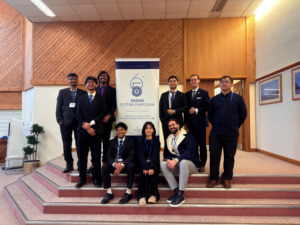 Another highlight of my year so far was chairing the 65th Engine Systems Symposium, an annual conference organised and run by each year’s MSc Thermal Power and Propulsion cohort. The programme comprised presentations by students alongside talks by members of Cranfield’s research staff, spanning a broad range of subjects in gas turbine engineering and future aerospace propulsion. Having been involved from the earliest stages of planning through to chairing the sessions on the day, I learnt a great deal about organisation, teamwork and leadership. It was a responsibility I had never anticipated undertaking when I first arrived, and one of which I am genuinely proud.
Ultimately, it is the people who shape a university, and Cranfield’s international community is among its greatest strengths. It draws talented individuals from a wide range of professional and academic backgrounds, and my conversations with them have opened my eyes to opportunities and career paths I might otherwise never have contemplated. Beyond the professional sphere, living in so cosmopolitan an environment offers the chance to form friendships with people from every corner of the globe. Our conversations about our respective countries and cultures have been among the most rewarding aspects of my time here.
Discovering both the differences and the similarities between us has broadened my outlook, and has even revealed things about myself and my own culture that I had never noticed before.
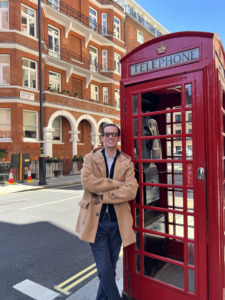
Cranfield’s modest size lends it a close-knit community, in which it is easy to meet people and to form the friendships that are vital on a course as demanding as ours. Its location is another bonus. Situated in the heart of the English countryside, Cranfield offers a glimpse of a quieter side of British life. For those of a more metropolitan disposition, fast trains from nearby Milton Keynes reach London in little over half an hour, placing concerts, world-class museums and the celebrated theatres of the West End within easy reach.
With the taught component of the course now complete, I look forward to submitting and defending my thesis. After months of work on a topic I find genuinely interesting, I am eager to present a piece of work I can be proud of. Wherever my path may lead after Cranfield, I can say with certainty that it has equipped me with the knowledge and skills to perform at a high level, and with the confidence to venture beyond my comfort zone.
Cranfield’s motto “Post Nubes Lux”, seems to me particularly fitting, as my time here has taught me how to look past the clouds and, ultimately, to fly above them towards the light. I shall always look back fondly on this unique year, spent studying the state of the art in aerospace propulsion within a stone’s throw of a working runway, at an institution where some of the most important chapters of aeronautical history were written.
Ready to shape the future of aerospace propulsion?
Study alongside a working airport, tackle real industry challenges and learn from experts at the forefront of aviation. Discover how the Thermal Power and Propulsion MSc can help you develop the knowledge, skills and confidence to become part of the next generation of aerospace engineers.


Categories & Tags:
Leave a comment on this post:
You might also like…

Engineering Tomorrow. Part two: Can we move around the world without emissions?
Moving people and goods around the world is essential to modern life. But every journey has an environmental cost, and reducing the emissions associated with transport is one of the major engineering challenges of ...
Following in the footsteps of aerospace pioneers
I came to Cranfield to understand how aircraft stay in the sky. Months later, I was measuring the performance of aircraft engines in flight aboard the National Flying Laboratory Centre's Saab 340B. My ...

From looking up at jet engines to powering the future of flight
From flying aboard Cranfield's Saab 340B flying classroom to rebuilding a gas turbine component by component, Jouni Kailouh's journey shows how specialist, hands-on experience can turn a fascination with propulsion into a future career ...
Engineering Tomorrow. Part one: Can we power the future without costing the Earth?
The world needs energy. To power homes, industries, transport and the technologies shaping our future. But as demand grows and the pressure to reduce emissions increases, how do we generate the energy we need ...

Looking ahead: Building foresight skills for a more sustainable future
As sustainability challenges become more complex and uncertain, organisations need people who can look beyond today's pressures and think strategically about the future. From changing regulations and emerging technologies to supply chain disruption and ...

Brazil to Cambridge: How Cranfield helped me build a career in data analytics
I was hungry for something bigger. Before Cranfield, I was living in São Paulo, Brazil, working as a Data and Market Intelligence Analyst in the trading division of Raízen. My background is actually ...