

Aerospace Materials MSc – delivering the future sustainable vision of aerospace
03/03/2020
The first month of the calendar year was a busy one for our Aerospace Materials MSc students, with exams, two teaching weeks and a private study week.
Aerospace Materials MSc in focus
January began with an interesting teaching week on “Materials Selection”. This involves working together in groups on a variety of design specifications, across a range of applications for aerospace through to automotive, using a recommended method to select and defend choices. Lots of discussion, followed by a week to work on a set problem in some depth, before the final, busy teaching week of “Surface Science and Engineering”.
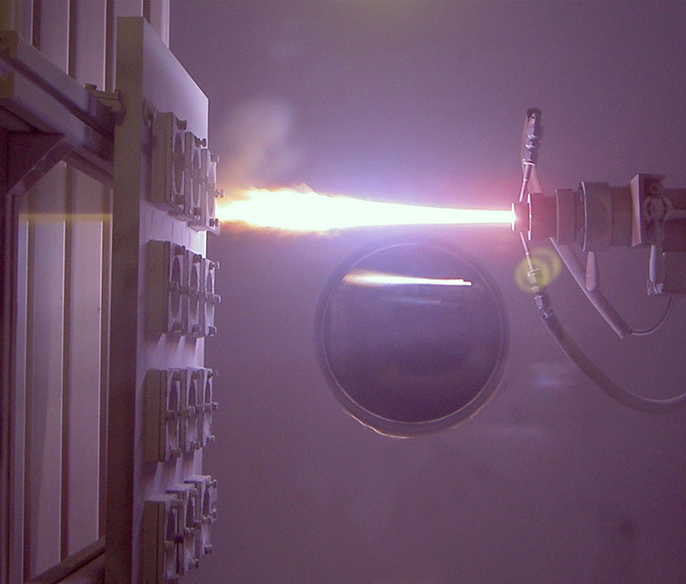
Surface science engineering is a specialism at Cranfield University, where we have a breadth of unique facilities and a long-standing track record of research with partners such as Rolls-Royce. This module allows us to consider how surface engineering may be used to optimise the performance of a range of components; coating systems on aero-engine turbine blades are great examples, developed in collaboration with Rolls-Royce. We address a range of methods of depositing coatings, suitable analytical techniques to evaluate surfaces and how to assess performance in application such as friction, wear, aqueous corrosion and high temperature oxidation.
The start of February, with the taught element of the course completed, our students started the first of two research project opportunities. They met in their new, small, project teams to address the many industry design problems and research challenges that have been set for the groups. This experience is highly valued by both students and prospective employers. With support from external organisations, the findings will be presented to industry in 12 weeks which is a very exciting time for our students.
“The research part of the MSc greatly exceeded what I expected. Both the group and the individual projects were invaluably enriching experiences, and the main reason I decided to come back to undertake an EngD,” says Koldo Amandoz Forcén who graduated from the Aerospace Materials MSc course in 2017.
Aerospace materials enabling sustainable aviation
Never before has there been such a need for specialist engineers with a deep understanding of aerospace materials. There is a real demand for innovative thinkers to address environmental impact and sustainability with the sector to enable the next-generation aircraft and future aerospace. We continually review our course content and equipment to ensure our graduates have the skills needed to meet the future challenges.
Cranfield University is committed to support of materials research and has recently invested £1.6M in renewal of the ‘Electron Microscopy Suite’, part of our materials characterisation facilities. Students took part in introductory lectures last month, focused on a range of techniques and will use these new facilities to support their group design projects and later in their own individual research projects in the spring.
We look forward to our students completing their MSc course and seeing them develop material technologies to deliver the future sustainable vision of aerospace.
For more information or to apply for this MSc, please visit the Aerospace Materials MSc course page.
Dr Sue Impey, Course Director, Aerospace Materials MSc
MSc Programme Director: Manufacturing Technology and Materials

Categories & Tags:
Leave a comment on this post:
You might also like…
Introducing Kings Norton Library
Welcome to all our new students! We are looking forward to meeting you soon. You will find Kings Norton Library in the centre of the Cranfield campus, and it is open 24/7 to all staff ...

Setting your research on the right course: Four questions every researcher should ask
Whether you are just beginning your doctoral journey or are already well into your research career, successful research rarely happens by accident. Like any successful mission, it depends on good planning, informed decisions, and getting ...

5 budgeting mistakes students make (and how to avoid them)
Good financial planning isn't about how much money you have. It's about the habits you build. We asked Dr Lakshmy Subramanian, Course Director for the Banking, Economics and Finance MSc, about the budgeting mistakes ...

Finding your reading materials
Use Library Search Library Search is the first place to start when you are trying to find academic sources for your work. This is the search box on the library website homepage. It allows you ...

Formula 1 was the dream and Cranfield was the conduit
I still remember the exact moment Formula 1 (F1) got its hooks into me. I was in my first year of an aerospace undergraduate engineering degree when I watched a video about the sport ...

Introducing Barrington Library
Welcome to all our new students! Barrington Library supports all the students and staff at Cranfield Defence and Security on the Shrivenham site. We are looking forward to meeting you all soon, in person or ...