

Expanding the World Soil Survey Archive and Collection (WOSSAC)
25/10/2018
Cranfield University’s World Soil Survey Archive and Collection (WOSSAC), has recently acquired a valuable collection of documents and maps which ensures the status of this unique resource centre as the principle collection of soil and land documentation in the UK, and one of the most significant centres in Europe, playing a key part in Cranfield University’s 2017 Queen’s Anniversary Prize in Further and Higher Education for Soil Science.
The additional materials have been provided by the long established international consultancy organisation Booker Tate Limited, based in Thame, Oxfordshire. Renovations to their offices within the UK, led to the decision to downsize the library resulted in some 600 items including reports, books, and over 200 maps relating to soils and land resources being offered to the WOSSAC facility at Cranfield University. A number of map storage units to house the collection have also been gifted to WOSSAC.
The materials are being introduced to the WOSSAC facility on the Cranfield campus, part of a significant investment of £4 million from Cranfield University to develop a new Environmental and Agricultural Informatics capability, with a dedicated new building being commissioned currently. The materials received from Booker Tate will be sorted, catalogued and entered into the web-based WOSSAC listings, ensuring that this resource is available for future research and development planning.
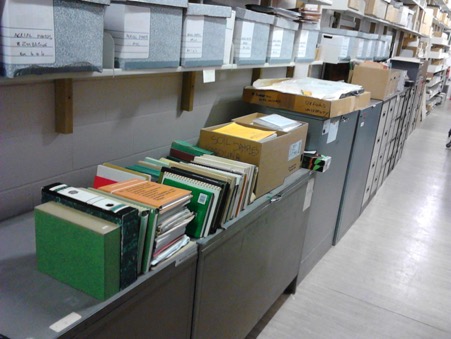
Materials arriving for sorting at the Cranfield WOSSAC archive
This additional material complements the existing WOSSAC resource and is especially important in soil science as the Booker Tate consultancy has a long history in tropical plantation agriculture. The documentation reflects this aspect of land resource assessment and includes land appraisals reports and maps from Africa, South-East Asia, the Caribbean and South America.
The map collection offers a particularly interesting resource as these maps are often difficult to locate in-country: many territories have suffered security breakdown, map collections are lost or destroyed and government agencies are merged or closed. These additional maps provide both reconnaissance and detailed assessments of land considered suitable for plantation crops such as sugar: land assessments in Somalia are one example.
Similarly the documents acquired include unpublished reports. With few copies printed, most are unlisted on any library data base, and are difficult to obtain.
The historical importance of these documents will be a rich source of research for academics and also be an essential first-step in any modern land evaluations for rural development, in many developing counties recovering following conflict and in plans to address the UN Sustainable Development Goals.
The ultimate aim is to scan documents in a systematic way and add these to the web based catalogue. In the short term documents or maps specifically requested can be scanned and made available in response to a request.
The Booker Tate consultancy continues to offer a wide range of professional services from offices in the UK and overseas, www.booker-tate.co.uk
A recent academic paper outlining more about WOSSAC its applications, and wider ‘land information systems’ work at Cranfield is:
Hallett, S.H., Sakrabani, R., Keay, C.A. and Hannam, J.A. (2017) Developments in Land Information Systems: Case studies in land resource management capabilities and options. Soil Use and Management. Volume33, Issue4. December 2017. Pages 514-529 doi:10.1111/sum.12380
http://onlinelibrary.wiley.com/doi/10.1111/sum.12380/full
Further information on WOSSAC can be obtained from Dr Stephen Hallett, Associate Professor in Environmental Informatics at Cranfield University (personal page), and from www.wossac.com

Categories & Tags:
Leave a comment on this post:
You might also like…
Finding your reading materials
Use Library Search Library Search is the first place to start when you are trying to find academic sources for your work. This is the search box on the library website homepage. It allows you ...

Formula 1 was the dream and Cranfield was the conduit
I still remember the exact moment Formula 1 (F1) got its hooks into me. I was in my first year of an aerospace undergraduate engineering degree when I watched a video about the sport ...
Introducing Barrington Library
Welcome to all our new students! Barrington Library supports all the students and staff at Cranfield Defence and Security on the Shrivenham site. We are looking forward to meeting you all soon, in person or ...

About to start your journey at Cranfield? We’re here to help!
Congratulations on accepting your offer to study at Cranfield! If you’re keen to get a head start before your course begins, our Library Services team is here to support you every step of the way. ...
Bank holiday hours for Library Services: Monday 31 August
Library Services staff will be taking a break on Monday 31 August for the bank holiday. You will still be able to access all the resources and help you need via our library website. The 24/7 ...

The real cost of studying in the UK – what international students need to budget for
Moving overseas to pursue a postgraduate degree is one of the most exciting investments you can make in your future. It's also one of the most significant financial commitments you and your family will ...