

Why I co-organised Ripples make Waves
22/03/2017
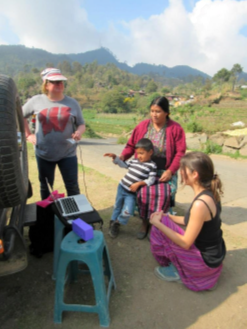
That picture was taken two years ago. I was talking to a school in the USA, answering questions and translating answers into English from indigenous people talking about their life.
Back then, I was working in Guatemala designing and implementing water systems with Agua Para la Salud, a non-profit organisation. One of the projects I worked on was at Chinimaya, a tiny village, where I met a great group of engineers and professionals from Wisconsin Water for the World. They go every year to work on a different project.
Joan Roehre (standing in the picture) and John Andersen were part of the organisation, but they also founded ‘Adventure Kids Learning’, a little non-profit organisation that helps to highlight the water crisis to classrooms in the USA. They decided to use their trips to raise awareness about water problems and share the different social realities with the students.
I had the opportunity to work with them and I enjoyed it greatly. The indignation of the North-American students when they learnt about the situation of women, their surprise when discovering that they didn´t have showers, and that children had to travel far to get water (not safe water, just water) showed, was an eye opener for them. They weren’t happy with that situation even though it was happening far away from them. For me, that was the beginning of this story.
Sometimes, you connect with people, sometimes you don´t. Sometimes it takes months, sometimes it takes hours. In my case, with Joan and John, it didn´t take long. We kept in touch after I came back to Europe, and last year in one of our conversations Joan told me: “I want to make a live, virtual event for the World Water Day, and I want you in” And that was all it took to convince me… So we started!
Ripples Make Waves is a live, 24-hour, interactive video event bringing students of the world together to share water stories, discuss change and advocate for each other, the need and the right for every child to have safe water. And it starts at 2pm today!
We have speakers presenting from 15 different countries, and the event is sanctioned by the UN Water. Ripples Make Waves was initially thought to be an event for schools from all around the world. However, due to the high interest shown by both, young and adult individuals, we decided to open it to all public. The aim is to share stories, problems and solutions about water so the more people we reach, the better!
 I have often been asked why did I get involved in Ripples Make Waves?
Short answer: Why not?
Long answer: Water and sanitation is a topic that needs to be raised, shared and discussed, and I truly believe that education and information are powerful tools for change.
In my opinion, bringing science and information to the general population is one of our responsibilities. But is more than that: Not everybody knows that a single battery can pollute 600,000l of water, or that a plastic bag has a degradation time estimated between 20 to 1000 years.
Developed countries tend to take for granted their access to safe water. However, the story in Flint, USA, may bring a bit of perspective on how this assumption can be wrong even in the so called ‘developed countries’.
It is difficult to understand the implications that the lack of toilets have when it comes to safety for girls and women if you have never heard about it. Also, communication among different countries with similar problems may inspire similar or new solutions, which would be a very useful consequence of this event.
It is necessary that people learn about the problems that plastic bags are causing in other parts of the world and it´s important to talk about environmental challenges and social realities. It is not the same to read it, than a person who is working on it shares their story, and their reasons to put effort on this particular task.
A message delivered by someone with passion travels further, and we have a lot of passionate speakers! Personally, co-organising Ripples Make Waves has been a very rewarding experience. It is indeed a lot of work, but I´ve got to learn about very interesting projects, contacted incredible people, developed new skills, and I also had the chance to work again with Joan Roehre, who is not only extremely passionate about water and social justice, but is also a natural at making entire classrooms and audiences, regardless their age, learn and have a great time.
We believe that future generations have the power to change things, that people can change behaviour if they find good reasons to do so. We are convinced that every action, every step, and every drop counts. And that´s why Ripples Make Waves was created, it’s our way to start a wave.

Categories & Tags:
Leave a comment on this post:
You might also like…
Keen to develop your study skills?
Alongside the technical skills and academic knowledge that you will gain on your course, as a Cranfield student you have the opportunity to develop a range of other skills that can enhance your learning experience. ...
The V-conomy: powering the sixth wave of global economic growth
The world could be on the verge of a major surge in economic growth and development, driven by the convergence of AI and clean energy technology. Waiting to ride the K-wave The Russian ...
Need help using the Python programming language?
We know some of our students are currently trying to learn Python, so we wanted to make you aware of some great LinkedIn Learning videos that can help. But don't you have to pay for ...
What does it really take to become a Chevening Scholar?
Say “Turkmenistan” to most people and you’ll get a blank look. That was true when I left Ashgabat for the UK to study an MSc in Logistics and Supply Chain Management at Cranfield University ...
Get a head start on referencing and plagiarism
We offer a module on Referencing And Avoiding Plagiarism which you can find on your Canvas dashboard. It explains the role and importance of citing references and how to incorporate the work of other authors ...
How Cranfield shaped my journey as an Aerospace Engineer
If I'm being specific about the moment it clicked, it was reading a paper called "On the Role and Challenges of Computational Fluid Dynamics (CFD) in the Aerospace Industry" by two Boeing engineers, P. ...