

Go big or go home!
19/12/2018

For the third two-week module of the Water and Sanitation for Development MSc, students were given the exciting task of participating in an urban water utility simulation. WaterMan is an activity which simulates the financial planning as well as management and development decision-making processes of an urban water utility in a low to middle-income country. Divided into teams of four, we were given the task of increasing the health of our populace whilst generating an adequate return on capital invested, all through improved service coverage.
This exercise exposed us to real world processes and the consequences of corporate decision making on both the utility and the community we were serving. Basing our decisions on examples from case studies provided during morning lectures, we spent four afternoons carefully devising key performance indicators and calculating investment priorities for our respective water utilities.
There was tough competition between Wasafi City, White Gold, Hydra and Manina water companies, each keen to provide the best service while maximising profit and efficiency. Wasafi City took the lead with their ambitious investment strategy and courage to request significant loans from government and private investors to reach a maximum number of people in the community.
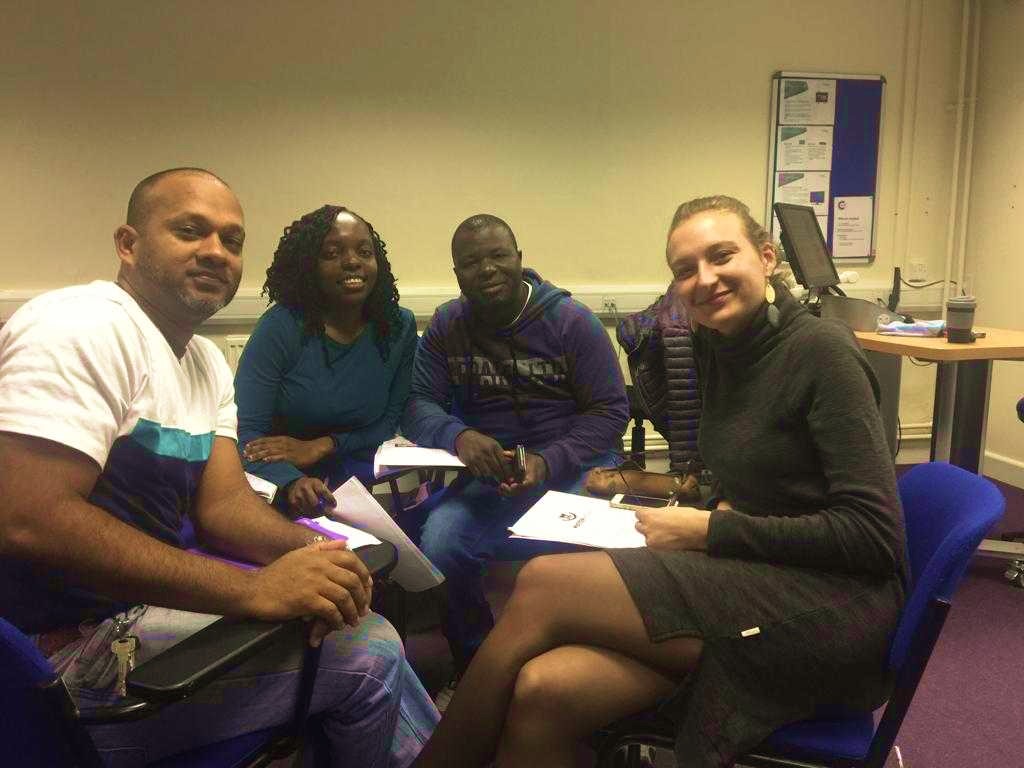
Stategy meeting between Wasafi City management
Each of the four afternoons represented a simulated ‘year’ (decision cycle) and required us to adjust our investment in hardware, software, tariff-setting and finance based on the outcome of the previous ‘year’. Pouring over our performance indicators, balance sheets and income statements, our investment decision sheets generated lively debates followed by suspense as we awaited the outcome the following day. By the next afternoon, the results were released and the cycle began again. Tensions were high in the room as each team strategized on how to make their companies most viable, competitive and equitable. The enthusiasm and emotional investment in the room made it hard to believe these weren’t ‘real’ water utilities.
When reflecting on the outcomes of the final ‘year’, the take home message for the module was clearly invest big or go home! It was most impressive to see just how much investment is needed to make a real impact in service provision.

Categories & Tags:
Leave a comment on this post:
You might also like…

Keen to develop your study skills?
Alongside the technical skills and academic knowledge that you will gain on your course, as a Cranfield student you have the opportunity to develop a range of other skills that can enhance your learning experience. ...
The V-conomy: powering the sixth wave of global economic growth
The world could be on the verge of a major surge in economic growth and development, driven by the convergence of AI and clean energy technology. Waiting to ride the K-wave The Russian ...

Need help using the Python programming language?
We know some of our students are currently trying to learn Python, so we wanted to make you aware of some great LinkedIn Learning videos that can help. But don't you have to pay for ...

What does it really take to become a Chevening Scholar?
Say “Turkmenistan” to most people and you’ll get a blank look. That was true when I left Ashgabat for the UK to study an MSc in Logistics and Supply Chain Management at Cranfield University ...

Get a head start on referencing and plagiarism
We offer a module on Referencing And Avoiding Plagiarism which you can find on your Canvas dashboard. It explains the role and importance of citing references and how to incorporate the work of other authors ...

How Cranfield shaped my journey as an Aerospace Engineer
If I'm being specific about the moment it clicked, it was reading a paper called "On the Role and Challenges of Computational Fluid Dynamics (CFD) in the Aerospace Industry" by two Boeing engineers, P. ...