


Cranfield alumni voyage to the International Space Station
19/02/2026
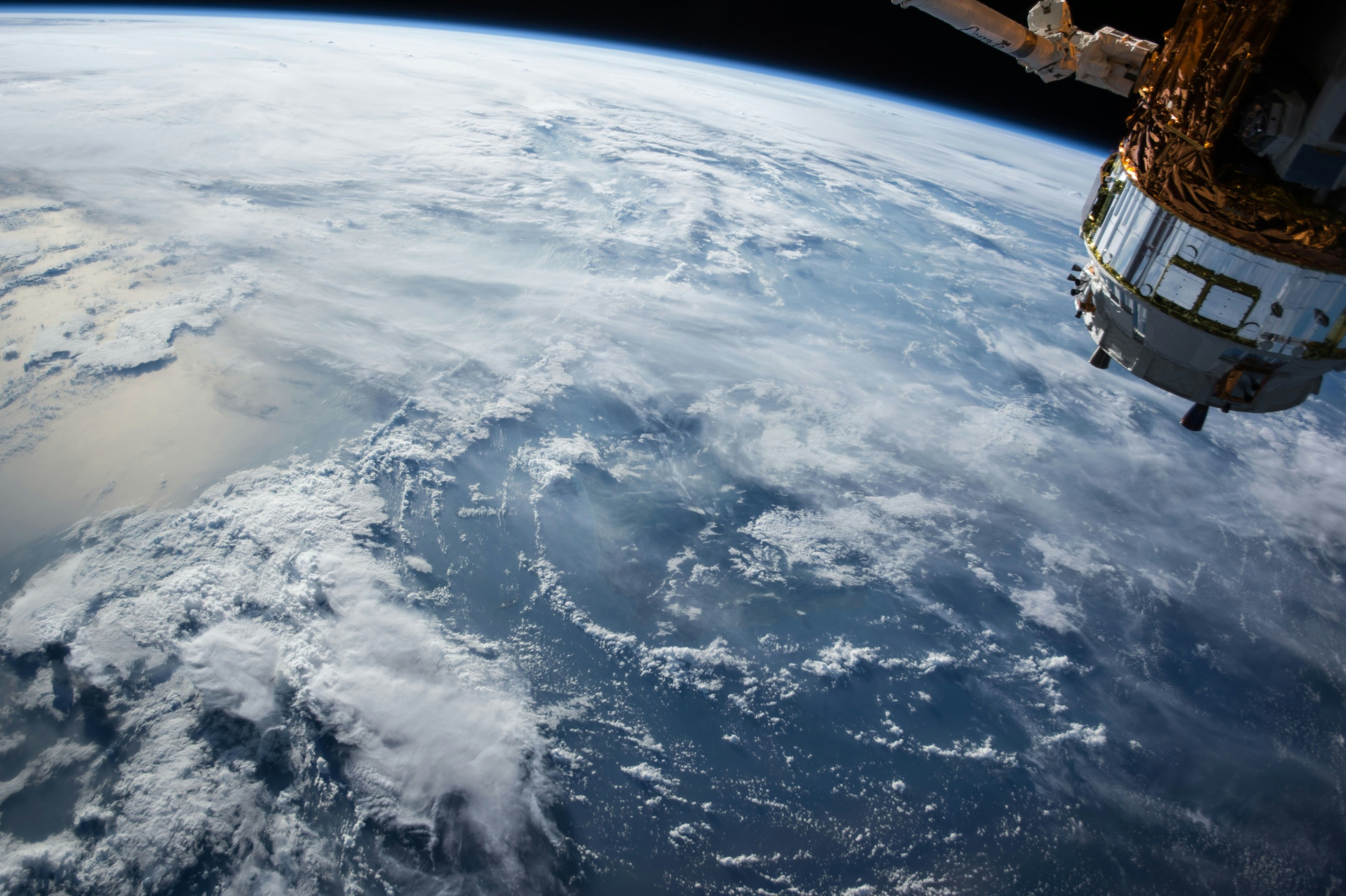
Seeing our alumni reach the International Space Station (ISS) has a ripple effect that extends far beyond the space sector. For school students questioning whether science is “for them”, for undergraduates weighing their next steps, and for professionals considering a career pivot, moments like these can resonate deeply.
Captain Jack Hathaway completed an MSc in Flight Dynamics at Cranfield in 2014.
At the time, he could not have anticipated the direction his career would take. While postgraduate study often supports progression within a field, in Jack’s case it formed one part of a professional journey that has now led to spaceflight.
As a Captain in the U.S. Navy, Jack has held numerous leadership roles. He completed operational tours with Strike Fighter Squadron 14 aboard the USS Nimitz and Strike Fighter Squadron 136 aboard the USS Truman. Additionally, he served as the F/A-18 air vehicle and propulsion project officer for flight test programmes, applying his technical expertise to naval aviation and flight testing.
In 2021, he was selected by NASA to join the Astronaut Candidate Class of that year. He received his ‘Wings’ in March 2024, with his first mission to the International Space Station scheduled for early to mid-February, subject to operational and weather conditions.
Jack’s career illustrates how pathways into the space sector are shaped through sustained technical development, operational experience and collaboration. Space missions depend not only on astronauts, but on the coordinated work of engineers, scientists and specialists across multiple disciplines.
We spoke with Jack in January 2025 after he was awarded the 2024 Distinguished Aerospace Alumni Award.
“Winning this award is incredibly meaningful to me,” Jack said. “It’s an opportunity to reflect on how Cranfield helped shape my career. Learning key technical concepts and applying them to modern computer-based control systems made me a better test pilot and contributed to my professional development.”
He added, with humour, that despite his career trajectory, he remains “a little scared of heights.”
When young people see someone who once sat where they sit now go on to work on an ISS mission, the abstract becomes tangible. Space exploration can feel more immediate and accessible, grounded in education, training and experience rather than abstraction.
Questions at over 28,000 kph
One aspect of Jack’s mission was a live Q&A session with Cranfield University, broadcast from the International Space Station and offering audiences on Earth the opportunity to hear directly about life and work in orbit.
During the session, Jack reflected on what daily life on the ISS was really like — physically, mentally and emotionally — and shared what had surprised him most on arrival. Questions from Holywell Primary School students explored the journey into space and whether it felt frightening, as well as what astronauts did for fun while in orbit. Cranfield students asked about the impact of repeated sunrises and sunsets every 90 minutes, and how microgravity affected the body and mind. Staff questions examined how astronauts maintained decision-making sharpness and managed risk in a mission-critical environment, the value of in-space manufacturing such as Cranfield’s metal 3D printer, and whether viewing Earth from orbit had shifted his perspective on humanity and our responsibility to the planet.
Opportunities for dialogue such as this help to contextualise spaceflight, highlighting both the technical rigour involved and the human experience behind it.
Expertise beyond Earth: science, engineering, and discovery in orbit
Missions to the ISS represent multidisciplinary collaboration. Every experiment conducted in space relies on years, sometimes decades, of preparation across engineering, physics, biology, medicine, materials science and systems engineering. International cooperation underpins much of this work, with contributions from space agencies, research institutions and industry partners across multiple countries.
In microgravity, scientists can study phenomena that cannot be observed in the same way on Earth. Experiments aboard the ISS will advance our understanding of:
- Human health, including muscle loss, bone density and cardiovascular function
- Advanced materials and manufacturing processes
- Fluid dynamics and combustion
- Climate monitoring and Earth observation
- Technologies that support long-duration spaceflight
Findings from these experiments inform research and innovation on Earth, contributing to developments in healthcare, transport systems, materials science and environmental monitoring.
For those on board, they have possibly the best ‘view from work’ with the orbital perspective offering a distinctive view of Earth. Space research is closely connected to challenges on our planet, with many investigations designed to generate practical applications.
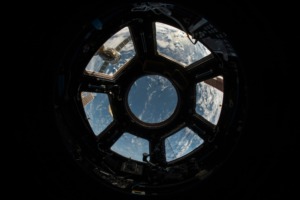
A ‘view’ from one of the observation panels in the International Space Station
A continuing relationship with space
“It is particularly special to see not just one, but three of our graduates connected to the same International Space Station mission,” says Dr Jenny Kingston, MSc Astronautics and Space Engineering Course Director from 2011 to 2024. “Jack’s journey is remarkable in itself, but he is joined in this wider operational ecosystem by fellow alumni whose roles are equally vital.”
“Frank Gallagher, who graduated in 2018 with an MSc in Astronautics and Space Engineering, now serves as a Columbus Flight Director at the German Aerospace Center, working on behalf of Telespazio Germany. In that capacity, he is responsible for the daily management and coordination of operations for the Columbus module on the International Space Station. It is a role that demands technical rigour, composure and systems-level thinking.”
She adds with a personal note, “I had the privilege of supervising Frank’s MSc thesis, so seeing him now directing operations in orbit is enormously rewarding. It is one of those moments that reminds you why teaching and mentoring matter.”
“Sophie Adenot, who completed a PgCert in Flight Test and Dynamics through the Empire Test Pilot School, flew to ISS alongside Jack and will serve as ISS flight engineer for their long-duration expedition. To witness graduates working both in orbit and on the ground in such closely connected roles speaks to the collaborative nature of spaceflight.”
Jenny places these achievements within a broader context, “Cranfield’s connections to spaceflight and space leadership span decades. Among our honorary graduates is Neil Armstrong, Commander of Apollo 11 and the first person to walk on the Moon. His honorary degree reflects a longstanding association between Cranfield and the advancement of aerospace and space exploration.”
She continues, “Libby Jackson OBE, who completed her MSc in Astronautics and Space Engineering in 2003, is currently Head of Space at the Science Museum, London. Earlier in her career, she served as a Columbus Flight Director at the European Space Agency — a role now held by Frank. Her career demonstrates how expertise in space operations can evolve into leadership and public engagement at a national level.”
“Katherine Bennell-Pegg, who graduated in 2010 with an MSc in Astronautics and Space Engineering, qualified as a professional astronaut in 2024, becoming the first Australian woman to do so. As Director of Space Technology at the Australian Space Agency, she is advancing Australia’s space capability and leading the Access to Space team to strengthen the nation’s international engagement. Her recognition as 2026 Australian of the Year and as Cranfield’s 2025 Distinguished Space Alumni Award recipient reflects the impact of that work.”
Jenny concludes, “What these alumni illustrate is the breadth of roles within the global space ecosystem — from mission operations and astronaut corps to policy, education and national capability development. Space exploration is sustained by many different kinds of expertise, and it is deeply encouraging to see our graduates contributing across that spectrum.”
Where ambition meets application
Cranfield University focuses on applied science and engineering, with an emphasis on industry engagement and real-world application. Alumni such as Jack, Sophie, Libby, Katherine and Frank reflect how technical expertise, systems thinking and professional experience can intersect in complex operational environments.
At Cranfield, students engage with practical challenges alongside theoretical study. Skills developed in areas such as aircraft design, airspace management and large-scale engineering programmes are also relevant to space operations.
Cranfield has established programmes in space systems, engineering and manufacturing, and in 2025 was ranked within the top 35 institutions globally for engineering, mechanical and aeronautical disciplines.
Students can study programmes such as the Astronautics and Space Engineering MSc and Robotics MSc, which provide advanced technical knowledge relevant to space systems, autonomy and emerging technologies.
What does this mean for the future?
Jack and Sophie launched for their mission to the International Space Station launched in the early hours of 13 February and docked to ISS the following day; in doing so they joined a small number of individuals in human history who have observed Earth from orbit. From approximately 400 kilometres above the planet, the ISS completes around 16 orbits each day, travelling at over 28,000 kilometres per hour. Crew members witness changing cloud systems, illuminated cities at night and major geographical features such as the Grand Canyon, Great Barrier Reef and the Amazon River.
Set against Cranfield’s longer relationship with space — from honorary graduates such as Neil Armstrong to contemporary leaders and astronauts across international space agencies — this mission forms part of a wider narrative of technical contribution and global collaboration.
Missions of this kind reflect sustained scientific enquiry, operational expertise and international partnership. For students and alumni working across space, aviation, sustainability and emerging technologies, they highlight the interconnected nature of research, industry and global engagement.



Categories & Tags:
Leave a comment on this post:
You might also like…
Commuting, collaborating and growing: My first term experience at Cranfield
My first term at Cranfield University has been an extremely positive and rewarding experience. While the course has been intense at times, it has pushed me in the best possible way and allowed me ...

Sourcing country analysis – a guide to Library sources
For those researching a country, you will find that country information tends to take two forms: Analysis - country reports are descriptive reports covering most areas of interest on a country. They contain an analysis ...

The degree that launched my marketing career
Insights from Tayo George, Strategic Marketing MSc Alumni I chose the Strategic Marketing MSc at Cranfield because I wanted a programme that combined academic rigour with practical, commercial relevance. The emphasis on applied learning, ...
From national service to Environmental Engineering: My journey to Cranfield
Postgraduate study is often a defining step in shaping one’s academic and professional direction. For me, pursuing an MSc in Environmental Engineering at Cranfield University has been both a personal and professional adventure—one that ...
From limited experience to a UK marketing career
Top tips for postgraduate marketing students by Elnaz Dashchi, Strategic Marketing MSc alumni Coming into the postgraduate Strategic Marketing MSc, I did not have a lot of professional experience - and that made me ...
My journey to Cranfield as an FIA Motorsport Engineering Scholar
"You don’t need to fit a stereotype to succeed in engineering or motorsport. You need curiosity. Resilience. And the confidence to take up space." In this blog, Sanya Jain, current MSc student and FIA ...
Comments are closed.