

HR in the new world: Shaping industries with the help of Cranfield
27/09/2022
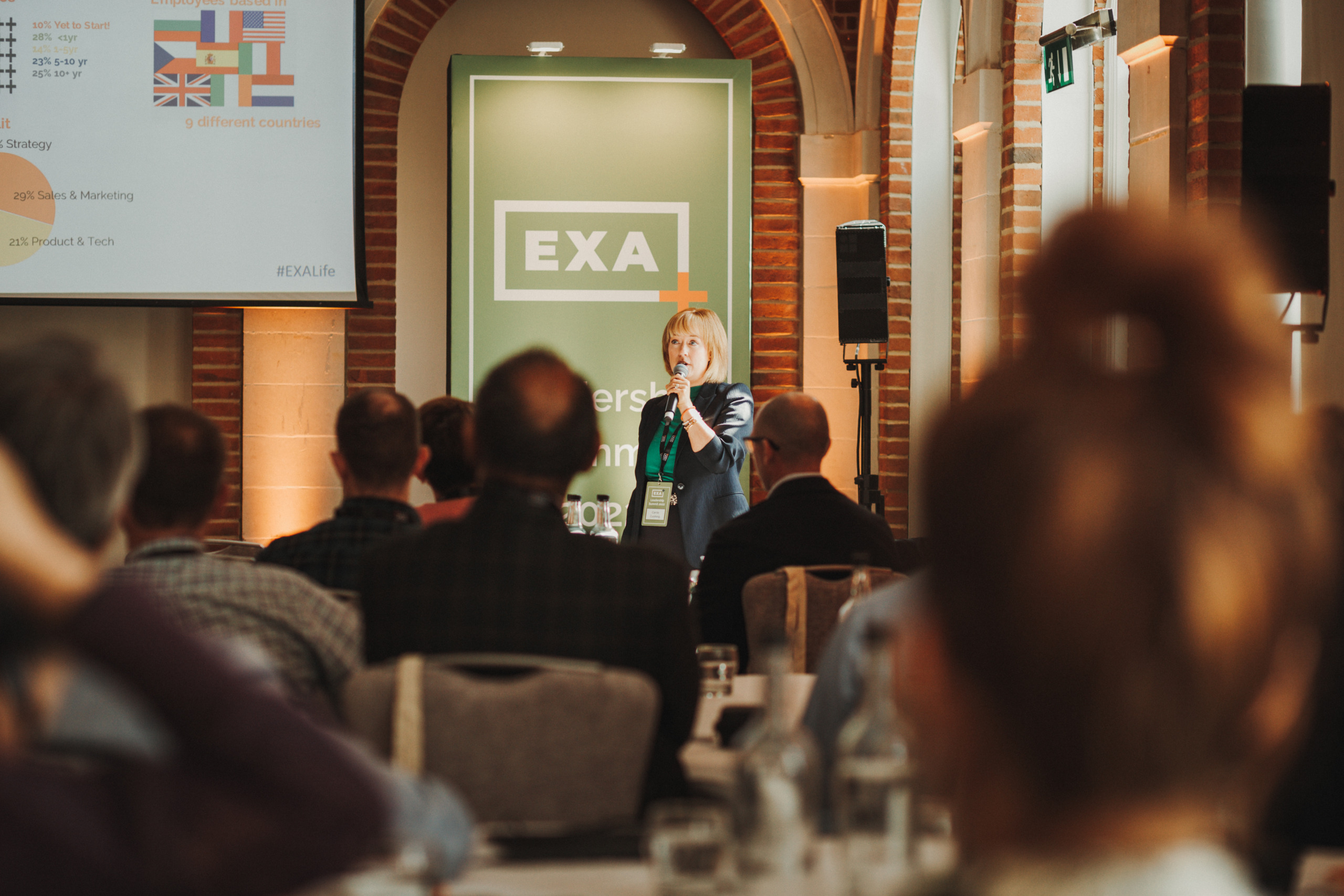
“I can absolutely pinpoint the moment I decided HR was for me,” enthuses Cranfield alumna Carrie Cushing (MSc International Human Resource Management, 2013). “I was in an undergraduate lecture on organisational behaviour. I found it so compelling, the idea that you can take this theory and help people and businesses to achieve more, learn more, and be better – that you can combine the rigour of running a business with the art form of helping people better themselves.”
Carrie is talking to us over video call from the London office of digital infrastructure business EXA Infrastructure, where she is Chief People Officer, having joined the company in April 2022 to lead on talent strategy and culture development.
“It’s a new industry for me,” she explains. “But the leadership team here passionately believes in helping people grow and develop for the benefit of customers, those individuals, and our business. I get to use lots of organisation development theory, and apply it with a group of people to bring about higher performance, more growth and more enjoyment for the people serving our customers.”
The Cranfield difference
Carrie joined EXA from General Electric, where she led the human resources function for the company’s Digital International business across more than 60 countries worldwide.
It was while at General Electric that she completed her Cranfield MSc, sponsored by her employer.
“I chose Cranfield for its high-quality teaching and the programme of modules, which sounded really interesting,” she explains. “It was important to me that I went to a well-established and well-recognised university. I also wanted to join a great cohort: to build a network of contemporaries that I could continue to learn from. Cranfield offered all of that.
“We were a super diverse group from lots of different countries, with really different backgrounds, and working in different industries,” she added. “We formed a close bond and, even now – more than 10 years after we graduated – we are still very connected. We have a WhatsApp group and, whenever we are in each other’s countries, we try to meet. They are such an incredible support system and great friends, but also a fantastic asset. If I don’t know how to do something, someone in that network will know the answer.”
Carrie credits Cranfield’s HR teaching with preparing her to step up to bigger opportunities in her career.
“I had been working in HR roles for about 10 years, so I had practical knowledge of how things worked,” she says. “But Cranfield gave me a shot of theory to help back that up. I gained a sophistication of language and a slightly different way of looking at the world.
“It was amazing to be so close to some of the industry’s leading thinkers working with some of the UK’s biggest businesses,” she added. “I remember leaving a lot of the lectures feeling incredibly inspired.”
HR in the new world
Carrie’s ongoing task since joining EXA has been helping the business to adapt to the post-Covid-19 world of work.
“Obviously, the question of where work is done is front and centre for a lot of businesses right now and, once you’ve answered that question, the answer then throws up a lot more questions about how you hire for your chosen arrangement, how you develop people, how you build a culture, what policies you need in place – all of those sorts of things,” she says.
“With the attrition crisis, there’s also a need for us in the HR profession to continue to show the excitement in the work people do, and to develop the employee value proposition that will make people choose to join or stay with a company.
“As a function, HR has a strategic role to play in sparking, facilitating and driving the internal conversations that need to be had to address these kinds of issues and more.”
“I feel quite fortunate, in a way, that I’ve not only changed job, but also business and industry at this time,” she adds. “My world is different, so I’ve had to reconfigure my outlook, and I can think differently.
“We are a new brand that’s been carved out of a much larger company. We have a much more focused proposition. With that newness, you can innovate. So, for me, it’s been an enjoyable time to have conversations with people about what they want the company to be and the culture they want to work in.”
“I think it’s incumbent on all HR people to find that newness,” she continues. “I think that’s a lot of what people are craving; they’re craving fresh thinking – difference – because, at the end of the day, everyone wants to be interested and engaged in what they’re doing.
“We’ve had this catalyst in the pandemic, and my job is to make sure we use it to the best of our ability to create something really quite special, and to ensure we take the team and all of us go on the journey together.”

Looking to the future
And how would Carrie like to see the HR profession itself change and develop over the coming years?
“I’d like to see HR much more consistently driving change within businesses and being a credible partner,” she says. “But I also want HR professionals to increasingly look at the bigger picture outside of their company, and come together to shape industries. One of my big passions, having moved into telecoms, is how we move the industry to be one in which a much more diverse range of people want to work. I would love to see the HR community in telecoms come together to change that for the better.”
“Maybe that brings us back full circle to what I got out of studying at Cranfield,” she muses. “Not only was it the education, but it was the relationships. HR is a function of relationships after all and, if more HR people can connect within an industry, we could shake things so much faster.
“If I want to get a much more diverse group to join my company, we’ve got to show the 16-year-old girl that becoming a network engineer is super exciting, because look at all these jobs that are available to you, and look at what this industry achieves. That’s not something I can do on my own.”

Categories & Tags:
Leave a comment on this post:
You might also like…

Cranfield: an environment where innovation thrives
The latest Knowledge Exchange Framework rankings from UK Research and Innovation (UKRI) gives an insight into the real and meaningful impact that UK universities have. The seven categories that make up KEF6 cover everything ...
How Cranfield accelerated my career in Logistics and Supply Chain Management
After graduating from the MSc in Logistics and Supply Chain Management at Cranfield University, I've been reflecting on the experiences that made my journey so valuable and the impact it has had on my ...

Mendeley: a powerful tool to organise and manage your references
Are you looking for a way to manage your references, create in-text citations and reference lists for your assignments or thesis? If so, you may wish to consider using Mendeley. What is it? Mendeley is ...

Keen to develop your study skills?
Alongside the technical skills and academic knowledge that you will gain on your course, as a Cranfield student you have the opportunity to develop a range of other skills that can enhance your learning experience. ...

The V-conomy: powering the sixth wave of global economic growth
The world could be on the verge of a major surge in economic growth and development, driven by the convergence of AI and clean energy technology. Waiting to ride the K-wave The Russian ...

Need help using the Python programming language?
We know some of our students are currently trying to learn Python, so we wanted to make you aware of some great LinkedIn Learning videos that can help. But don't you have to pay for ...
Comments are closed.