


My life as an engineer
06/11/2019
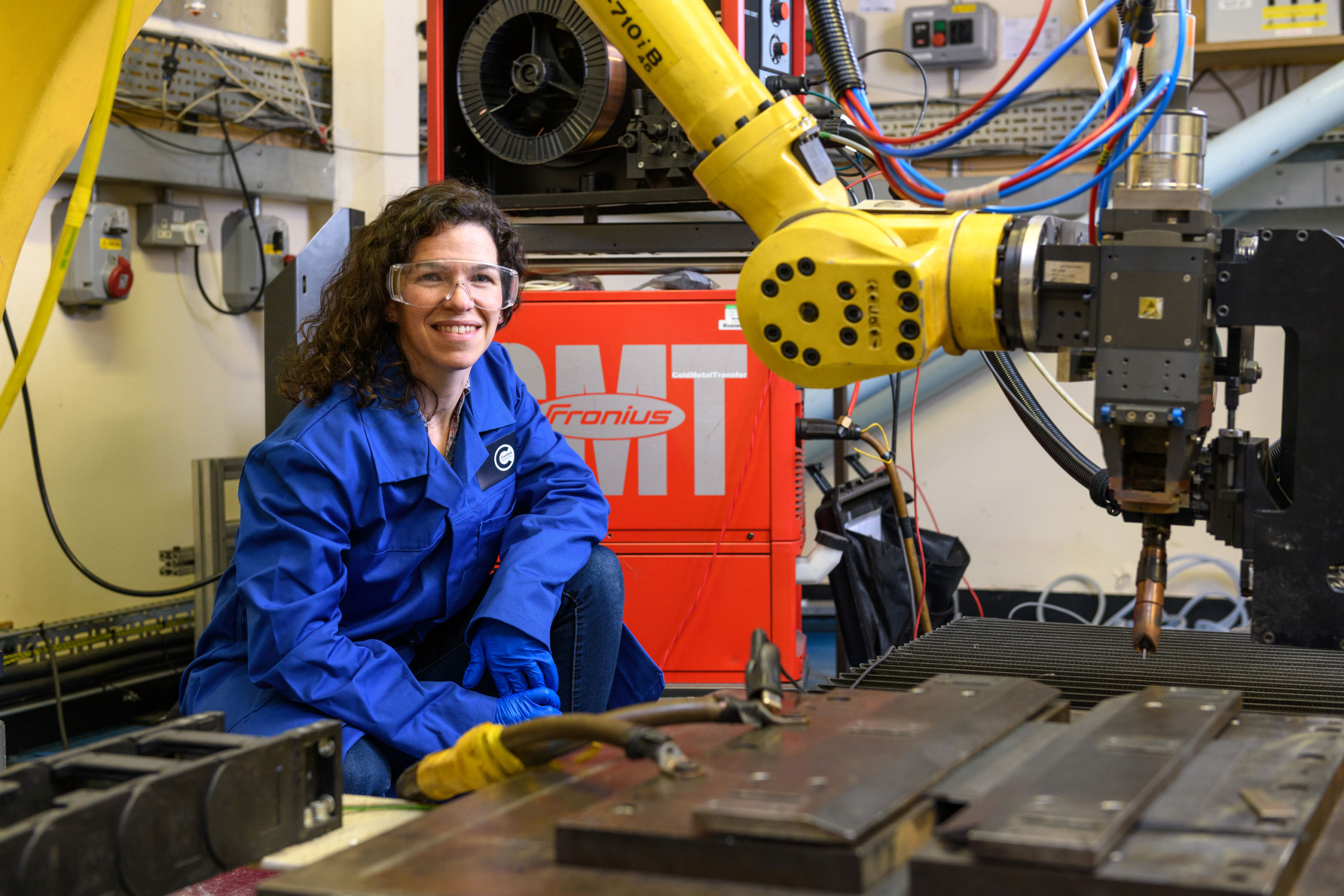
After completing her PhD in laser processing at Cranfield, Sonia joined the University as a Research Fellow. Eight years on she is now a Senior Research Fellow and Project Manager and gives us an insight into her life as an engineer.
I was in Portugal finishing my MSc project, and my Professor, an Invited Lecturer at Cranfield, told me that they were looking for candidates to study a PhD in laser processing. Because I was finishing my MSc, I thought it would be a good idea to join Cranfield and carry on working in an academic environment. It’s been an amazing experience – working with students, industry and other academics. The multi-cultural environment means we have people all over the place.
Engineering is super exciting. Manufacturing, the area in which I work, is applied across sectors and this allows me to work in shipbuilding, car manufacturing, development of sensors for process monitoring, all without changing job. Being at Cranfield also allows me to do some teaching and not only share my knowledge but also the excitement of working in engineering.
When I was a kid I thought engineering was about creating and fixing big machines and structures, that it was an extremely hard subject to study, and loads of mathematics were involved. At the same time, I thought that there was something interesting in it – being able to create something new, being the first to discover the solution to a problem, despite all the difficulties.
My role is very broad – I can be doing research one moment and project management the next. I can work with the students, do the research myself or sit down in the office and look at Gantt charts, research plans, talk to other people in the same research project.
Days are very busy! We have started a five-year research project with three other universities – Manchester, Coventry and Strathclyde. I need to make sure all the universities as well as the industrial partners are delivering to this project. It’s so different to what I was doing before. In my previous role, I was doing research, I was in the lab doing laser welds, mechanical testing, and all these things. Now I’m on the other side as well, planning the work, making sure everyone is delivering on time. It’s very interesting.
The challenge is what I find most interesting about working in higher education. Doing something new, something unique, starting with a problem which I find interesting, that no one has found the solution to. Trying to think up different hypothesis, planning the work, trying to apply different procedures, seeing the outcome, the results, and if we can solve the problem, or, at least, suggest a direction to go in. I’m very stubborn. I don’t give up!
I really like the environment, the people, the diversity, the research challenges and seeing our research being applied in industry. I think it’s a unique experience and is why I’m still here. If you have a generic topic given to you by your line manager, but you don’t see the reason why, it’s not very motivating. If you have a new project given to you and you know that the sponsor is waiting for the results because they have this real problem and anything that you find will be helpful for the industry, it makes you feel more excited and motivated to work towards this. When you present your work at a conference and you say that you have a high-profile industrial partner, they pay attention. You feel proud of doing research for this particular partner.
I never feel bored – there’s always something new in the pipeline. My role means I get exposure to different fields. It’s very good when we are asked to propose a new project, look for partners and write funding proposals. We are not restricted to a particular topic, we can work in whatever we want, as long as there is the need from the industry to do research in a particular area. In my previous Cranfield role, I was doing just research, but now it’s something new. Before, I used to help offline with project management and now my duty is to deliver on this aspect as well. I get more experience to help improve my career.
Working with people from different countries and cultures brings with it many different perspectives and ways of working. You learn that you could approach things differently, improve as a result. I feel proud to be working for a university that is so inclusive and is open to so many different people – during one departmental meeting, there were 13 countries represented by the 20 people in the room. I strongly believe that having a diverse team improves the quality of the work.
Objectivity is the best thing about working in STEM. It means you’re working based on facts. There are rules that should be followed to find the solution to the problem. You only need to learn the rules of the game, know them really well to be the best player and be very patient.
I haven’t faced any challenges as a woman working in this area of engineering. Not at all. I would say even the opposite. I have been very well looked after since I joined the University for the first time as a student. On the first year of the University there were only eight girls in the lecture room with nearly 100 students. The lecturers did not make any distinction between girls and boys, we were all the same. My colleagues were very happy to work with me because I was very organised and methodical which I believe is something that girls are usually better at than boys! On the other hand, I have found that boys can be more pragmatic than girls which made our group projects being very successful. Nowadays in my workplace I feel exactly the same. The working environment is great, our team has 45 staff and PhD students from which nine are female. I strongly believe that having a diverse team improves the quality of the work.
If you are interested in studying a research degree at Cranfield – either by undertaking a bespoke research project, applying for one of our research degrees or by considering one of our funded research opportunities, visit our website.

Categories & Tags:
Leave a comment on this post:
You might also like…
Cranfield: an environment where innovation thrives
The latest Knowledge Exchange Framework rankings from UK Research and Innovation (UKRI) gives an insight into the real and meaningful impact that UK universities have. The seven categories that make up KEF6 cover everything ...
How Cranfield accelerated my career in Logistics and Supply Chain Management
After graduating from the MSc in Logistics and Supply Chain Management at Cranfield University, I've been reflecting on the experiences that made my journey so valuable and the impact it has had on my ...

Mendeley: a powerful tool to organise and manage your references
Are you looking for a way to manage your references, create in-text citations and reference lists for your assignments or thesis? If so, you may wish to consider using Mendeley. What is it? Mendeley is ...
Keen to develop your study skills?
Alongside the technical skills and academic knowledge that you will gain on your course, as a Cranfield student you have the opportunity to develop a range of other skills that can enhance your learning experience. ...
The V-conomy: powering the sixth wave of global economic growth
The world could be on the verge of a major surge in economic growth and development, driven by the convergence of AI and clean energy technology. Waiting to ride the K-wave The Russian ...

Need help using the Python programming language?
We know some of our students are currently trying to learn Python, so we wanted to make you aware of some great LinkedIn Learning videos that can help. But don't you have to pay for ...