


How do I reference… a conference paper in the APA7 style?
29/08/2023

Many of you will be using conference papers in your work. Some of these will also have been published as articles in the traditional way – but others are not. So, how do you go about referencing a conference paper in your work?
First of all, you need to collect together the following ‘elements’ to build your reference:
- Author or authors – in the format Surname, Initials.
- Date(s) of conference in full – in the format (Year, Month Day(s)).
- Title of conference paper [followed by type of paper],
- Title of conference, Location of conference.
- URL or DOI (if available online)
Each element of the reference needs to be separated from the next by a full-stop and a space.
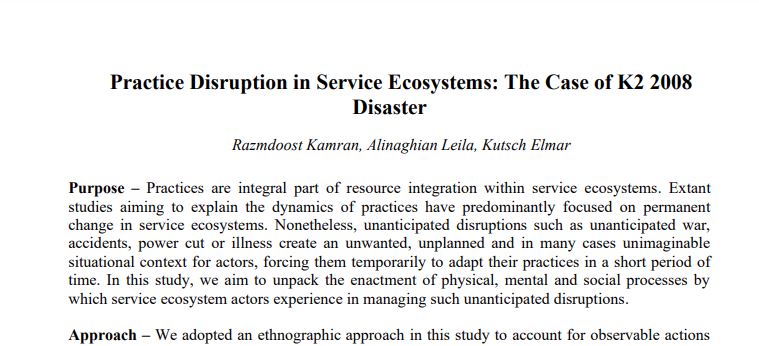
Conference paper image taken from https://naplesforumonservice.com/wp-content/uploads/2021/09/Razmdoost.pdf
So, if we were using this conference paper in an assignment or an article, its bibliographic reference would look like this:
Razmdoost, K., Alinaghian, L. & Kutsch, E. (2021, September 6-9). Practice disruption in service ecosystems: the case of K2 2008 disaster [Conference paper]. 7th Naples forum on service, Naples, Italy.
Remember that APA7 references should all be formatted with a hanging indent.
Your in-text citations (where you refer to the work within your own text) would simply include the authors’ surnames and the year of publication so they would be…
Razmdoost, Alinaghian & Kutsch (2021) or, where you were quoting directly, Razmdoost, Alinaghian & Kutsch (2021, p3).
Any questions about referencing? Consult our Referencing and Plagiarism pages or drop us an email here.
Please note: Cranfield supports two different referencing styles – APA7 (Author-date) and Numbered (NLM). Please make sure you use the style preferred by your supervisor or lecturer. The advice above relates only to the APA7 style. If you have any questions about referencing, please contact the Library.
Feature image from Pixabay. Available at: https://cdn.pixabay.com/photo/2016/06/01/06/26/open-book-1428428_960_720.jpg

Categories & Tags:
Leave a comment on this post:
You might also like…

Norman C. T. Liu scholarships providing the next generation of opportunities to succeed in Air Transport Management
Cranfield University is proud to work with global industry leaders who believe in investing in the next generation of aviation professionals. One of those leaders, Norman C. T. Liu, has personally committed to supporting ...
Designing the future of space: My group design project experience at Cranfield
For three years, I worked at Tata Consultancy Services (TCS) in India. While my time in the IT sector provided me with a strong analytical foundation, my true passion had always been anchored in ...

How do I reference lecture notes… in the NLM style?
If your course material contains original content that you want to use in your work, it will need to be referenced as follows: What information do you need in the reference? Author – surname initials e.g. ...
From Nigeria to Cranfield: My journey into Future Food Sustainability
My name is Jolaosho Eniola, and I’m studying the MSc in Future Food Sustainability. I’m originally from Nigeria, and I’m passionate about food systems, food sustainability, food supply chain and creating solutions that improve ...

How to present well as a group
You will have put a lot of work into your research or group project and want to show everyone what you have achieved or discovered, so you need to impart this knowledge as clearly as ...
Building more than research: Reflections from the ECRn Symposium 2026
There’s something quietly powerful about a room full of early career researchers. Not just the ideas, although there were plenty of those—but the conversations, the curiosity, and the sense that everyone is figuring things ...