


Private Equity data in Capital IQ
17/08/2023

For those of you interested in private equity, here’s a quick summary of the information available in Capital IQ…
Capital IQ users need to register first for an account. Read about how to do that here.
Viewing details for a named Private Equity/Venture Capital company
Let’s take BlackRock Inc. as an example. Simply search for the company name in the search box at the top of the screen. The tearsheet is usually displayed as default.
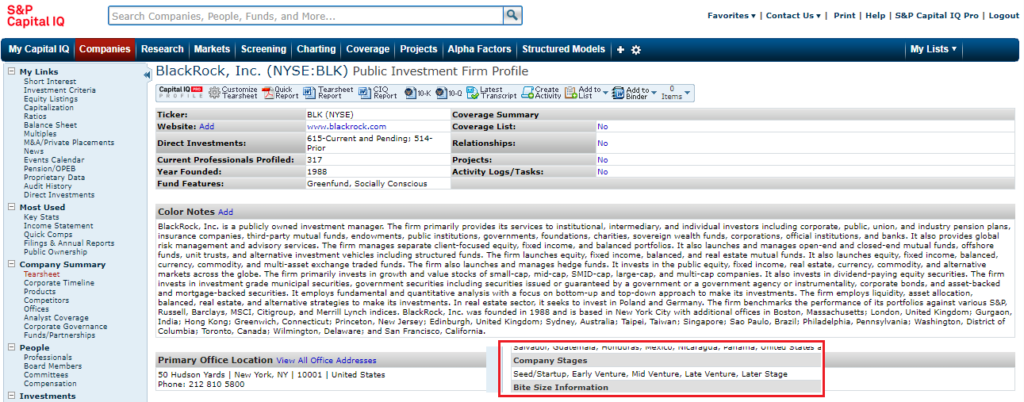
Under the tearsheet’s Company Summary heading you can see that the company is described as a Public Investment firm and that the company stages part of the record show the various stages that it has been through.
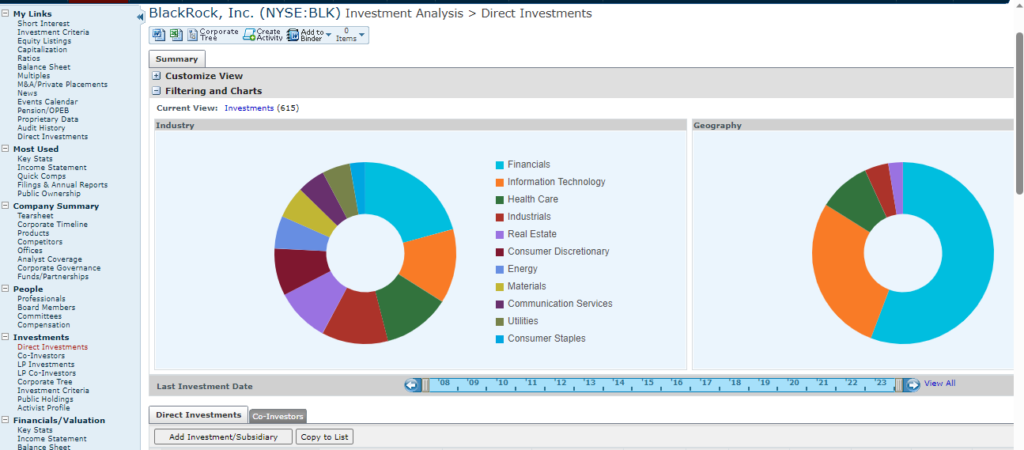
For details of where your private equity company invests, select Investments from the left-hand menu. Direct Investments shows a breakdown by industry and geography. You can also access this from the company tearsheet’s current and pending subsidiaries/investments section.
For information on BlackRock’s funds, select the option for ‘Funds/Partnerships‘ in the Company Summary menu. Funds are categorised by type. Click through on any fund name for more information.
In the left hand menu, towards the bottom, look for the heading for Investors. Here you can view both public and private ownership of your company. Public ownership will show the fund portfolio’s disclosures whilst Private ownership shows the PE/VC investments.
Identifying Private Equity/Venture Capital companies
First select the Screening tab at the top of your screen.

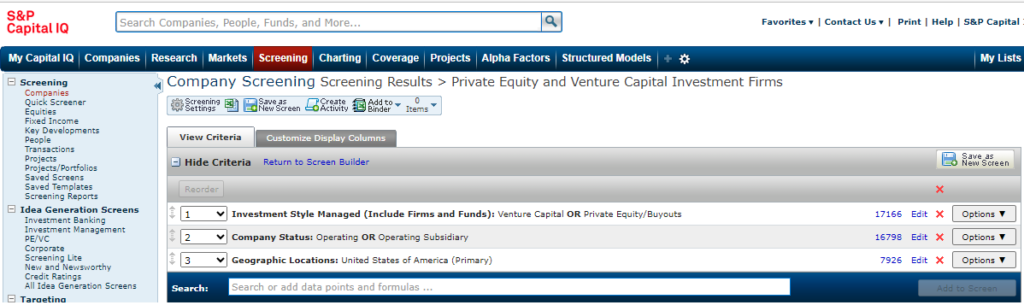
From the Criteria options displayed in the Screening criteria menu (see below), find the ‘Investment/Advisory Firms’ section and select ‘Investment style managed’ then select Venture Capital and Private Equity. Click on ‘Add Criteria’ to add your selections into your search.

- Then select from company status – operating or operating subsidiary
- Select a geographic location from Company Details, in my example United States of America.
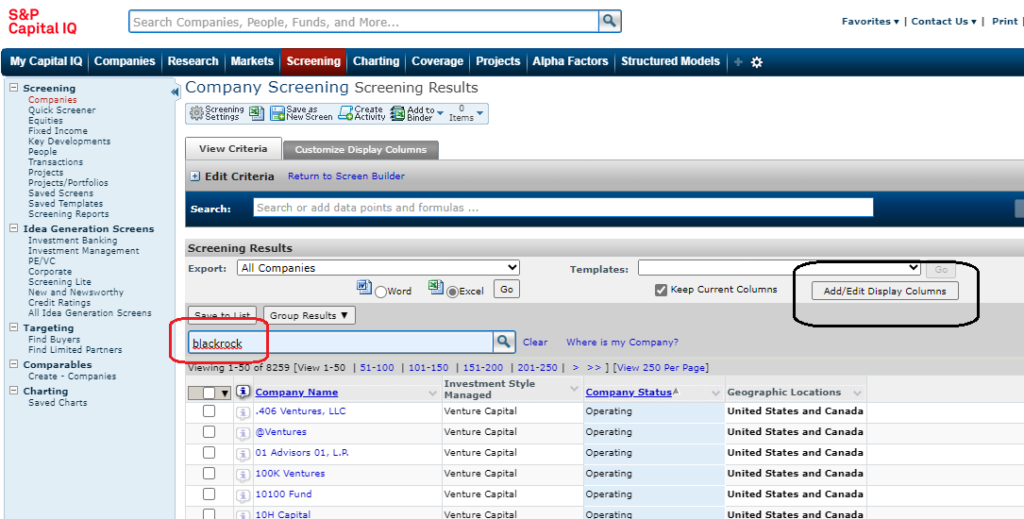
When you are ready, click ‘View Results’. Results will show lists of PE/VC companies with company name, investment style, location etc. You can search within the results to locate a specific company name or you can add extra columns of data to your results. Results can be exported to Excel.
Any questions at all on any part of your PE/VC research, please contact us or visit us in the Library.
Feature image from Pixabay. Available at: https://pixabay.com/photos/savings-budget-investment-money-2789112/

Categories & Tags:
Leave a comment on this post:
You might also like…

Building more than research: Reflections from the ECRn Symposium 2026
There’s something quietly powerful about a room full of early career researchers. Not just the ideas, although there were plenty of those—but the conversations, the curiosity, and the sense that everyone is figuring things ...

Library services over Easter, 3-6 April
Kings Norton Library will remain open for study 24/7. You will need your University ID card to enter the building and can use the self-service machines to borrow and return items as usual. Barrington Library ...

How do I access the full-text of Harvard Business Review (HBR)?
This is a frequently asked question, and it's worth knowing how to access this key management journal. So, how do you access HBR in full-text? The short answer is via our eJournals finder. You can find ...

Engineering problem to solve? Let Knovel help you find a solution
Did you know that Knovel provides you with more than just eBooks? Knovel is a key database for many engineering, mechanical and materials courses here at Cranfield University, and contains content from an extensive range ...

What happens when female scholars meet influential leaders?
On the 5 March 2026, our British Council Women in STEM Scholars had the privilege of sitting down with two excellent role models of industry and academia: Professor Dame Karen Holford, ...

From MSc to CEO: Igniting a research revolution
For many, a master’s degree is achieving a big milestone. Kilyan Ocampo, Computational Fluid Dynamics alumni shares how studying at Cranfield helped launch his career in the energy sector. Today, Kilyan ...
Comments are closed.