

Looking for audiobooks?
03/07/2025

Do you prefer to listen rather than read? Maybe audiobooks suit your on-the-go lifestyle, or perhaps listening is simply how you learn best. For some students, using audiobooks or other accessible formats is essential due to a disability or learning difference.
Whatever your reason, the good news is that the Library offers a wide range of audiobooks and other audio-friendly resources to support your learning.
The easiest way to search for audiobooks is through Library Search.
-
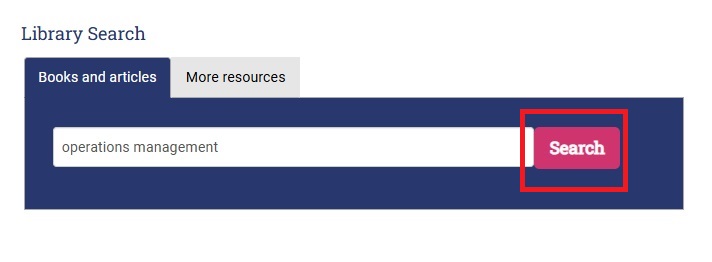
Start on the Library homepage, enter your keywords and click on Search.
2. In the left hand menu, look under Material Type (you might need to click on ‘More’ to show all the options). Click on Audiobook.
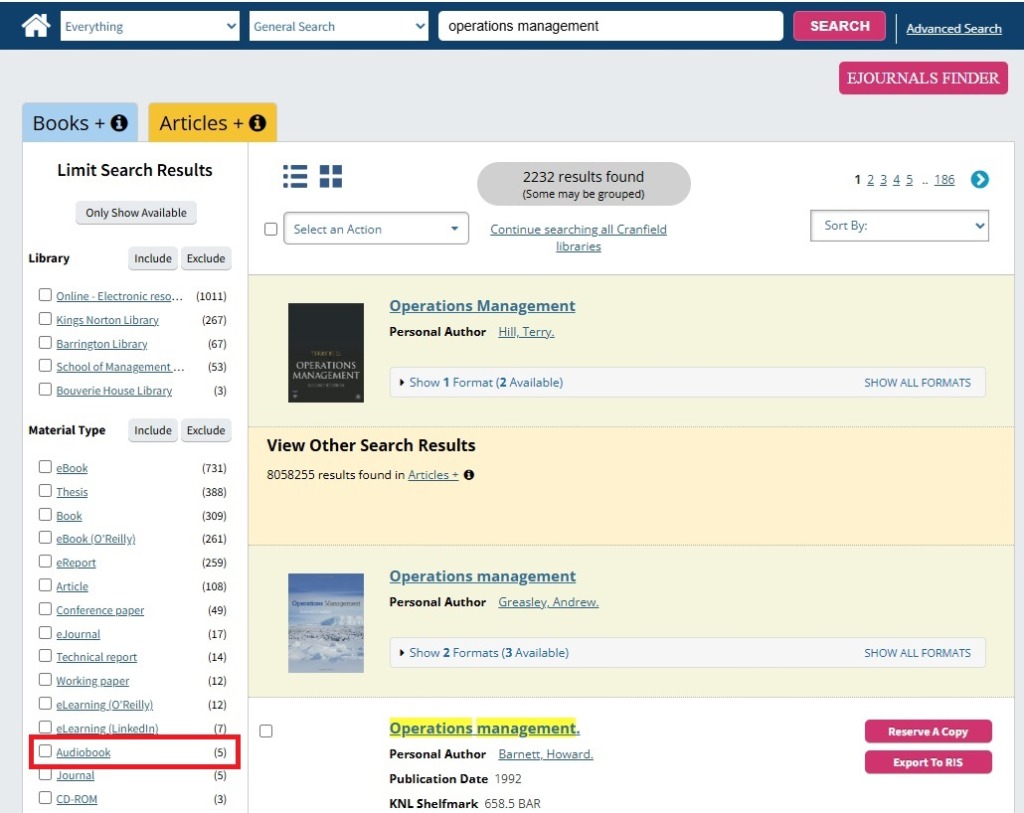
You’ll then see a list of audiobooks related to your topic. Click on the Available online link to access the title. Some suppliers may ask you to log in or download extra software before you can start listening.
Using Text-to-Speech Tools
If an audiobook isn’t available, many eBooks and online documents can still be listened to using text-to-speech tools. These tools read the text aloud and are especially helpful for users with print disabilities.
- HTML format eBooks work best with these tools – PDFs can be more difficult.
- Try tools like Microsoft Immersive Reader or browser plugins such as Natural Reader or Read Aloud.
Check out our guide to Free accessibility tools for more information.
Platforms With Built-In Audio Features
Some of our eBook platforms include their own audio or read-aloud features (these don’t get picked up when you search for audiobooks through Library Search):
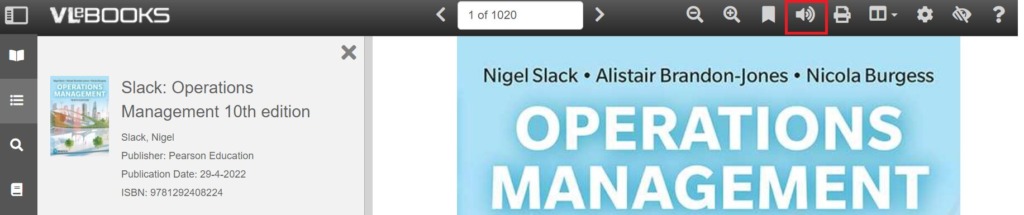
VLEBooks
- Choose Read Online (works on desktop or mobile).
- Then click the Audio button at the top of the screen.
EBSCO
- Text-to-speech is available for EBSCO eBooks, articles, reports and other full-text content.
- Open the full text of the item, and look for the headphones icon on the toolbar for articles, etc.

And for the loudspeaker/volume icon for eBooks.

- You can even download article audio as an MP3.
Will These Work on My Device?
We’re often asked if eBooks and audiobooks will work across different devices (laptops, tablets, phones, eReaders, etc.). The answer is: it depends.
Each eBook provider has its own requirements. Check the platform’s Help pages (usually under a ❓ icon) or their Accessibility Statement. And if you’re ever unsure – just ask us!
Don’t Forget Podcasts!
Audiobooks aren’t the only way to listen and learn.
- Sage Research Methods offers podcasts from social scientists on methodology.
- Mintel has podcasts featuring expert commentary on marketing trends.
These are great for learning while commuting or taking a break from screens.
Listening in Canvas (VLE)
Most content in Canvas can also be accessed in audio format using Ally, the built-in accessibility tool.
- Look for the downward arrow icon next to your course documents.
- Select Audio format from the available options.
More help is available in our guide: Using accessibility features to access content.
Please contact us if you have any questions about audiobooks, or other query about accessibility of Library resources.
Feature image from ski-life on Pixabay. Available at: https://pixabay.com/photos/audiobook-tablet-touch-screen-read-3106986/

Categories & Tags:
Leave a comment on this post:
You might also like…

Norman C. T. Liu scholarships providing the next generation of opportunities to succeed in Air Transport Management
Cranfield University is proud to work with global industry leaders who believe in investing in the next generation of aviation professionals. One of those leaders, Norman C. T. Liu, has personally committed to supporting ...
Designing the future of space: My group design project experience at Cranfield
For three years, I worked at Tata Consultancy Services (TCS) in India. While my time in the IT sector provided me with a strong analytical foundation, my true passion had always been anchored in ...

How do I reference lecture notes… in the NLM style?
If your course material contains original content that you want to use in your work, it will need to be referenced as follows: What information do you need in the reference? Author – surname initials e.g. ...
From Nigeria to Cranfield: My journey into Future Food Sustainability
My name is Jolaosho Eniola, and I’m studying the MSc in Future Food Sustainability. I’m originally from Nigeria, and I’m passionate about food systems, food sustainability, food supply chain and creating solutions that improve ...

How to present well as a group
You will have put a lot of work into your research or group project and want to show everyone what you have achieved or discovered, so you need to impart this knowledge as clearly as ...
Building more than research: Reflections from the ECRn Symposium 2026
There’s something quietly powerful about a room full of early career researchers. Not just the ideas, although there were plenty of those—but the conversations, the curiosity, and the sense that everyone is figuring things ...
Comments are closed.