


Knovel – another great resource for engineers
03/03/2017

This is the second in a series of posts highlighting specialist resources for engineers; the first post was all about ESDU. Like ESDU, Knovel is another one of my go-to resources as it contains information that isn’t easily available elsewhere. I often suggest it to MSc students to help them find information to complete their assignments, although PhD students and academics will also find very useful information on it.
Knovel comprises three main elements – engineering eBooks, an equation solver, and a materials property database.
The engineering eBooks cover a wide range of subjects including aerospace, environmental engineering, materials, mechanical engineering, and oil and gas. You can browse the subject categories or do a search. Its power lies in its ability to search the full text of the books – if you search a traditional library catalogue you’ll just be searching title words, so you need to keep your searches fairly simple and broad. Not so with an eBook service like Knovel. Searching the full text means you can be pretty specific, and it’s likely you’ll get some results. You’ll be taken straight to the part of the book where your search terms appear, and from there you can navigate to the contents page of the book where you can see what else it contains. A useful tip – make sure you know which book the text that you are using has come from, and make sure that you cite it accordingly!
The equation solver on Knovel is one of our hidden gems. Find it through the ‘Tools’ menu on the Knovel home page:

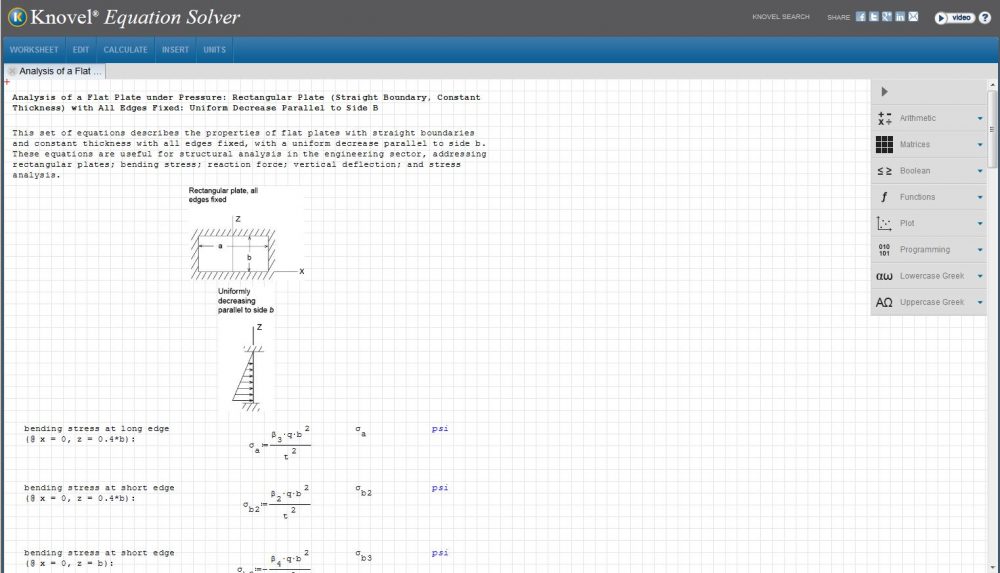
It contains hundreds of equation worksheets combined with browser-based calculation software with export capabilities. You can browse the collections, which include electrical and power engineering, general engineering, mechanics and mechanical engineering, and metals and metallurgy, or filter by keyword once you’ve picked a collection. Here’s an example of the kind of thing you can find: Analysis of a flat plate under pressure: rectangular plate (straight boundary, constant thickness) with all edges fixed: uniform decrease parallel to side B. Here’s a screenshot of its equation solver, it’s a small picture but I hope it gives you an idea of what it can do:
The last thing to tell you about Knovel is the data search section. Find the link to it just below the main Knovel search box, circled in the screen shot below:
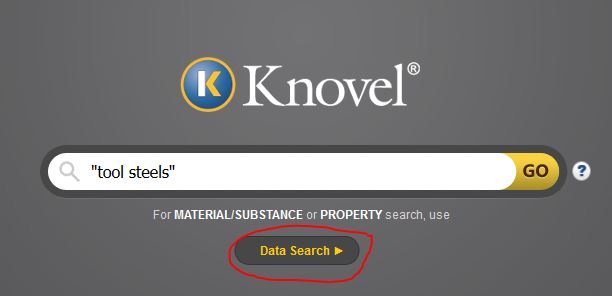
This allows you to search for property data of thousands of materials, including metals and composites. You can search by material name, property name, or both, then manipulate the data easily. Properties you can choose from include chemical, dimensional, electrical, electrochemical…..the list goes on, so it’s worth visiting and taking a look. You can specify numerical values and/or ranges, plus units of measurement. The results are usually presented in tabular or graphical form, and some of the graphs are interactive, allowing you to manipulate the data further. Here’s an example:

You can also personalise Knovel using the ‘My Knovel’ option. This allows you to save searches, favourite books and equations whilst Knovel provides a lot of videos and help guides from their support area, or contact me for further advice. Find the link to Knovel from the eResources A-Z on the Cranfield Libraries intranet pages.

Categories & Tags:
Leave a comment on this post:
You might also like…

From classroom to cockpit: What’s next after Cranfield
The Air Transport Management MSc isn’t just about learning theory — it’s about preparing for a career in the aviation industry. Adit shares his dream job, insights from classmates, and advice for prospective students. ...
Setting up a shared group folder in a reference manager
Many of our students are now busy working on their group projects. One easy way to share references amongst a group is to set up group folders in a reference manager like Mendeley or Zotero. ...

Company codes – CUSIP, SEDOL, ISIN…. What do they mean and how can you use them in our Library resources?
As you use our many finance resources, you will probably notice unique company identifiers which may be codes or symbols. It is worth spending some time getting to know what these are and which resources ...
Supporting careers in defence through specialist education
As a materials engineer by background, I have always been drawn to fields where technical expertise directly shapes real‑world outcomes. Few sectors exemplify this better than defence. Engineering careers in defence sit at the ...

What being a woman in STEM means to me
STEM is both a way of thinking and a practical toolkit. It sharpens reasoning and equips us to turn ideas into solutions with measurable impact. For me, STEM has never been only about acquiring ...
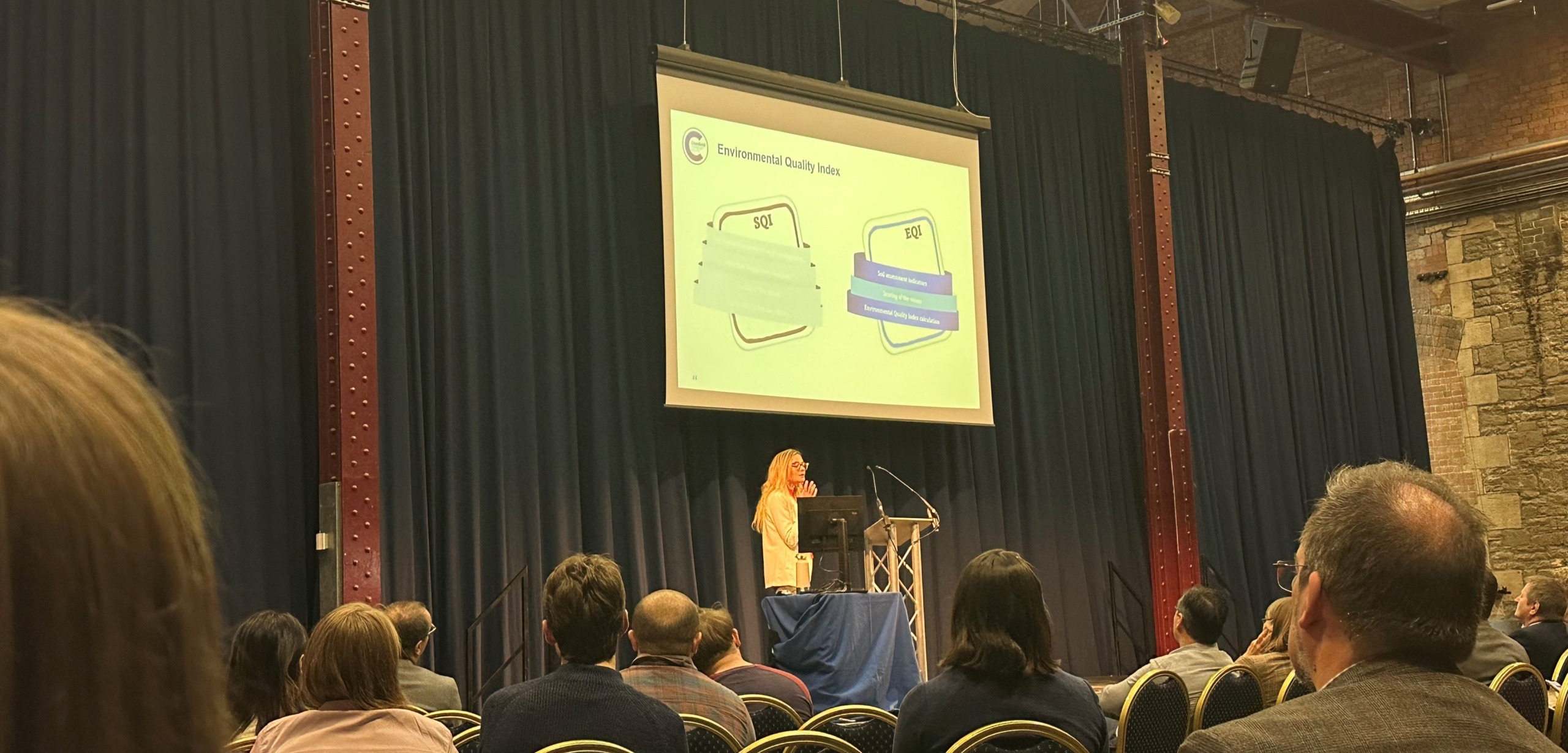
A woman’s experience in environmental science within defence
When I stepped into the gates of the Defence Academy it was the 30th September 2019. I did not know at the time that this would be the beginning of a long journey as ...
This is interesting – would have been super useful to me doing my studies. Edsu too. I’ll be sure to tell other students about it.
Thanks!
This is interesting – would have been super useful to me doing my studies. Edsu too. I’ll be sure to tell other students about it.
Thanks!
This is interesting – would have been super useful to me doing my studies. Edsu too. I’ll be sure to tell other students about it.
Thanks!
This is interesting – would have been super useful to me doing my studies. Edsu too. I’ll be sure to tell other students about it.
Thanks!